
The pianist steps forward
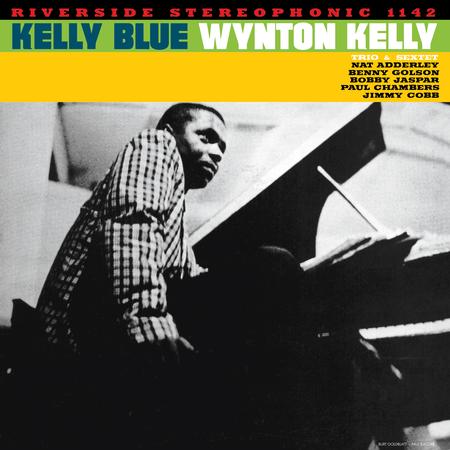
Wynton Kelly joined Miles Davis at the beginning of 1959. A few weeks later, a Riverside recording placed him at the centre of his own group. “Kelly Blue” was made at two sessions in New York’s Reeves Sound Studios, with Paul Chambers on bass and Jimmy Cobb on drums. These were also his partners in Davis’s rhythm section. Here, Kelly’s compositions and choice of standards set the agenda.
Orrin Keepnews produced the sessions, with Jack Higgins handling the recording. On February 19, the group was a sextet; on March 10, it was a piano trio. That change of scale is integral to the record. Kelly can be heard both within a larger ensemble and in direct conversation with just bass and drums, without the programme losing its shared rhythmic foundation.

Three guests, two performances
Nat Adderley plays cornet, Bobby Jaspar flute and Benny Golson tenor saxophone. All three appear on the title track and “Keep It Moving”. The remaining four selections feature Kelly, Chambers and Cobb alone. The flute gives the sextet a different instrumental palette from the more familiar trumpet-and-saxophone frontline, while the rhythm section provides continuity between the two sessions.
Kelly wrote three of the album’s six pieces: “Kelly Blue”, “Keep It Moving” and “Old Clothes”. They sit alongside “Softly, as in a Morning Sunrise”, “Green Dolphin Street” and Ann Ronell’s “Willow Weep for Me”. His own blues material and these established songs offer contrasting starting points. Rather than building the programme around one kind of tune, Kelly brings a consistent musical partnership to several different forms.

Listen to the accompanist
Kelly is often associated with “Freddie Freeloader”, his sole appearance on “Kind of Blue”. This album provides a more sustained encounter with his playing. During the title track, follow the piano beneath the horn solos. Where does Kelly place an accent, and how does his role change when his own solo arrives? The trio selections then offer a useful comparison, with fewer instrumental voices sharing the foreground.
“Old Clothes” is a particularly good place to continue. There are no extra horns for the pianist to accommodate. Listen for the relationship between Kelly’s phrases, Chambers’s bass lines and Cobb’s rhythmic responses. The changing personnel thus become something more than a credit list: the same three musicians can explore different responsibilities, depending on the space available around them.
About this edition
Analogue Productions presents “Kelly Blue”, catalogue AAPJ 210-45, as a stereo double LP at 45 RPM on 180-gram vinyl. Kevin Gray and Steve Hoffman mastered the album at AcousTech Mastering; pressing is by Quality Record Pressings. The packaging is a matte Stoughton tip-on gatefold. The title track occupies a side of its own, as does “Old Clothes”. This edition contains the six selections from the original album. Alternate takes and “Do Nothin’ Till You Hear from Me”, added to later CDs, are not part of this LP programme.
Michael 45 holds the records in Germany and dispatches them from Hilden, allowing customers to avoid a personal US import and the associated customs wait.
Customer question: Buying Analogue Productions records in Europe
Musicians
Documented selection of participating musicians. Personnel may vary by track; this list does not claim to be complete.
| Name | Instrument / role |
|---|---|
| Wynton Kelly | Piano |
| Nat Adderley | Cornet |
| Bobby Jaspar | Flute |
| Benny Golson | Tenor saxophone |
| Paul Chambers | Bass |
| Jimmy Cobb | Drums |

Reviews
There are no reviews yet.