A club date with a change of personnel
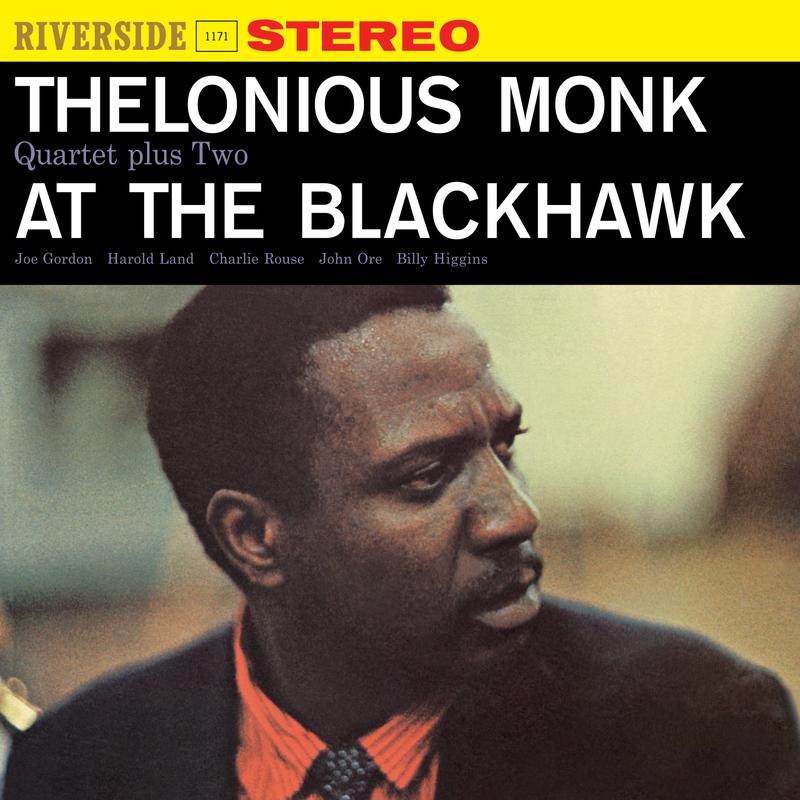
On 29 April 1960, an unusually configured Monk group was recorded at the Blackhawk in San Francisco. Charlie Rouse and John Ore were joined by two guests from the West Coast scene: trumpeter Joe Gordon and tenor saxophonist Harold Land. Billy Higgins occupied the drum chair. Quartet Plus Two describes the starting point neatly, but a last-minute change also shaped the evening.
Shelly Manne had originally been intended for the project, and recordings with him had been made the previous day. Producer Orrin Keepnews and Manne concluded that the musical combination had not worked as hoped. Higgins stepped in. This LP presents the following evening’s group; the Manne recordings, released much later, are not part of its programme.

Two tenors and a trumpet
Rouse, Land and Gordon give the themes three distinct horn voices. Monk’s piano moves in relation to them, while Ore’s double bass and Higgins’s drums support the sextet. Higgins had recently attracted attention in Ornette Coleman’s quartet. Here he enters Monk’s world, where musical freedom develops within a different compositional order.
“Let’s Call This” and “Four in One” open the album. Their themes invite attention to the passage between ensemble writing and individual voices. “I’m Getting Sentimental Over You,” by George Bassman and Ned Washington, follows. Placing original compositions beside a familiar standard offers a rewarding way to consider how much a particular group can change our perspective on a melody.

San Francisco Holiday is also Worry Later
Side two begins with “San Francisco Holiday,” also known as “Worry Later.” The two names refer to the same Monk composition. “’Round Midnight” follows, before “Epistrophy” serves as a brief closing theme. The LP preserves a defined six-track programme, without the additional performances included on later CD editions.
Collectors may be especially drawn to the meeting of Joe Gordon and Harold Land with the more familiar Charlie Rouse. Follow the horns together on one playing, then turn to bass and drums on the next. A composition you think you know can become a new point of discovery. The album documents a particular night and a combination of musicians that should not simply be equated with Monk’s regular quartet.
Riverside on one 180-gram LP
The Analogue Productions edition, AAPJ 1171, plays at 33⅓ RPM and presents the album in stereo. Kevin Gray cut the lacquers at AcousTech. The documented runout markings match those of the 1998 Riverside Tenor Sessions box, with the cutting history reaching back to 1997. The later individual release is a repress of that work.
The publisher identifies the original analog master tape as the source, with pressing at Quality Record Pressings and a Stoughton tip-on single-pocket jacket. It makes this Blackhawk date available as an individual LP, without requiring the complete box. Six tracks, three horns and a drummer brought in at short notice give the encounter its particular historical setting.
You order from Michael 45 in Germany. We arrange the US import and dispatch from Hilden.
Customer question: Buying Analogue Productions records in Europe
Musicians
Participants and documented credit status. Track references correspond to the tracklist.
- Thelonious MonkpianoParticipation: Album personnel
- Charlie Rousetenor saxophoneParticipation: Album personnel
- Harold Landtenor saxophoneParticipation: Album personnel
- Joe GordontrumpetParticipation: Album personnel
- John Oredouble bassParticipation: Album personnel
- Billy HigginsdrumsParticipation: Album personnel


Produced by Orrin Keepnews. Sextet on all six tracks. Reice Hamel is credited as recording engineer; Discogs additionally lists Ray Fowler.

Reviews
There are no reviews yet.