Between a Village club and Carnegie Hall
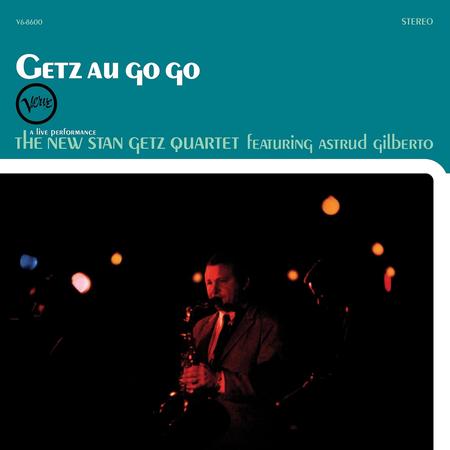
The world around Stan Getz and Astrud Gilberto changed quickly in 1964. Getz/Gilberto appeared in the spring, and “The Girl from Ipanema” reached listeners far beyond jazz. Getz Au Go Go preserves another part of that year: Brazilian songs, American standards and a quartet in which a young vibraphonist was contributing ideas of his own. The huge hit single is absent from this programme.
The title names the Greenwich Village club. Session discographies, however, trace the ten selections to two New York engagements: Café Au Go Go in May and Carnegie Hall in October 1964. The original sleeve gives a conflicting date. This is therefore best approached as an album assembled from different performances, rather than the uninterrupted record of one concert. Its sequence creates its own movement between settings and musicians.

Gary Burton gives the quartet another voice
Gary Burton appears alongside Getz on all ten tracks. The vibraphonist was only 21 at the time, and two compositions, “6-Nix-Pix-Flix” and “The Singing Song”, are his. His instrument introduces a melodic and harmonic voice that is neither a piano nor another horn. Getz had already recorded in the studio with Burton that spring; some of the same repertoire continued to develop on stage.
“Summertime” gives the instrumental partnership considerable room. Follow Getz first, then listen again for Burton’s responses and accompanying figures. When do the two lines move alongside each other, and when does one take the lead? The bass chair also changes across the album, with Chuck Israels and Gene Cherico both involved. What emerges is a portrait of a working group with several configurations, rather than a single frozen line-up.

Astrud Gilberto beyond one famous song
Gilberto sings on six selections. “Corcovado” opens the record, while “It Might As Well Be Spring” and “Only Trust Your Heart” bring American songwriting into the programme. Brazilian material and the American songbook meet without being placed in separate compartments. Gene Lees wrote the sleeve notes and is also connected to the opening selection as the writer of its English lyrics.
Kenny Burrell adds guitar on the four recordings assigned to Carnegie Hall. Compare the accompaniment on “Corcovado” with the instrumental “Summertime”: what role does the vibraphone take, and where is space left for the saxophone? Gilberto is central to the album’s identity, but the quartet has an equally substantial presence. That shifting balance gives the complete sequence a character that individual vocal selections cannot convey on their own.
This Acoustic Sounds Series edition
AVER 64990 presents the stereo album on one 180-gram LP at 33⅓ RPM. The publisher credits Matthew Lutthans at The Mastering Lab, working from the original master tape. Documented runouts carry the TML stamp. Quality Record Pressings handles the pressing, and a Stoughton tip-on gatefold jacket completes the presentation. All ten selections follow the original album programme.
These details belong to the Verve Acoustic Sounds Series release. The earlier ORG edition used two 45 RPM records, with Bernie Grundman cutting and Pallas pressing; those credits do not apply here. This edition keeps the music across two sides, preserving the original sequence of vocal performances and instrumental quartet pieces as a coherent listening programme.
You order from Michael 45 in Germany. We arrange the US import and dispatch from Hilden. Editions not currently in stock are dispatched after the goods arrive.
Series: Verve – all 34 records: voices, organ and bossa nova
Musicians
Documented selection of participating musicians. Personnel may vary by track; this list does not claim to be complete.
| Name | Instrument / role |
|---|---|
| Stan Getz | Tenor saxophone |
| Astrud Gilberto | Vocals |
| Kenny Burrell | Guitar |
| Gene Cherico | Bass |
| Chuck Israels | Bass |
| Helcio Milito | Drums |
| Joe Hunt | Drums |
| Gary Burton | Vibraphone |


Reviews
There are no reviews yet.