
The Hammond organ meets a larger ensemble
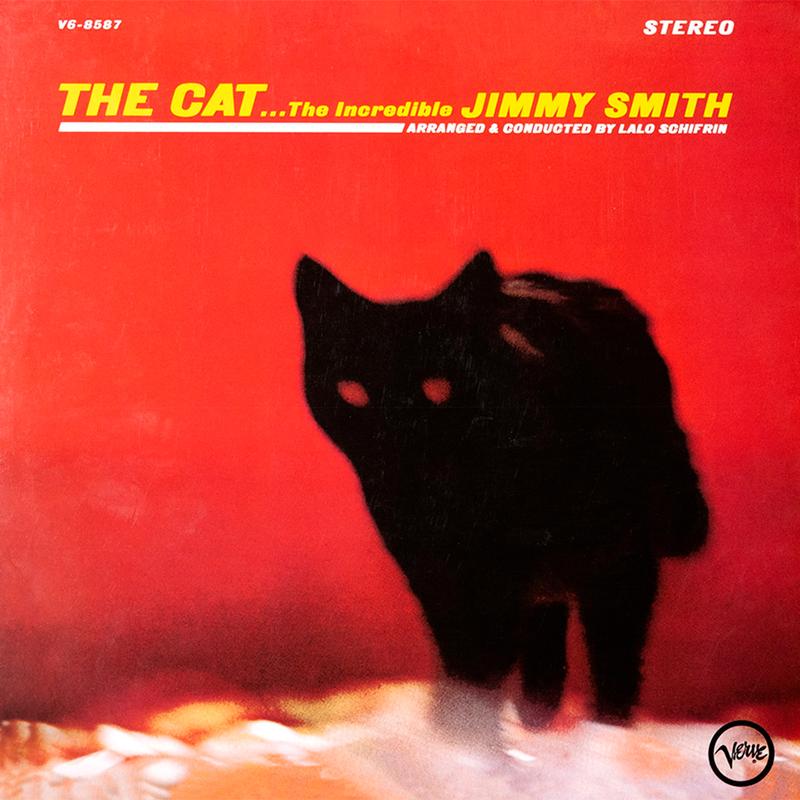
Jimmy Smith’s The Cat places the Hammond organ alongside a substantial brass ensemble. It provides a different setting from the small organ trio also strongly associated with Smith. Lalo Schifrin arranges and conducts, while Smith plays the featured instrument. The encounter moves through jazz, blues and film music, giving each area specific selections in the programme. You do not need to know the films to follow the record. Begin with the allocation of responsibility: when does the organ stand in front of the ensemble, when do the horns answer, and how do the remaining instruments maintain continuity between those exchanges?
The sessions took place on April 27 and 29, 1964, at Rudy Van Gelder’s studio in Englewood Cliffs, with Creed Taylor producing for Verve. Three released selections came from the first date and five from the second; the LP does not simply arrange them by recording day. Its programme was assembled from both sessions. Taylor had already involved Smith in larger ensemble projects at Verve. For The Cat, the organist met Schifrin, who had worked as pianist and arranger with Dizzy Gillespie while also establishing himself in film music. Both aspects of his experience form part of the background to this collaboration.

A brass ensemble, precisely identified
The instrumentation comprises six trumpets, three trombones, bass trombone, four French horns and tuba. No saxophones, clarinets or flutes appear in the checked personnel lists. That is an important distinction from a generic description of brass and reeds. The trumpeters include Thad Jones, Ernie Royal and Snooky Young; Urbie Green and Jimmy Cleveland are among the trombonists, and Don Butterfield plays tuba. Schifrin is working with a specific instrumental palette. Its possibilities arise from different registers, attacks and combinations within the brass family, rather than an additional saxophone section assumed to be present because the ensemble is large.
Alongside Smith are Kenny Burrell on guitar, George Duvivier on bass, Grady Tate on drums and Phil Kraus on percussion. Twenty instrumentalists are documented, with Schifrin additionally serving as arranger and conductor. Composers of other selections are not automatically members of the performing ensemble. These distinctions also assist listening. The rhythm section is more than a foundation beneath a large-scale effect: it links organ and brass and sustains the movement of the programme. Try following Burrell, Duvivier and Tate while the attention might otherwise be drawn immediately towards Smith or the passages written for the larger brass forces.

Film themes meet the blues tradition
The first side connects music from Joy House with “Basin Street Blues” and the main title from The Carpetbaggers. Joy House, originally Les Félins, is René Clément’s film starring Alain Delon and Jane Fonda, with music by Schifrin. The album’s title piece, “The Cat”, belongs to that setting. Elmer Bernstein, by contrast, composed the music for The Carpetbaggers. The two film worlds are connected here by the same performers. Their origins are not interchangeable labels: different composers supply material that Schifrin brings into a shared framework for Smith and the particular musicians assembled in the studio.
Side two contains “Chicago Serenade”, “St. Louis Blues”, Smith’s own “Delon’s Blues” and “Blues In The Night”. The record therefore extends beyond a selection of contemporary cinema themes, drawing on older blues and popular-song traditions. Schifrin received the Grammy for Best Original Jazz Composition for “The Cat”; the award recognises his composition. The changes between sources can be especially revealing to follow. How does the relationship between organ and ensemble shift when a familiar blues follows a film theme? Eight selections give that question a varied but manageable course, showing how one instrumental setting can accommodate material with different histories.
The Acoustic Sounds Series LP
AVER 27374 identifies this 180-gram LP from the Verve/UMe Acoustic Sounds Series, running at 33⅓ RPM. Ryan K. Smith is responsible for mastering, with Sterling Sound supported by edition-specific credits and reported “RKS STERLING” runout inscriptions. The publisher identifies original analogue tapes as the source. That wording is not expanded into the stronger claim of an independently established master-tape lineage. The reissue work must also be distinguished from Rudy Van Gelder’s original recording engineering. Both names describe different stages in the history of the same music, and neither credit substitutes for the other.
Quality Record Pressings is specified as the pressing plant, together with a Stoughton tip-on gatefold jacket. The stereo LP retains the eight-track programme and its original side order. Other formats, including subsequent SACD releases, are separate editions whose specifications require their own verification. Here, The Cat remains the meeting of an organist with Schifrin’s precisely constituted ensemble. Listeners arriving through the familiar title track can explore the connections between film composition, blues repertoire and studio collaboration. The complete personnel information helps translate the scale of the ensemble back into its individual, documented contributions. Michael 45 dispatches orders from Hilden, Germany, so you do not need to arrange your own US import. Please refer to the stated availability and delivery time for this item.
You order from Michael 45 in Germany. We arrange the US import and dispatch from Hilden.
More by Jimmy Smith: Organ Grinder Swing · Root Down
Series: Verve – all 34 records: voices, organ and bossa nova
Musicians
Documented participants in this recording. Track references correspond to the tracklist.
- Jimmy Smithorgan (Hammond B-3)Participation: Album personnel
- Lalo Schifrinarrangement, conductorParticipation: Album personnel
- Bernie GlowtrumpetParticipation: Album personnel
- Thad JonestrumpetParticipation: Album personnel
- Marky MarkowitztrumpetParticipation: Album personnel
- Jimmy MaxwelltrumpetParticipation: Album personnel
- Ernie RoyaltrumpetParticipation: Album personnel
- Snooky YoungtrumpetParticipation: Album personnel
- Billy ByerstromboneParticipation: Album personnel
- Jimmy ClevelandtromboneParticipation: Album personnel
- Urbie GreentromboneParticipation: Album personnel
- Tony Studdbass tromboneParticipation: Album personnel
- Ray AlongeFrench hornParticipation: Album personnel
- Jim BuffingtonFrench hornParticipation: Album personnel
- Earl ChapinFrench hornParticipation: Album personnel
- Bill CorreaFrench hornParticipation: Album personnel
- Don ButterfieldtubaParticipation: Album personnel
- Kenny BurrellguitarParticipation: Album personnel
- George DuvivierbassParticipation: Album personnel
- Grady TatedrumsParticipation: Album personnel
- Phil KrauspercussionParticipation: Album personnel


20 instrumentalists plus arranger and conductor Lalo Schifrin. The horn section consists exclusively of brass instruments.
How Michael hears this edition
Listening impression · paraphrased from the video
On this Acoustic Sounds edition, Michael is excited by the powerful, energetic combination of Jimmy Smith’s organ and the big-band sound. He describes the music as deeply groovy and considers the release a personal highlight of the series. His assessment concerns the listening experience; he does not compare it with an original pressing here.
🎧 Review video: New Amazing Records From Smith, Simone and Webster
This video is hosted by YouTube (Google). It only loads once you switch on “Functional” in the cookie settings.

Reviews
There are no reviews yet.