
One side devoted to an open journey
The title performance of East Broadway Run Down lasts more than twenty minutes and occupies the entire first side. That layout establishes an important feature of the album before the record begins: Sonny Rollins allows substantial time for a musical development. The session took place at Van Gelder Studio in Englewood Cliffs on May 9, 1966. Jimmy Garrison plays bass, Elvin Jones plays drums, and Freddie Hubbard adds trumpet on the title track. There is no piano. The setting puts melodic movement into a particularly direct relationship with the choices made by the bassist and drummer.
The format already had a history in Rollins's work. Way Out West and the Village Vanguard recordings of 1957 used bass-and-drums accompaniment, with Jones participating in much of the Vanguard material. In 1966, Rollins returned to that approach in another context. Garrison and Jones had worked together in John Coltrane's quartet, which Jones had recently left. They brought an intensive shared rhythmic experience into this session. That background matters, but the album's musical identity comes from the particular meeting with Rollins and the three pieces recorded on the day, rather than from the players' association with another band.

Freddie Hubbard on the first side
The personnel changes within the programme. Hubbard appears only on “East Broadway Run Down”. “Blessing In Disguise” and “We Kiss In A Shadow” are trio performances for tenor saxophone, bass and drums. Keeping that distinction in mind provides a useful listening perspective. The first side places another horn alongside Rollins; turning the record concentrates attention on three musicians. The album can thus be approached through two possibilities within the same basic ensemble. Trumpet expands the opening half, while the second side follows the relationship between Rollins, Garrison and Jones without an additional melodic voice.
Rollins composed the title track and “Blessing In Disguise”. The concluding selection, “We Kiss In A Shadow”, comes from Richard Rodgers and Oscar Hammerstein II's 1951 musical The King And I. After the two extended originals, a familiar song form closes the programme. That movement is part of the album's character. The possibilities of a longer development and the orientation supplied by a standard coexist within the same session. Rollins's exploration of freer approaches includes his continuing relationship with established songs, allowing the final piece to provide another point of reference after the larger forms that precede it.

Garrison and Jones as active partners
Garrison and Jones are widely associated with their work alongside Coltrane, but their function here is especially clear from the actual lineup. Without a piano, bass and drums carry different responsibilities. The bass can provide harmonic orientation while developing an independent line; the drums help shape the music's progress through time. Those contributions create possibilities to which the tenor can respond. Following one accompanying voice over a longer passage is a rewarding way into the record. It encourages the title performance to be heard as a developing set of relationships, rather than solely as an extended feature for the saxophone.
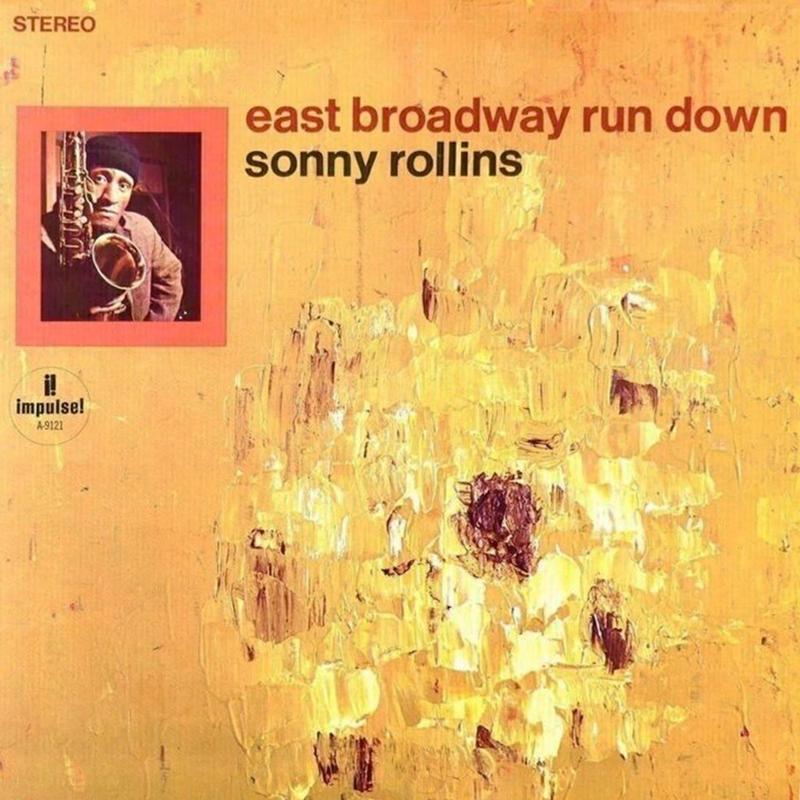
Bob Thiele produced the session and Rudy Van Gelder engineered it. The album follows Sonny Rollins On Impulse! and Alfie within Rollins's Impulse! period. Several years passed before his next studio album, Next Album, appeared in 1972. That subsequent gap gives the record a particular place in his discography, but the session itself remains the starting point: three pieces, a change between quartet and trio, and a saxophonist developing new possibilities within a small-group format he already knew well. Mel Cheren supplied the cover painting and Chuck Stewart the photographs, adding their own contributions to the album's original presentation.
The Acoustic Sounds Series LP
This edition belongs to the Verve Acoustic Sounds Series under the Impulse! label. It is a single 180-gram LP playing at 33⅓ rpm, catalogue number AIMP 512466. Ryan K. Smith handled mastering and lacquer cutting at Sterling Sound. The publisher identifies the original analog tapes as the source, and Quality Record Pressings manufactures the record. The original programme is retained: the title track on side A, with “Blessing In Disguise” and “We Kiss In A Shadow” on side B. The contrast between the two lineups therefore remains connected to the physical division between the album's sides.
Stoughton Printing supplies the tip-on gatefold jacket, and Chad Kassem supervises the release within the series. For a collection, the title offers a different perspective on Rollins from an album built around many short standards. Its small number of selections makes room for longer developments and places particular importance on the accompanying musicians. The ending then returns to a song with a history outside the session. This reissue preserves that relationship in the original album form: three pieces, two sides and a change in personnel whose effect is part of how the complete programme unfolds.
You order from Michael 45 in Germany. We arrange the US import and dispatch from Hilden.
More by Sonny Rollins: On Impulse
Artist page: All titles by Sonny Rollins
Series: Impulse! – all 19 records: the house that Trane built
Musicians
Participants and documented credit status. Track references correspond to the tracklist.
| Name | Instrument / role | Participation |
|---|---|---|
| Sonny Rollins | tenor saxophone, bandleader | Album personnel |
| Jimmy Garrison | bass | Album personnel |
| Elvin Jones | drums | Album personnel |
| Freddie Hubbard | trumpet | A |
Freddie Hubbard plays only on the title track (A). B1 and B2 are trio recordings.
🎧 Review video: 14 Amazing New Reissues
This video is hosted by YouTube (Google). It only loads once you switch on “Functional” in the cookie settings.

Reviews
There are no reviews yet.