


Steely Dan in 2003
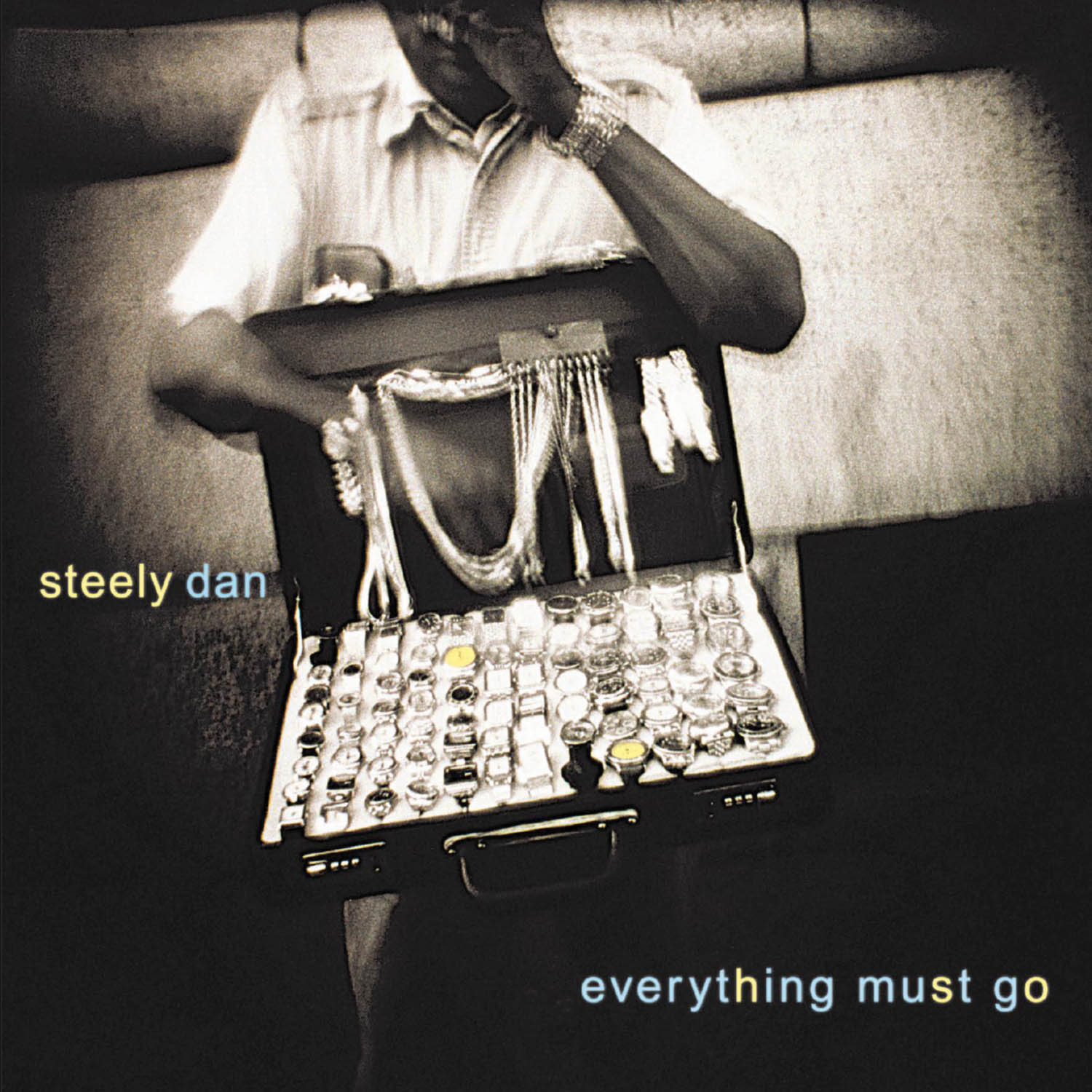
Everything Must Go is Steely Dan’s ninth studio album and the last released jointly by Donald Fagen and Walter Becker. It appeared in 2003, following their return with “Two Against Nature.” Nine new songs continue their distinctive combination of narrative distance, sharply observed characters and carefully organised ensemble playing. For listeners whose picture of Steely Dan is based mainly on the celebrated 1970s records, this is a substantial later chapter in the partnership, with concerns and an identity of its own.
The album title suggests a clearance sale, but as a heading for the entire programme it allows more than one interpretation. Its songs move among relationships, self-images, business and different versions of reality. Characters may speak fluently while revealing something about themselves that they fail to recognise. That gap provides a useful point of entry: between what a narrator claims and what the story allows us to understand. The lyrics need not be resolved immediately; perspective and word choice can remain productive subjects for attention.
An established group of players stands at the musical centre. Fagen later recalled that the band was working together so well that looking elsewhere for musicians would have made little sense. That offers a different perspective from the familiar image of a Steely Dan production involving an endless rotation of individual session players. The actual personnel remain the essential reference, however. They should not be borrowed from a later touring line-up or assembled from earlier records. On this album, Becker’s bass and Keith Carlock’s drums form a continuous part of the foundation.
A final joint studio album should not automatically be read as an intended farewell. Later biographical knowledge can change a listener’s perspective without establishing an intention that was never documented. It is more illuminating to consider how Fagen and Becker continued their shared language in 2003: through new situations, recognisable interests and a band whose contributions can be identified in detail. For collectors, that is reason to approach the album as a complete work rather than merely the final entry in a chronology.

Fagen, Becker and the musicians behind the songs
Donald Fagen sings lead on eight selections and plays a range of keyboard instruments. Walter Becker plays bass throughout, contributes guitar solos and takes the lead vocal on “Slang of Ages.” That change of singer is one of the record’s distinctive features. Both men are also credited with writing, arrangements and production. Their partnership consequently extends beyond two names placed above a studio group: it connects composition with direct participation in the performances.
Jon Herington and Hugh McCracken contribute guitars, while Keith Carlock plays drums on all nine tracks. Ted Baker supplements Fagen on keyboards. Bill Charlap also participates, playing Rhodes on “Godwhacker” and piano on “Pixeleen” according to the detailed album credits. This distinction matters because a general identification as a pianist does not specify every keyboard actually played. The musician section therefore separates instrument and track assignment rather than distributing the full personnel list indiscriminately across every song.
The horns are similarly differentiated. Walt Weiskopf contributes alto and tenor saxophones, Chris Potter tenor on “Lunch with Gina,” and Roger Rosenberg baritone saxophone. Michael Leonhart and Tony Kadleck play trumpet, Jim Pugh trombone, and Ken Hitchcock clarinet. Supporting vocal parts include contributions from Carolyn Leonhart, Catherine Russell, Cindy Mizelle and Tawatha Agee, among others. The musician section retains 22 participants with their documented roles. The variety comes from particular combinations, not from an unchanged large ensemble appearing on every track.
The two new principal illustrations focus separately on Fagen and Becker. Their securely identified facial reference is a joint photograph from 2007, a few years after the album, and that later date is stated explicitly. Existing small portraits in the musician section are retained. The distinction is useful when reading the album’s story: an illustration accompanies the account, while the credits document musical participation. Neither a picture nor a familiar name takes the place of an accurate track assignment.

From the last mall to the final song
“The Last Mall,” “Things I Miss the Most” and “Blues Beach” occupy the first side. Even their titles place different settings and perspectives beside one another. “Things I Miss the Most” offers a particularly useful opportunity to consider the relationship between loss and the language used to describe it. Which things does the narrator choose to mention, and what does that selection reveal? Such questions suit a group whose characters can acquire additional meaning through their self-absorption or unreliability.
The second side joins “Godwhacker” and “Slang of Ages.” Becker’s lead vocal changes a familiar division of responsibilities. It invites attention to the relationship between a singer and a character. A lyric does not automatically express the performer’s private opinion: it may construct a role, play with that role’s language and leave contradictions unresolved. Recognising this provides a more precise route into Steely Dan than searching for a simple autobiographical translation of every line.
“Green Book” and “Pixeleen” form the third side. Both encourage reflection on the relationship between a represented world and a constructed identity. Fagen’s own account places “Green Book” in a virtual encounter and describes “Pixeleen” in relation to an imagined action series. These are stories in which reality is already mediated. That offers an interesting connection with the album as a carefully constructed studio production: the record also creates a space of its own by selecting and arranging many different contributions.
“Lunch with Gina” and the title track, “Everything Must Go,” bring the programme to its conclusion. The longest selection consequently occupies the final position. A title that initially resembles a business announcement gains a different weight at the end of a complete sequence than it has in an isolated list. Preserving the order allows that ending to emerge from what precedes it. This double LP contains those nine album tracks, rather than turning the record into a retrospectively expanded compilation.
Bernie Grundman and the analogue source
Analogue Productions AAPP 142-45 spreads the album over two 180-gram LPs running at 45 RPM. Bernie Grundman cut the reissue directly from the original analogue tapes. Quality Record Pressings is identified as the pressing plant, and the presentation includes a traditional-style tip-on gatefold jacket. These details describe this particular reissue. They should not be confused with the mastering credits of the original release or with the technical specifications of a SACD edition.
The four sides contain three, two, two and two songs respectively. This means more frequent side changes than a single LP, together with a clearly divided presentation of the programme. The documented analogue source is notable for an album released in 2003, but remains a factual description of provenance. It does not, on its own, establish a universal verdict on every alternative edition. A considered choice involves the exact release, mastering and preferred practical format together.
Everything Must Go combines a later Steely Dan line-up with nine individual songs and a thoroughly documented ensemble. You order from Michael 45 in Germany. We handle the US import and ship from Hilden. Collectors following the complete development of Fagen and Becker will find an important part of that story here. New listeners can encounter music whose narratives and relationships deserve attention independently of the group’s famous earlier titles.
More by Steely Dan: Gaucho · Katy Lied
Artist page: All titles by Steely Dan
Customer question: Buying Analogue Productions records in Europe
Musicians
Participants and documented credit status. Track references correspond to the tracklist.
- Donald Fagenexisting earlier portraitlead vocals except B2; organ A3/B2/C1/C2; synthesizer B2; piano A3; Clavinet D2; Rhodes A1/A2/B2/C1/C2/D2; Wurlitzer A1/B1/D1; synth solos B1/C1/D1; percussion C1/D2Participation: A1, A2, A3, B1, B2, C1, C2, D1, D2
- Walter Beckerexisting earlier portraitbass throughout; guitar solos A1–A3/B1/C1; lead vocals B2; percussion D2Participation: A1, A2, A3, B1, B2, C1, C2, D1, D2
- Ted Bakerpiano A1–A3/C1/D2; Rhodes D1; Wurlitzer B2Participation: A1, A2, A3, B2, C1, D1, D2
- Bill CharlapRhodes B1; piano C2Participation: B1, C2
- Jon HeringtonguitarParticipation: A1, A2, A3, B1, B2, C1, C2, D1, D2
- Hugh McCrackenexisting individual portraitguitarParticipation: A1, A2, A3, B1, B2, C1, C2, D1, D2
- Keith CarlockdrumsParticipation: A1, A2, A3, B1, B2, C1, C2, D1, D2
- Gordon GottliebpercussionParticipation: A2, A3, B2, C2, D1
- Ken HitchcockclarinetParticipation: C2
- Walt Weiskopfalto saxophone A1; tenor saxophone A2/B2/C2/D2Participation: A1, A2, B2, C2, D2
- Chris Pottertenor saxophoneParticipation: D1
- Roger Rosenbergbaritone saxophoneParticipation: A1, C2
- Tony KadlecktrumpetParticipation: A1
- Michael LeonharttrumpetParticipation: A2, B2, C2, D1
- Jim PughtromboneParticipation: A1, C2
- Tawatha Ageebacking vocalsParticipation: B1, B2, D2
- Ada Dyerbacking vocalsParticipation: B2
- Michael Harveybacking vocalsParticipation: B2, C2, D1
- Carolyn Leonhartbacking vocals / featured vocal C2Participation: A2, A3, B2, C1, C2
- Cindy Mizellebacking vocalsParticipation: A1, C1
- Catherine Russellbacking vocalsParticipation: A1, B1, B2, C1
- Brenda White-Kingbacking vocalsParticipation: D2


All compositions by Walter Becker/Donald Fagen. Nine tracks, assignments mapped to the four LP sides. Detailed instrument credits from the supplementary album discography; Fagen’s own liner notes confirm several soloists and guests. Bill Charlap: Rhodes on Godwhacker, piano on Pixeleen per detailed credits. Produced by Becker/Fagen; mixed by Elliot Scheiner.
Also on SACD: Everything Must Go
How Michael hears this edition
Listening impression · paraphrased from the video
Michael discusses Everything Must Go and Two Against Nature together, praising the dynamics, detail, soundstage and quiet vinyl of the AP 45 RPM editions and preferring them to the Record Store Day editions compared. This passage is a joint assessment of both releases.
🎧 Review video: New Analogue Production: 2 Great Steely Dan! + Thoughts on AP vs. MoFi
This video is hosted by YouTube (Google). It only loads once you switch on “Functional” in the cookie settings.

Reviews
There are no reviews yet.