

An album between Rio and New York
Getz/Gilberto is one of those records whose most famous selection has become so familiar that the story of the complete album can slip out of view. “The Girl from Ipanema” opens the programme, but the recording contains eight pieces and a particular collaboration: Stan Getz on tenor saxophone, João Gilberto on guitar and vocals, Antonio Carlos Jobim on piano, Milton Banana on drums and Astrud Gilberto singing on two selections. The sessions took place on 18 and 19 March 1963 at A & R Recording in New York. Creed Taylor produced and Phil Ramone engineered the recording. Verve released the album in March 1964.
The interval between recording and release belongs to the history, as does the meeting of two musical environments. Getz had already enjoyed an important success with Jazz Samba. Here his partners include Gilberto and Jobim, musicians for whom bossa nova was not primarily a new colour within an American jazz repertoire. They bring their own relationships between singing, guitar rhythm, harmony and melodic movement. The album grows from that encounter rather than simply adding a Brazilian rhythm to a fully formed jazz conception.
João Gilberto has a double responsibility. His guitar belongs to the rhythmic and harmonic fabric, while his voice introduces Portuguese words into that relationship. Jobim is not only the composer of much of the programme but a participating pianist. Those roles deserve to remain visible beside Getz’s internationally familiar name. The album title identifies two partners, yet the music emerges from the complete group. Its restrained gestures can be underestimated when attention follows only the performer occupying the foreground at a particular moment.
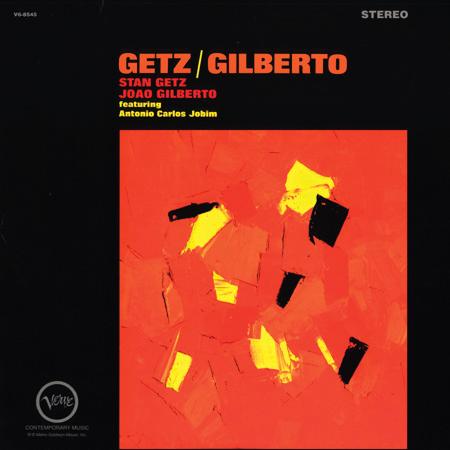
The presentation also has an identity of its own. The cover uses a painting by Olga Albizu, the Puerto Rican artist whose abstract forms have become closely associated with the record’s visual memory. It does not illustrate a literal beach scene. That choice suits an album frequently attached to an easily available image of sunshine and holidays, although its musical interest lies in specific relationships between voices and instruments. Listening beyond that familiar surface reveals considerably more than an attractive backdrop across these eight selections.

Astrud, João and a tenor saxophone: different ways of telling a story
Astrud Gilberto participates in “The Girl from Ipanema” and “Corcovado”. Her presence should neither be extended to the entire album nor reduced to an incidental studio anecdote. Different accounts circulate about the circumstances of her first contribution. The secure musical starting points are the changes of voice and language in the opening selection and her participation in Corcovado. English words offer another route into the material, while João’s Portuguese singing and its particular verbal contours remain part of the music’s character.
The extended album version of The Girl from Ipanema is especially worth attention when the song’s identity as a hit tends to dominate memory. Jobim, Vinicius de Moraes and English lyricist Norman Gimbel stand behind its different layers. On the record it belongs to a sequence of further compositions, rather than endlessly repeating its own recognisability. Follow the exchange between sung lines and saxophone: which ideas continue, and where does Getz introduce a different length or emphasis? An overfamiliar melody can become a particular unfolding performance again.
Getz’s tenor meets a small ensemble in which each entry can change the balance. Piano is not automatically responsible for every harmonic detail, since guitar also combines harmony and rhythmic motion. Milton Banana, as drummer, belongs to the core of this partnership. Rather than treating accompaniment as an unchanging pattern, follow the shared pulse and the shifts around it. Restraint is not equivalent to a minor role. A small adjustment can carry considerable weight in an ensemble of this size.
The double-bass credit requires a qualification. Original credits and the current publisher description name Tommy Williams, while supplementary histories of the album attribute the actual playing to Sebastião Neto. Those accounts have not been silently combined into an apparently unambiguous personnel record. Neto appears in the musicians section with a qualification; Williams is explained as the differing historical credit. The bass remains an essential musical voice regardless of that documentary issue. For a collection, it is useful to distinguish the name printed on an edition from a later attribution.

Eight pieces with more to offer than the famous hit
After The Girl from Ipanema comes “Doralice”, by Dorival Caymmi and Antônio Almeida. “P’ra Machucar Meu Coração” was written by Ary Barroso. These two selections connect the programme with Brazilian song repertoire beyond the Jobim compositions that predominate here. They help prevent the album from being understood as a self-contained package of one entirely new style. The musicians engage with existing songs and bring them into their shared language. Beside the celebrated opening, these pieces can develop their own appeal when given equal attention.
“Desafinado”, by Jobim and Newton Mendonça, closes the second side of this 45 RPM edition. The third opens with “Corcovado”, whose English lyrics are associated with Gene Lees, and continues with “Só Danço Samba”, by Jobim and de Moraes. Moving from song to song offers a chance to hear the relationships between voice, guitar figure and saxophone afresh. The personnel need not change for the musical emphasis to move. A different melodic shape or distribution of entries can place the same players in a changed relationship.
Side D contains “O Grande Amor”, also by Jobim and de Moraes, and Jobim’s “Vivo Sonhando”. The record consequently ends within the compositional circle that has sustained it from the beginning. Eight selections remain compact enough for the listener to learn the complete progression and varied enough to avoid becoming accompaniment to a single mood. A rewarding second hearing might concentrate on João Gilberto’s guitar. Another can follow the piano contributions or the tenor’s responses. The purpose is not to dismantle the music into isolated components but to hear the collaboration more fully.
For a collection, Getz/Gilberto thus connects several histories: the international spread of bossa nova, Getz’s encounter with Brazilian musicians, Jobim’s presence as a composer and Astrud Gilberto’s emergence before a worldwide audience. No single one explains the whole record. Its particular attraction lies in their intersection within a small session ensemble and a concentrated programme. Familiarity need not obstruct another hearing. It can become an invitation to follow the pieces beyond the one internationally famous song.
George Marino, four sides and the original channel arrangement
The edition offered here is AVRJ 8545-45 from Analogue Productions, a stereo double LP at 45 RPM in a gatefold jacket. George Marino at Sterling Sound is credited with mastering, and the records are pressed at Quality Record Pressings. Each of the four sides contains two selections: A pairs The Girl from Ipanema with Doralice, B P’ra Machucar Meu Coração with Desafinado, C Corcovado with Só Danço Samba, and D O Grande Amor with Vivo Sonhando. The turntable must accordingly be set to 45 RPM.
A distinctive point in the publisher’s description concerns channel assignment. Analogue Productions states that many earlier releases, including the original issue, had their channels reversed. This edition is intended to present the mix in its original left-right arrangement. That is a specific publisher statement about the mastering, not a claim that the music has been newly recorded or entirely remixed. It may be useful when comparing it with a familiar earlier edition: a change in spatial placement need not originate in a change to the listener’s own system.
The 45 RPM format divides the album into four short sides and requires three turns. Someone who prefers the more compact sequence of a 33⅓ LP will weigh that everyday difference differently from a listener who enjoys deliberately playing two selections at a time. Playback speed alone does not settle the merits of an edition. The publisher currently specifies 180 grams; earlier AP pressings from 2011 are documented at 200 grams, including numbered copies. Neither the weight nor a particular numbering of each stocked record is thereby guaranteed. AVRJ 8545-45 with George Marino’s mastering remains the clear identification. You order from Michael 45 in Germany. We arrange the US import and dispatch from Hilden.
Also in another edition: Getz and Gilberto
Musicians
Participants and documented credit status. Track references correspond to the tracklist.
- Stan Getztenor saxophoneParticipation: Album personnel
- João Gilbertoguitar, vocalsParticipation: Album; guitar and vocals, not every role on every track
- Antonio Carlos JobimpianoParticipation: Album personnel
- Astrud GilbertovocalsParticipation: A1, C1
- Milton BananadrumsParticipation: Album personnel
- Sebastião Netodouble bassParticipation: Album; disputed bass credit


Recorded 18–19 March 1963, A & R, New York. Creed Taylor, producer; Phil Ramone, recording. Astrud Gilberto on A1/C1 only. Disputed bass credit: original/label Tommy Williams; supplementary album history Sebastião Neto. Not resolved through inspection of the stocked pressing. AP: George Marino, Sterling; QRP.
How Michael hears this edition
Listening impression · paraphrased from the video
In a direct comparison with the 33⅓ RPM Acoustic Sounds edition, Michael prefers his AP 45 RPM double LP. He hears a sonic advantage on his system. The judgment concerns these two editions and is not a blanket claim about every 33 and 45 RPM record.
🎧 Review video: 21 Albums to start an Audiophile Collection in 2021
This video is hosted by YouTube (Google). It only loads once you switch on “Functional” in the cookie settings.

Reviews
There are no reviews yet.