A voice that needs no large ensemble
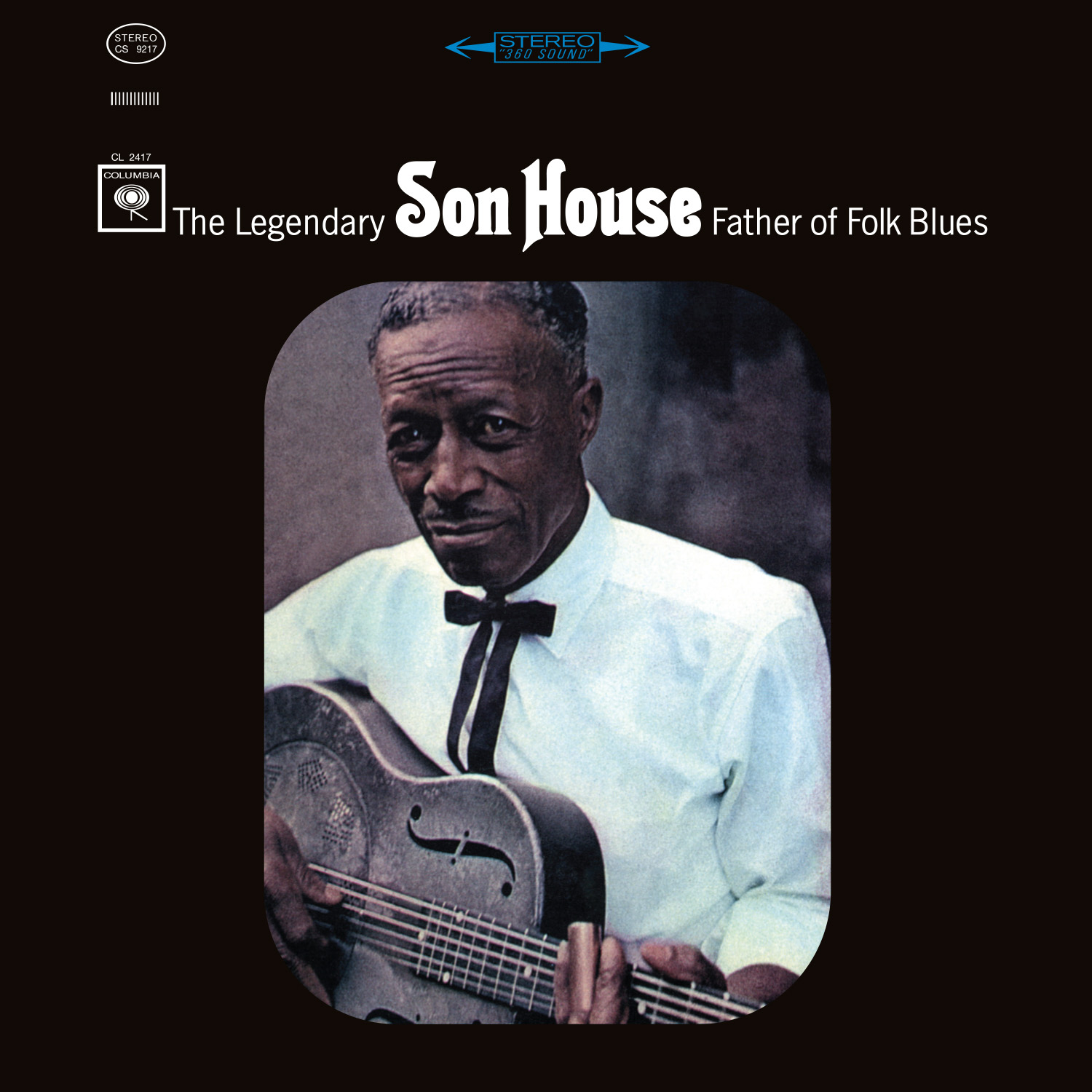
One man, his voice and a guitar: in Son House’s case, that short inventory barely begins to describe the musical forces involved. His voice can place a phrase in the room with the authority of a sermon, hold on to a syllable and launch the next thought with almost physical determination. The guitar does more than accompany a regular vocal line. Its metallic tone, sliding bottleneck phrases and clipped rhythmic responses belong to the same language. Father of Folk Blues documents that relationship in recordings made in 1965. This is the music of an older artist whose career reached back well beyond the contemporary folk and blues revival, now encountering a new audience.
House had first recorded for Paramount in 1930. Further historical documents followed in the early 1940s through recordings associated with the Library of Congress. He subsequently disappeared for many years from the view of the expanding blues audience, before being located in Rochester, New York, in 1964. That history helps explain the distinctive place of this Columbia album. A younger performer is not recreating somebody else’s old repertoire here. An actual participant in that earlier blues world is returning to his own music under changed circumstances. Decades separate the early records from these tapes, and that distance is an essential part of the album’s story.
The title Father of Folk Blues belongs to a period when rediscovered music was being presented and marketed to a new public. It need not turn House into a merely paternal symbol, still less suggest that he single-handedly invented an entire tradition. The more revealing question concerns the personal uses he makes of inherited forms. A repeated line can prepare the next outburst; a guitar figure supplies movement and resistance as well as harmony. For listeners interested in the older expressive possibilities behind later blues-rock gestures, this record offers an especially direct encounter. Its value does not depend on treating the music simply as a preliminary stage in somebody else’s history.

Son House and Alan Wilson: support, attention and individual authority
The Columbia sessions were overseen by John Hammond, the record producer and talent scout, rather than his namesake son, the blues musician. Son House remains the central performer throughout, singing and playing acoustic guitar. On the accompanied pieces, the resonator character is an important element of the expression. Its attack differs from that of a conventional wooden soundboard, while the bottleneck moves between clearly outlined notes and sliding connections. This does not produce an undifferentiated wash of sound. Attack, damping, decay and voice each need their own place. The small interruptions are often as revealing of the rhythmic work as the sustained sounds.
Alan Wilson played a special part in House’s return. The young blues scholar and musician, subsequently famous as a member of Canned Heat, had studied House’s early recordings closely and helped him recover parts of his earlier repertoire during his re-emergence. That contribution deserves to be named precisely, without implying that Wilson somehow supplied House with a musical identity of his own. The younger man’s detailed knowledge met the older musician’s experience. On this album their recorded collaboration can be located in two particular performances: Wilson plays second guitar on Empire State Express and harmonica on Levee Camp Moan.
Those assignments matter. This is neither a continuous duo record nor a Canned Heat session. Wilson joins at specific points, while House remains the principal voice and musical authority. A second guitar establishes a different kind of exchange on Empire State Express from the harmonica’s contribution to Levee Camp Moan. It is worth attending not only to the added instrument but also to the spaces between the musicians’ statements. Elsewhere, the concentration on House alone is equally significant. The overall personnel list is small, but the differences between individual performances are substantial. They reward listening across the complete sequence instead of assuming that the same accompaniment continues throughout.

Ten performances between narrative, preaching and an open pulse
This edition opens with Death Letter, also known as Death Letter Blues. The news of a loved woman’s death is not delivered through a smooth, uninterrupted melody. Repetition, verbal accents and the guitar’s replies give the narrative its weight. Although it is among House’s best-known performances, the surrounding album allows it to remain part of a larger musical statement rather than an isolated famous blues number. Pearline, which follows on the same side, offers another form of personal address. Together, the opening pair demonstrates how a relatively concentrated musical vocabulary can sustain different kinds of movement and tension.
Side B brings together Louise McGhee, John the Revelator and Empire State Express. John the Revelator changes the listener’s focus particularly clearly: the voice carries the performance without guitar accompaniment. Its biblical imagery and calling delivery reveal the proximity between sacred address and House’s musical expression. Wilson’s second guitar then enters the programme with Empire State Express, located at B3 on this double LP. This is a useful place to connect the personnel table with the music actually playing. An additional musician’s name identifies a particular change in the arrangement, rather than implying participation on every one of the album’s ten tracks.
Preachin’ Blues, Grinnin’ in Your Face and Sundown occupy the third side. Grinnin’ in Your Face gives the foreground to voice and handclaps; a guitar is not required to make its warning compelling. The extended Levee Camp Moan opens side D, allowing time for the exchange between House and Wilson’s harmonica to unfold. Motherless Children closes the set. This tenth selection expands the original nine-track Columbia album. The Analogue Productions release should therefore not be confused with an exact reproduction of the old running order, or with a complete collection of everything recorded at the sessions. It presents a specific version of the album, supplemented by an additional performance.
The Analogue Productions edition: two LPs at 45 RPM
With catalogue number AAPB 092-45, Father of Folk Blues is presented as a stereo double LP playing at 45 RPM. Ryan K. Smith handled the remastering and lacquer cutting at Sterling Sound using the original master tapes. Plating and pressing are credited to Quality Record Pressings, with a glossy Stoughton tip-on jacket completing the package. The principal production stages, from mastering through manufacture and packaging, are therefore identified for this particular vinyl release. They apply to these records. Manufacturing credits associated with a separately issued SACD should not automatically be transferred to the LP edition.
The current publisher listing specifies 180-gram vinyl, whereas older documented pressings under the same catalogue number are listed at 200 grams. Weight alone consequently cannot describe the full release history. The defining features of the offered version are its two records, 45 RPM playback, Ryan K. Smith’s mastering and QRP manufacture. The four sides divide the programme into groups of two, three, three and two tracks. That involves more side changes than a single LP at 33⅓ RPM, while giving the individual sections a manageable shape. The higher speed is a technical feature of this edition, rather than an automatic promise of the same result on every system or for every listener.
There are very specific ways into this recording. How long does a struck guitar note remain beside the voice? Where does House alter the relationship between singing and pulse? How different is the effect of an unaccompanied performance from the later exchange with harmonica? The record addresses those questions through the variety within its small complement of musicians, rather than through a multitude of instruments. For a collection that takes blues seriously as a musical language in its own right, that is a substantial reason to give this album close attention. You order from Michael 45 in Germany. We arrange the US import and dispatch from Hilden.
Customer question: Buying Analogue Productions records in Europe
Musicians
Participants and documented credit status. Track references correspond to the tracklist.
- Son Houseportrait reference 1965vocals; guitar except B2/C2; handclaps C2Participation: Ten tracks; B2 John the Revelator and C2 Grinning in Your Face without guitar
- Alan WilsonLater portrait reference 1970second guitar B3; harmonica D1Participation: Empire State Express; Levee Camp Moan


Columbia recordings from 1965, produced by John Hammond. Alan Wilson: second guitar on Empire State Express, harmonica on Levee Camp Moan, confirmed by Dick Waterman’s contemporary statement and the official Wilson discography. Motherless Children is this AP edition’s additional tenth track.

Reviews
There are no reviews yet.