

Genius + Soul = Jazz: Ray Charles at the organ
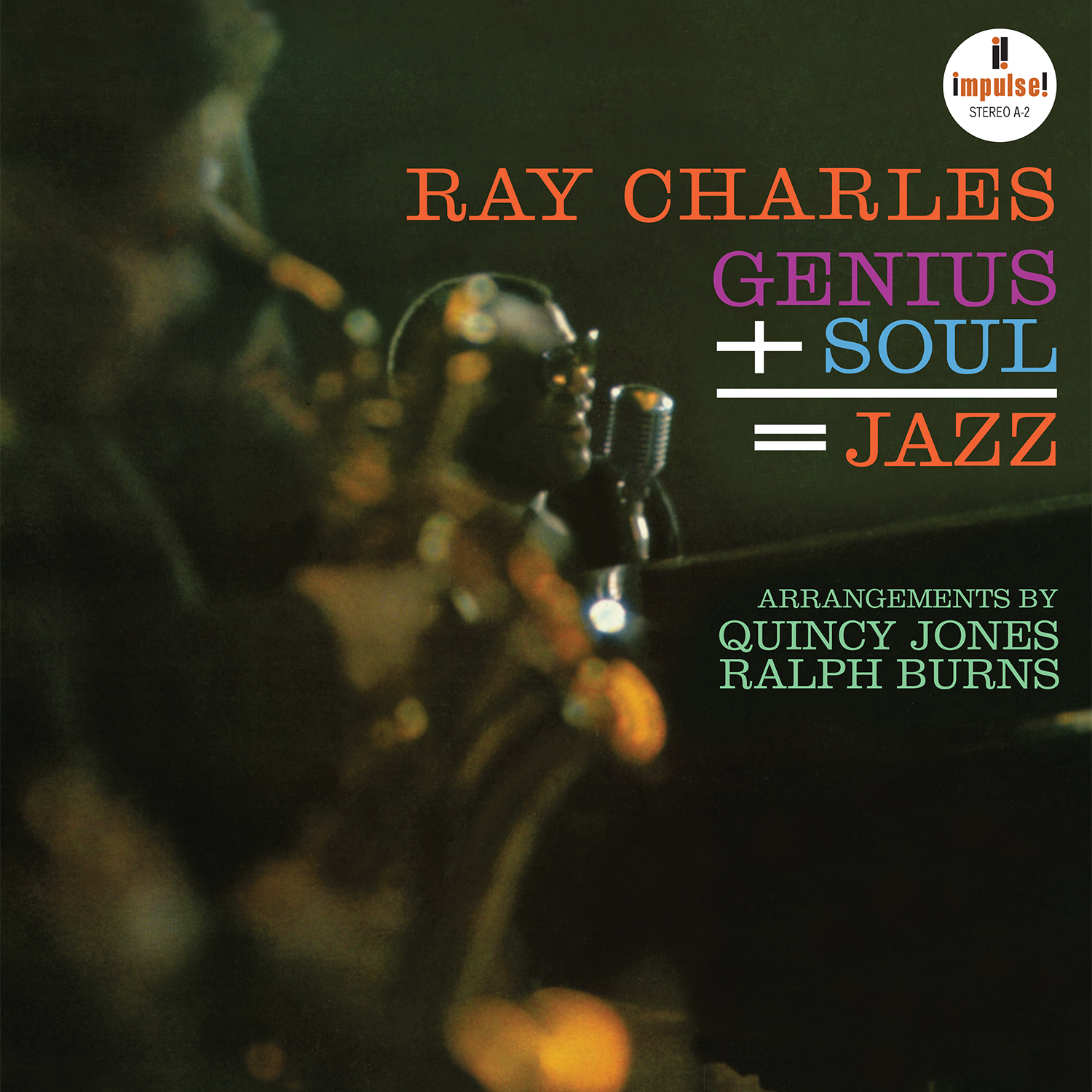
The name Ray Charles often brings his voice to mind first. Genius + Soul = Jazz shifts that expectation: the organ occupies the centre, and only two of the ten tracks carry a vocal credit. A substantial group of horn and rhythm-section players surrounds him. The album therefore offers another route into his musical personality. Listeners arriving through the singer can discover the instrumentalist, while collectors of large-ensemble jazz encounter a setting in which the organ occupies its own position between featured voice, harmonic centre and rhythmic partner, rather than simply accompanying a sequence of songs.
The recordings were made on December 26 and 27, 1960, at Van Gelder Studio in Englewood Cliffs, New Jersey, with Creed Taylor producing. The title connects three ideas as an equation, but the music is more interesting when that phrase is not treated as a rigid formula. An organ can sustain tones while horns work through breath and articulation. It can hold a chord while moving a line above it. Those different capabilities create possibilities for tension, responses and shared accents. The instrumentation itself encourages attention beyond the expectations associated with a conventional vocal album.
The personnel do not remain identical throughout. Two substantial groups are assigned to different tracks in the credits, while the arrangements are attributed to Quincy Jones and Ralph Burns. This creates several layers within the project: Charles as its central figure, the individual instrumentalists and the written organisation of their contributions. Listening does not require immediate recognition of every name. A more useful starting point is the relationship between a continuing lead voice and its changing surroundings. The different horn groups provide contexts in which the organ can occupy varying positions and develop different kinds of musical conversation.

Ten selections, two vocal performances and an instrumental centre
From the Heart opens side A, followed by I’ve Got News for You, Moanin’, Let’s Go and One Mint Julep. I’ve Got News for You is one of the two selections on which Charles sings. Within a predominantly instrumental programme, that gives the human voice a particular significance. Singing is not the assumed starting point of every number, but an additional expressive resource used at selected moments. Notice how the arrival of words changes your attention: the instruments continue to act as musical partners, while the centre of perception can move towards language and the shape of a sung phrase.
Side B begins with I’m Gonna Move to the Outskirts of Town, the other documented vocal selection. Stompin’ Room Only, Mister C, Strike Up the Band and Birth of the Blues follow. Five tracks per side create a clear outer structure, while the individual durations remain varied. Let’s Go and Strike Up the Band are particularly compact. At 5:05, Birth of the Blues receives the longest span. The album therefore does not treat every selection according to one fixed scale, and its closing performance has room to establish a different sense of proportion from several earlier numbers.
Moanin’ and One Mint Julep may already be familiar to many listeners. Even without that recognition, the programme offers several ways in: through the organ, the rhythmic movement, or the exchanges between horns and the central instrument. The vocal tracks should not become the sole measure of the album. Eight pieces proceed without Charles’s singing, and that is a significant part of the record’s identity. It presents a musician whose expression is not confined to one means, and whose place within a large ensemble allows him to assume different responsibilities while remaining recognisably central to the music.

Two personnel groups and a carefully qualified credit record
For A1 through A3 and B2 through B4, the documented players include Frank Wess, Marshall Royal, Billy Mitchell, Frank Foster, Charlie Fowlkes, Snooky Young, Joe Newman and Thad Jones. Al Grey, Benny Powell, Henry Coker, Freddie Green, Eddie Jones and Sonny Payne are also listed. Another track-specific group appears on A4, A5, B1 and B5, including Earle Warren, George Dorsey, Budd Johnson, Seldon Powell, Haywood Henry, Jimmy Nottingham, Joe Wilder and John Frosk, alongside further trombonists and the rhythm players Sam Herman, Joe Benjamin and Roy Haynes.
The complete panel below the story identifies those musicians and their instruments. Clark Terry, Urbie Green and Phillip Guilbeau also appear in the research, but without established track assignments. That distinction remains visible rather than turning an album credit into a claim of participation on every selection. Quincy Jones and Ralph Burns are treated separately as arrangers, not automatically counted among the instrumentalists. Their assignments overlap on A2 in the source used here; an exclusive attribution is not invented to remove the ambiguity. For a large ensemble, this precision is more useful than an impressive but inaccurate total of participants.
While listening, set the names aside at first and concentrate on instrumental groups. How do shorter horn accents relate to a sustained organ tone? When does the rhythm section register as a collective foundation, and when do individual voices become more apparent? Such questions open the music without prescribing an answer. The credits can then help place what you have noticed. They become a tool for curiosity rather than a prerequisite for entry. Charles remains the central figure, but the record acquires its particular shape through his relationships with many other individual musical personalities and their changing combinations.
The Acoustic Sounds edition and its corrected mastering credit
This Acoustic Sounds Series reissue presents the album on one 180-gram stereo LP at 33⅓ RPM. It carries the catalogue number B0033210-01 and shop reference AIMP 21001, and was pressed at Quality Record Pressings. One production detail is particularly important for this version: Kevin Gray at Cohearent Audio handled the mastering and lacquer cutting. The jacket incorrectly names Ryan Smith and Sterling Sound. The documented correction is reflected here, so the description does not simply repeat a printed error and pass it on as reliable information about the edition being offered.
Manufacturing details help identify a release, but the musical attraction lies in the programme’s unusual emphasis. Listeners who mainly know Charles as a singer receive a record that gives considerably more space to his instrumental playing. Those interested in large jazz ensembles can follow changing groups and arrangements within a compact album. One LP holds that variety together in an approachable form. Five selections on each side make it easy to hear the programme completely, then return to the passages where the organ, horns and rhythm section have raised a particular question or invited closer attention.
Genius + Soul = Jazz broadens the view of Ray Charles without removing his singing from the picture. His voice appears selectively, while the organ connects the entire programme. Michael 45 dispatches orders from Hilden in Germany, allowing customers in Germany and the EU to order without importing it themselves from the United States or waiting for customs clearance. If you want to buy Genius + Soul = Jazz on vinyl, this Acoustic Sounds edition comes with a corrected mastering credit, the complete running order and a personnel panel that distinguishes established track assignments from details that remain open.
Current availability and delivery information appear beside the purchase controls; this edition description is not a statement of stock availability.
Series: Impulse! – all 19 records: the house that Trane built
Musicians
Participants and documented credit status. Track references correspond to the tracklist.
- Ray CharlesExisting portrait; not a session depictionorgan, vocalsParticipation: Organ: all ten tracks; vocals: A2 and B1
- Clark TerryPortrait reference: 1964trumpetParticipation: Album credit; track assignment undocumented
- Urbie GreentromboneParticipation: Album credit; track assignment undocumented
- Phillip GuilbeautrumpetParticipation: Album credit; track assignment undocumented
- Frank Wessalto saxophoneParticipation: A1–A3, B2–B4
- Marshall Royalalto saxophoneParticipation: A1–A3, B2–B4
- Billy Mitchelltenor saxophoneParticipation: A1–A3, B2–B4
- Frank Fostertenor saxophoneParticipation: A1–A3, B2–B4
- Charlie Fowlkesbaritone saxophoneParticipation: A1–A3, B2–B4
- Snooky YoungPortrait reference: spätere Lebensjahre, undatierttrumpetParticipation: A1–A3, B2–B4
- Joe NewmantrumpetParticipation: A1–A3, B2–B4
- Thad JonestrumpetParticipation: A1–A3, B2–B4
- Al GreytromboneParticipation: A1–A3, B2–B4
- Benny PowelltromboneParticipation: A1–A3, B2–B4
- Henry CokertromboneParticipation: A1–A3, B2–B4
- Freddie GreenExisting portrait; not a session depictionguitarParticipation: A1–A3, B2–B4
- Eddie Jonesdouble bassParticipation: A1–A3, B2–B4
- Sonny PaynedrumsParticipation: A1–A3, B2–B4
- Earle Warrenalto saxophoneParticipation: A4, A5, B1, B5
- George Dorseyalto saxophoneParticipation: A4, A5, B1, B5
- Budd Johnsontenor saxophoneParticipation: A4, A5, B1, B5
- Seldon Powelltenor saxophoneParticipation: A4, A5, B1, B5
- Haywood Henrybaritone saxophoneParticipation: A4, A5, B1, B5
- Jimmy NottinghamtrumpetParticipation: A4, A5, B1, B5
- Joe WildertrumpetParticipation: A4, A5, B1, B5
- John FrosktrumpetParticipation: A4, A5, B1, B5
- George MatthewstromboneParticipation: A4, A5, B1, B5
- Jimmy ClevelandPortrait reference: 1965tromboneParticipation: A4, A5, B1, B5
- Keg JohnsontromboneParticipation: A4, A5, B1, B5
- Sam HermanguitarParticipation: A4, A5, B1, B5
- Joe BenjaminExisting portrait; not a session depictiondouble bassParticipation: A4, A5, B1, B5
- Roy HaynesPortrait reference: vorhandenes gesichertes PorträtdrumsParticipation: A4, A5, B1, B5


Production: Creed Taylor. Recording: Rudy Van Gelder. Photography: Bob Gomel. Series supervision: Chad Kassem. Mastering/lacquer cutting: Kevin Gray, Cohearent Audio (correcting the jacket error). Arrangements: Quincy Jones (A1, A2, A3, A5, B1, B3, B4) and Ralph Burns (A2, A4, B2, B5); the source assigns A2 to both without resolving the overlap. Unassigned album credits are not extended to every track.

Reviews
There are no reviews yet.