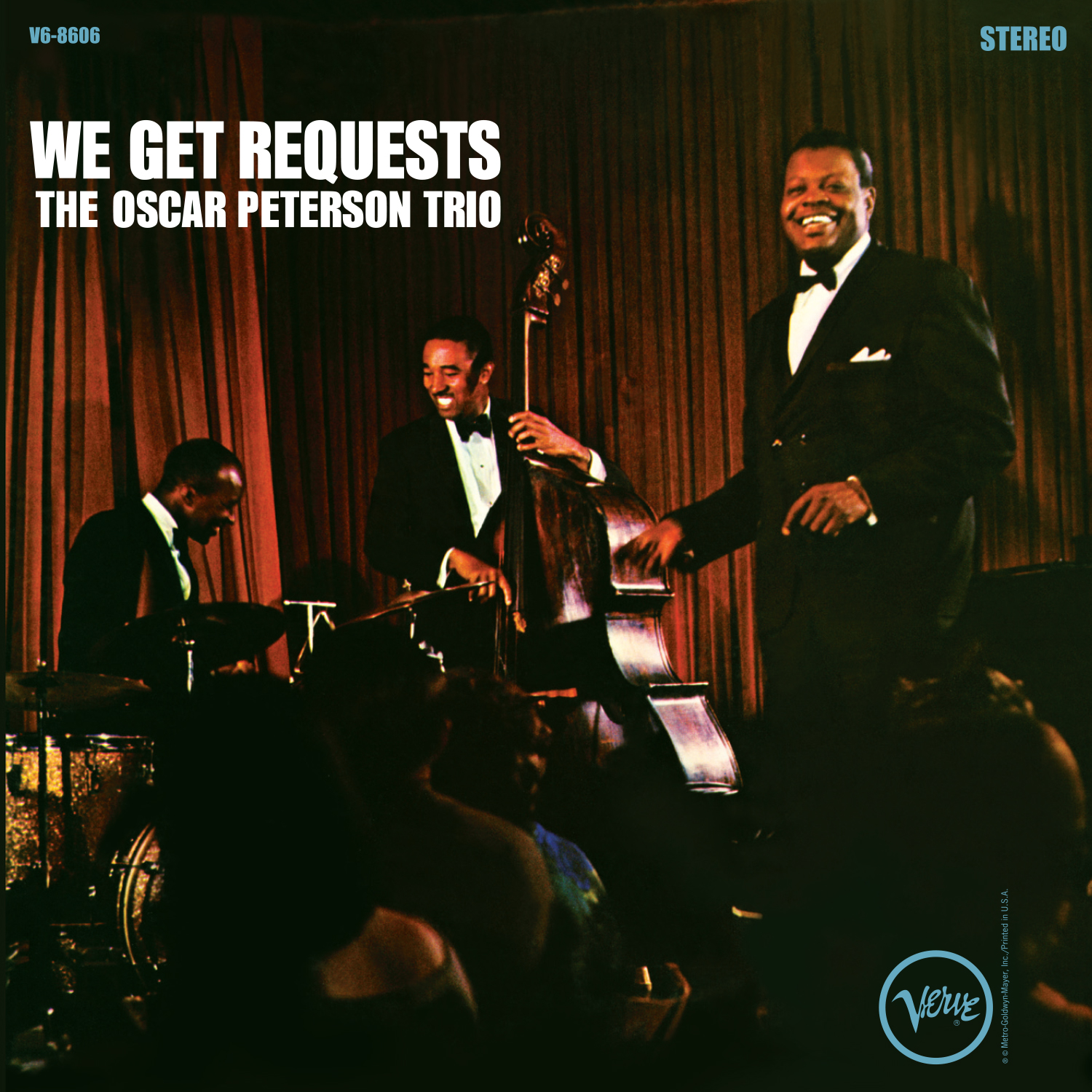



We Get Requests: familiar melodies, distinctive partners
Some records invite you to begin by simply trusting a melody. The repertoire of We Get Requests offers that kind of welcome: The Days of Wine and Roses, My One and Only Love, People and The Girl from Ipanema provide approachable starting points. The Oscar Peterson Trio turns them into a programme with its own identity. Oscar Peterson on piano, Ray Brown on double bass and Ed Thigpen on drums are the personnel throughout all ten selections. Three musicians are enough to establish a continually changing balance between melody, harmonic movement and rhythmic shape, with each instrument contributing something the others cannot supply.
The recordings were made between October 19 and November 20, 1964, at RCA Studios in New York. That gives the album a clear historical anchor, even though accounts of its first release differ between 1964 and 1965. The documented recording period is more useful than presenting an apparently certain date where the sources disagree. What matters here is the trio within a compact ten-piece programme, bringing a personal musical identity to familiar material. Recognisable themes make entry easy, but they do not tell us in advance what the players will do with them or how their conversation will unfold.
The title suggests requests from listeners. There is no need to invent a story about a particular evening to understand its appeal: music to which people already have a connection becomes the basis of a shared conversation. Peterson’s name leads the group, yet Brown and Thigpen are not interchangeable accompanists. Bass and drums help determine how a melody can settle, develop and draw back. With repeated listening, it is possible to move from the familiar theme towards the relationships underneath it, discovering more detail without losing the immediate pleasure that made the music approachable in the first place.

Ten selections with different proportions and points of emphasis
Side A begins with Quiet Nights of Quiet Stars (Corcovado), then moves through The Days of Wine and Roses to My One and Only Love. People, from Funny Girl, and Have You Met Miss Jones? complete the side. These five selections bring together different musical backgrounds, all translated through the same three instruments. The consistent ensemble creates continuity while leaving each composition room to retain its own character. One rewarding approach is to notice how the themes are introduced: which parts of a melody establish immediate recognition, and which possibilities become apparent only as the performance continues?
Side B opens with You Look Good to Me and proceeds to The Girl from Ipanema, D. & E., Time and Again and Goodbye J.D.. It is an interesting sequence because familiarity is not its only organising principle. Widely recognised songs sit beside pieces that many listeners may first come to know through this particular record. Recognition and discovery can alternate within the same side. Even with a much-played album, there is value in resisting the urge to jump straight to a favourite selection and instead considering the transitions and final piece as parts of a complete musical shape.
The timings reinforce that impression. The Days of Wine and Roses is compact at 2:40, while My One and Only Love receives 5:06 and D. & E. 5:10. The closing Goodbye J.D. lasts 2:35. The programme does not impose a standard duration on every selection. Shorter and more extended treatments sit alongside one another, changing the pace at which the album unfolds. On an LP, that variety is especially tangible: five pieces per side, a deliberate turn between them and a defined ending. The complete sequence can remain rewarding even after individual tracks have become thoroughly familiar.

Bringing Ray Brown and Ed Thigpen into the foreground
A piano can occupy a great deal of musical space. That makes it particularly worthwhile to shift attention towards Ray Brown and Ed Thigpen while listening to We Get Requests. Brown’s double bass has its own way of beginning a note and allowing it to decay; Thigpen’s drums offer another means of dividing and shaping time. The relationship between these different forms of articulation is fundamental to a trio recording. No specialist vocabulary is needed to explore it. Simply follow the instrument that seemed less prominent on the first hearing and notice how it changes your understanding of the whole.
Choose one of the shorter selections and play it twice. Follow the melody first, then concentrate on the bass. A further hearing might focus on the accents and spaces created by the drums. These changes of perspective are invitations to discover musical relationships, rather than tests that an audio system must pass. They also help release a familiar recording from the role of demonstration material. The interaction between the musicians deserves attention in its own right, whether a new component has just been connected or the record is simply accompanying an unhurried evening of listening at home.
Jim Davis produced the album, Bob Simpson engineered the recording, and Val Valentin is credited with engineering direction. These details describe how the record was made and remain separate from the performing personnel. On the musical side, the line-up is straightforward: Peterson, Brown and Thigpen throughout. That does not imply that every possible technique appears on every track. The credits identify the documented players; listening reveals what they do within that framework. This is part of the lasting appeal of a trio record: the same partners can establish different relationships from one selection to the next without changing the ensemble itself.
This edition and its specifically documented analogue tape chain
The Verve Acoustic Sounds Series presents We Get Requests on one 180-gram stereo LP at 33⅓ RPM. Ryan K. Smith at Sterling Sound handled the mastering. Pressing was undertaken at Quality Record Pressings, with a Stoughton Printing gatefold jacket. The edition number is B0033797-01, and the shop reference is AVER 79701. For this album, it is worth reading the description of the tape source carefully. Its actual production chain is more specific than the shorthand phrase “from the original master”, and a precise account is more useful than an impressive but ambiguous slogan.
According to the publisher, a new analogue stereo tape was made from the original three-track master. The LP was then cut directly from that new stereo master. The chain therefore remains analogue, while the newly created stereo tape sits between the original three-track recording and the lacquer cutting stage. That is the documented method used for this edition. It is not presented here as proof of superiority over every other pressing, nor described as a direct cut from the three-track tape. Collectors comparing releases receive a concrete production detail that can genuinely help distinguish this particular version.
Musically, We Get Requests remains an invitation to hear familiar themes through a clearly defined ensemble. Ten selections, three musicians and two LP sides provide variety without pulling the programme apart. Michael 45 dispatches orders from Hilden in Germany, allowing customers in Germany and the EU to order without importing it themselves from the United States or waiting for customs clearance. If you want to buy We Get Requests on vinyl, this Acoustic Sounds edition comes with a clearly explained tape chain, the full tracklist and the names of the three musicians whose interaction remains the real centre of the record.
Current availability and delivery information appear beside the purchase controls; this edition description is not a statement of stock availability.
Series: Verve – all 34 records: voices, organ and bossa nova
Musicians
Participants and documented credit status. Track references correspond to the tracklist.
- Oscar PetersonPortrait reference: 1977pianoParticipation: all ten tracks
- Ray BrownPortrait reference: 1976double bassParticipation: all ten tracks
- Ed ThigpenPortrait reference: spätere undatierte VorlagedrumsParticipation: all ten tracks


Production: Jim Davis. Recording: Bob Simpson. Engineering director: Val Valentin. Series supervision: Chad Kassem. Mastering: Ryan K. Smith, Sterling Sound. A new analogue stereo tape was made from the original three-track tape and used to cut this LP.
How Michael hears this edition
Listening impression · paraphrased from the video
Michael praises the clarity and soundstage of the Acoustic Sounds edition. In a direct comparison, however, he prefers the older George Marino-mastered AP 45 for its more open, punchy presentation, particularly in the bass. He still rates the new 33⅓ edition very highly.
🎧 Review video: Acoustic Sounds Series: Oscar Peterson Trio–We Get Requests vs. Analogue Production 45 rpm RPM
This video is hosted by YouTube (Google). It only loads once you switch on “Functional” in the cookie settings.

Reviews
There are no reviews yet.