A question for the future, asked in early 1959
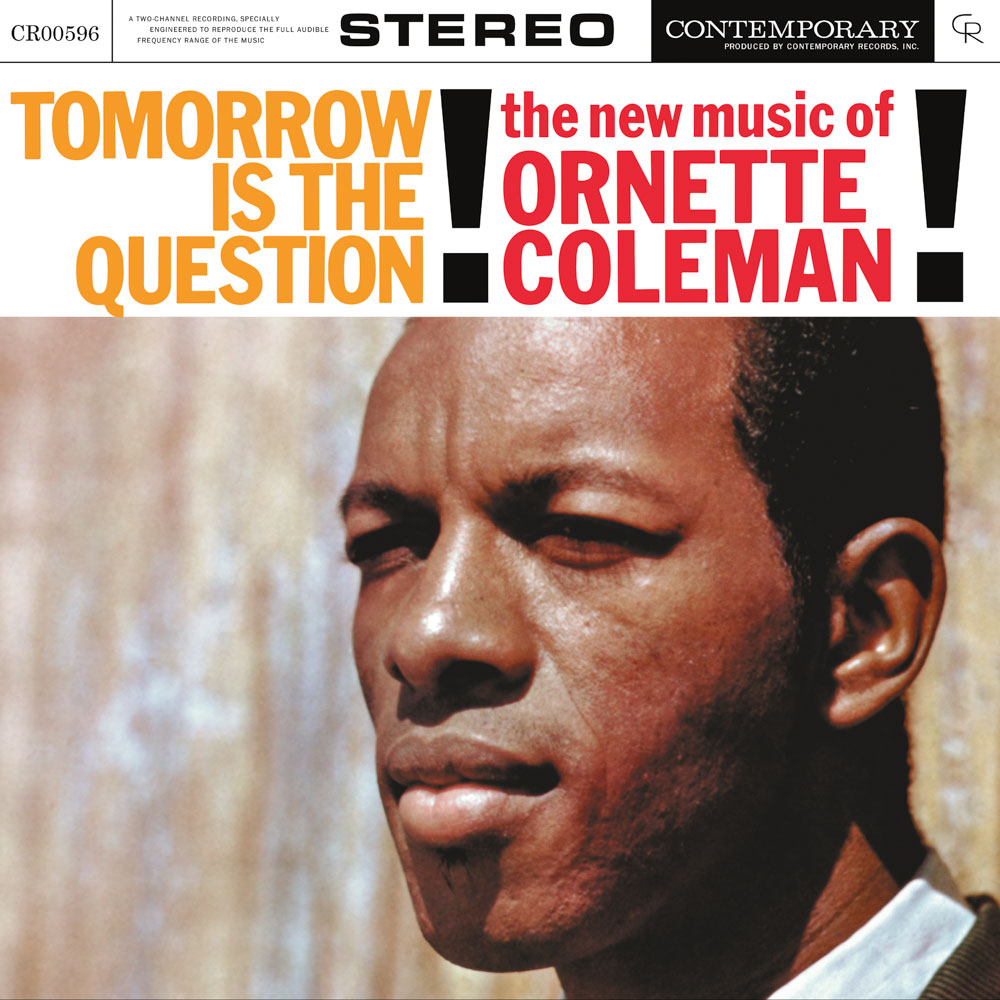
Tomorrow Is the Question! is a title that looks openly ahead. For Ornette Coleman, that openness belongs directly to the album’s place in musical history. This was his second LP and his final album for Contemporary before the Atlantic recordings began. His debut, Something Else!!!!, had included a piano. Here the focus is on alto saxophone, trumpet, double bass and drums. Removing the chordal instrument changes the conditions of the ensemble: the two horns, bass and drums establish relationships without a pianist supplying a continuous sequence of chord voicings.
The music was recorded early in 1959 at Contemporary’s Studio in Los Angeles, with Lester Koenig producing and Roy DuNann engineering. Coleman plays alto saxophone, Don Cherry trumpet and Shelly Manne drums. Red Mitchell and Percy Heath alternate on double bass. Both belong to the album, but they do not perform simultaneously: Mitchell appears on the three selections on side two, Heath on the six on side one. This division already shows that the LP brings several recording dates together into a deliberately ordered programme.
The chronology is particularly interesting. Lorraine was recorded on January 16, with Turnaround and Endless following on February 23, 1959. The six first-side selections were made during the night of March 9–10. By May 22, Coleman was recording The Shape of Jazz to Come for Atlantic, with Charlie Haden and Billy Higgins replacing the rhythm-section players heard here. Tomorrow Is the Question! was not released until later in the year. Session order and release order are therefore different, a small but revealing complication in Coleman’s passage through 1959.

Ornette Coleman and Don Cherry without a piano between them
Don Cherry partners Coleman in the front line on all nine tracks. Alto saxophone and trumpet offer different ways of approaching the same melodic situation: a sustained breath, a short entry, a shared figure or two lines moving apart. Without piano, the relationships between these voices become particularly rewarding to follow. This does not mean that the music must dispense with form or orientation. Rather, melodic decisions and the other players’ responses become especially significant points of reference within the performance.
Coleman wrote all nine compositions. This is not a programme of standards in which a new ensemble reinterprets familiar material. The themes already belong to his own musical conception. The passage from composed material into improvisation consequently becomes a central listening question: what shape does a melody take at the beginning, which of its movements reappear later, and how do the horns find their way back to a shared idea? There is no need to answer analytically. Following one voice on a return visit, and then giving the other your attention, can be enough to open another route through a piece.
The recording captures a particular step between the Contemporary debut and the Atlantic sessions that soon followed. Cherry provides continuity while the bass and drum chairs change between projects. It would be a loss to treat Tomorrow Is the Question! only as preparation for a more famous album. Its combination of Shelly Manne and the two bassists has an identity of its own. Knowing what came later makes it all the more rewarding to hear this configuration on its own terms: nine pieces with their own proportions, played by musicians who are not simply interchangeable with the later regular group.

Two bassists and two record sides
Side A belongs to Percy Heath. It opens with the title track and moves through Tears Inside, Mind and Time, Compassion and Giggin’ to Rejoicing. Most of these pieces last between three and five minutes. The sequence provides a succession of compact beginnings, themes and fresh departures. That can make an inviting introduction: instead of entering through one extended improvisation, the listener encounters several shorter pieces, each establishing another starting point. A shared recording period and unchanged personnel give the side its continuity.
Red Mitchell takes the bass chair on side B. Lorraine precedes Turnaround and Endless, with all three coming from the two earlier sessions. At just under eight minutes, Turnaround is the longest performance on this edition. Turning the record therefore introduces a different scale of duration as well as another bassist. Three longer performances balance six shorter ones. The arrangement can be experienced directly, without keeping a discographical table beside the turntable: the physical shape of the LP already carries part of its recording history.
Shelly Manne remains on drums throughout both sides. His continuous involvement links the dates, as do Coleman and Cherry. On a return listen, try giving bass and drums particular attention: where do they sustain a shared movement, where do they introduce an accent of their own, and how does the space beneath the horns change? These relationships offer one way into the recording, just as Coleman’s themes and their return offer another. Nat Hentoff’s liner notes, dated September 14, 1959, belong to the original presentation of an album whose title addresses the future while its practical work is rooted in these Los Angeles sessions.
Contemporary Acoustic Sounds Series: the 2023 edition
The edition offered is ACONC 596, issued by Craft Recordings as CR00596: a single 180-gram stereo LP playing at 33⅓ RPM in the Contemporary Records Acoustic Sounds Series. This edition appeared in 2023. Bernie Grundman handled the all-analogue mastering from the original tapes, as specifically described by the publisher for this title. The record was manufactured at Quality Record Pressings and comes in a Stoughton Printing tip-on jacket. These are the specifications of this individual LP, rather than the contents or packaging of a separate Coleman box set or SACD.
The 33⅓ RPM format preserves the two original sides as continuous sections. On this album, turning the record has an especially clear meaning: it takes the listener from Percy Heath’s six March performances to Red Mitchell’s three earlier selections. The distribution of running time and the change of bassist remain directly apparent. Approaching the album in two concentrated stretches also follows a meaningful division of its sessions. Playback speed alone does not establish a quality guarantee; here it chiefly determines the practical sequence and the length of the musical spans between interruptions.
For collectors, this edition combines a clear place in the Contemporary catalogue with documented information about tape source, mastering, pressing plant and jacket. The musical point of entry is simpler still: nine Coleman compositions, two horns, two alternating bassists and Shelly Manne as a continuous partner. That particular group of players tells its own part of the jazz story of 1959. You order from Michael 45 in Germany. We arrange the US import and dispatch from Hilden.
Series: Contemporary – all 24 records: sunny jazz from Los Angeles
Musicians
Participants and documented credit status. Track references correspond to the tracklist.
- Ornette Colemanalto saxophoneParticipation: All 9
- Don CherrytrumpetParticipation: All 9
- Percy Heathdouble bassParticipation: A1–A6
- Red Mitchelldouble bassParticipation: B1–B3
- Shelly MannedrumsParticipation: All 9


Track numbers and side references refer to this edition.

Reviews
There are no reviews yet.