
Three nights in Washington
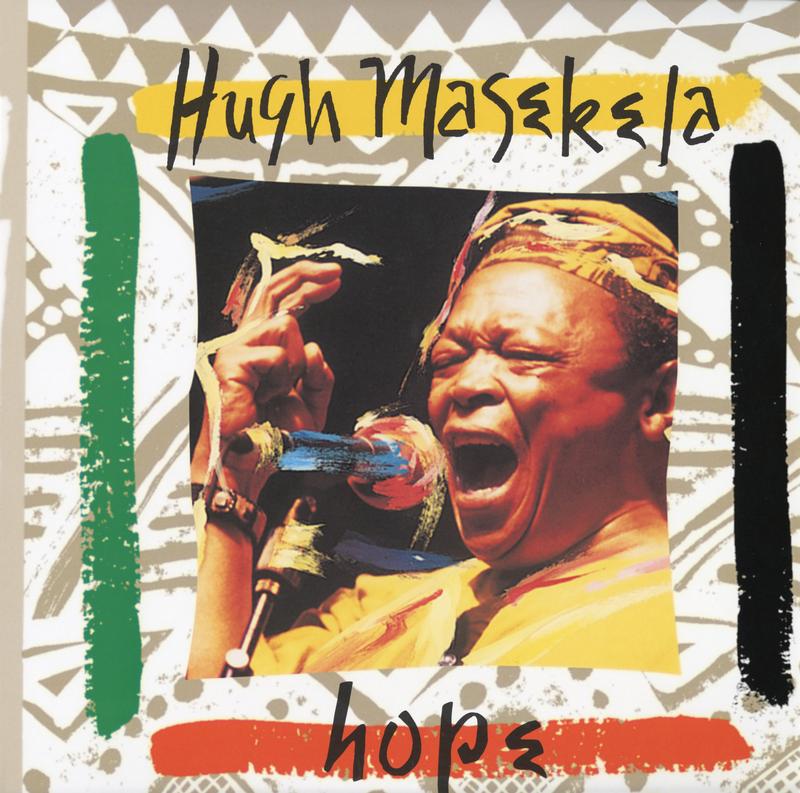
Between 30 July and 1 August 1993, Hugh Masekela performed at Blues Alley in Washington, D.C. The recordings appeared as “Hope” in 1994. An American jazz club became the setting for a programme reaching far back into South African music and history. Masekela appears as horn player, singer and storyteller, connecting different parts of his repertoire with the country where he grew up.
The band includes bassist Bakithi Kumalo, keyboardist Themba Mkhize and percussionist Remi Kabaka. Along with the other musicians, they form an ensemble in which horns, electric instruments and percussion can take on different roles. Across twelve tracks, the group has time to reveal more than one aspect of Masekela’s music.

From “Grazing in the Grass” to “Stimela”
“Grazing in the Grass”, Masekela’s international success from 1968, appears early in the sequence. “Uptownship”, “Market Place” and “Ntyilo Ntyilo” are among the other selections. Music by Miriam Makeba, Fela Kuti and Caiphus Semenya also belongs to the album’s repertoire. The programme brings together musical relationships that had developed across many years of Masekela’s life.
Two pieces carry especially direct historical connections. “Mandela (Bring Him Back Home)” was written for Nelson Mandela while he was still imprisoned. The closing “Stimela” tells of migrant workers in South Africa’s mines. The coal train named in its title belongs to that story. Its extended form allows narration a place that a brief instrumental performance could not provide.

The storyteller and the band
When listening to “Stimela”, follow the relationship between spoken words, singing and accompaniment. When does the band carry the piece forward, and when does it follow a narrated passage? On a live record like this, time becomes shared material. A pause from the soloist can also be a decision that involves every other musician.
Another contributor speaks for himself in this edition. An insert contains an interview with David Hewitt, who engineered the original recording. The reissue therefore leads back behind the concert document as well. The recordings were subsequently mixed at Mad Hatter Studios in Los Angeles: production and release followed those three club nights, while remaining distinct stages in the record’s creation.
This edition
Analogue Productions’ AAPJ 117 presents all twelve tracks on two 180-gram LPs running at 33⅓ RPM. Kevin Gray at Cohearent Audio mastered from the original analogue tape. QRP handled plating and pressing, and Stoughton supplied the tip-on gatefold. The David Hewitt interview is included. This is the double-LP release, distinct from the separate four-record box running at 45 RPM.
Michael 45 holds the goods in Germany and dispatches orders from Hilden, so EU collectors need not organise a personal US import or wait for customs processing.
Also on SACD: Hope
Customer question: Buying Analogue Productions records in Europe
Musicians
Documented selection of participating musicians. Personnel may vary by track; this list does not claim to be complete.
| Name | Instrument / role |
|---|---|
| Hugh Masekela | Flugelhorn, Trumpet |
| Damon Duewhite | Drums |
| Bakithi Kumalo | Vocals, Bass |
| Lawrence Matshiza | Vocals, Guitar |
| Themba Mkhize | Keyboards, Vocals |
| Remi Kabaka | Percussion, Vocals |
| Los Ballederos Hornas Africanos De Townsheep | Backing vocals |
How Michael hears this edition
Listening impression · paraphrased from the video
Michael counts the AP 33⅓ RPM edition among his especially good-sounding records, while hearing additional dynamics, soundstage and clarity on the 45 RPM box in the subsequent comparison.

Reviews
There are no reviews yet.