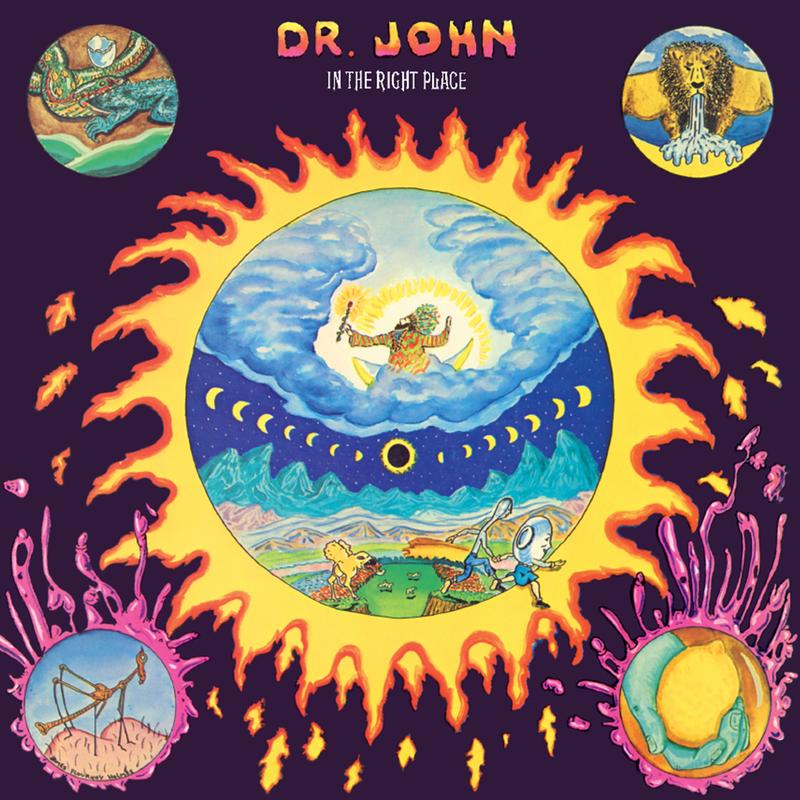
Eleven songs with New Orleans in their bones
A voice can evoke an entire musical landscape. With Dr. John, a few syllables are enough: the rough timbre, the stretched vowels, the combination of ease and sly emphasis. On In the Right Place, that personality meets musicians with an equally distinctive approach to rhythm. Allen Toussaint produces and arranges, while the Meters provide the core of the backing band. Released in 1973, the album brings their different experiences together in eleven concise songs. It offers an inviting way into Dr. John’s world without smoothing away the qualities that make it his own.
Behind the stage name is Mac Rebennack, whose early Night Tripper records had explored a more incantatory side of his musical imagination. Following Dr. John’s Gumbo in 1972, funk takes a more prominent place here. The connection to New Orleans rhythm and blues remains essential. Rather than treating that tradition as a period backdrop, the band puts it into motion: brief guitar figures, displaced accents, bass lines that find space between beats, and a singer who seems entirely at home within the resulting movement.
Right Place Wrong Time introduced this combination to a broad audience. The single reached number nine in the American charts, while the album climbed to number 24 on the Billboard 200. Yet the opener’s success is only one entrance to the record. Qualified allows itself a little more room, Such a Night offers a different melodic emphasis, and I Been Hoodood suggests, even through its title, that the Night Tripper has not disappeared. Part of the album’s lasting appeal is the variety gathered into a little over half an hour.

Toussaint and the Meters: making the parts belong together
The music’s geographical roots should be distinguished from its recording location. The album credits identify Criteria Recording Studios in Miami for the sessions held in 1972. Karl Richardson handled recording engineering. Allen Toussaint served as producer, arranger and musical director; Arif Mardin and Jimmy Douglass are credited with mixing, with Toussaint himself mixing Traveling Mood. These names describe some of the work behind a record whose apparent ease can conceal the care involved in bringing its contributions together.
The Meters here are Art Neville on organ, Leo Nocentelli on guitar, George Porter Jr. on bass and Joseph “Zigaboo” Modeliste on drums. Their association with Toussaint’s work around Sansu Enterprises had given them a shared musical language. One rewarding way to approach the album is to follow the relationship between bass and drums, then listen for the replies supplied by guitar and organ. Rhythm comes from more than a clearly marked beat. The spaces in which a short figure can make its presence felt are equally important.
Toussaint also performs. His album credits include piano, electric piano, acoustic guitar, congas, tambourine and backing vocals. Dr. John’s own keyboard contributions are more specifically identified than his reputation as a pianist might suggest: piano on Qualified, organ on Peace Brother Peace, and percussion on I Been Hoodood. That distinction makes the collaboration especially revealing. The singer need not play piano throughout to remain the centre of his record. Toussaint and the band provide a setting that gives his personality room to work.

Guitar, horns and voices around the songs
David Spinozza plays the guitar solo on the opening track, an early indication that the personnel extend beyond Dr. John and the Meters. Such carefully placed additions matter to the record. Same Old Same Old and Just the Same continue the opening sequence before Qualified opens up a longer stretch. Listeners who first came to these songs through the vocals can return with their attention on the instrumental parts: which figure carries a section forward, and which contributes a brief but telling interruption?
The writing credits offer another perspective on the variety. Rebennack and Jessie Hill wrote Qualified; Cold Cold Cold adds Alvin Robinson to that partnership. Traveling Mood comes from James Wayne, while Life is a Toussaint composition. These different origins do not disappear behind a uniform production. The band connects the material while allowing the melodies, lyrical manner and structures to retain their own emphases. For collectors interested in the relationships within New Orleans music, the album offers several paths beyond the headline artist.
Such a Night, subsequently familiar to another audience through Dr. John’s appearance in The Last Waltz, sits here between Life and Shoo Fly Marches On. Ralph MacDonald’s percussion credit is specifically attached to Such a Night, Shoo Fly Marches On and I Been Hoodood. Robbie Montgomery and Jessie Smith supply backing voices, and the Bonaroo Horn Section adds further brass and reed colours. The result invites two complementary kinds of listening: enjoying a sequence of compact songs and gradually identifying the individual contributions that give them their character.
The Atlantic 75 edition on hybrid SACD
This is Analogue Productions’ CAPA 006 SA stereo hybrid SACD, part of the Atlantic 75 Series. The eleven original tracks appear in their familiar order on a single disc. A hybrid SACD contains both a SACD layer and a CD layer: a compatible SACD player is needed for the high-resolution layer, while the CD layer can be played on a conventional CD player. This edition does not include a multichannel mix. Its focus remains the stereo album and the continuity of its original programme.
Ryan K. Smith at Sterling Sound handled the mastering. The publisher specifically describes a transfer from the original analogue tape directly to DSD. That statement belongs to this SACD: it identifies a digital release made from an analogue tape source. It does not specify a DSD rate, particular converters or further details of the transfer equipment. The separate 45 RPM double LP is another edition, with its own physical format and packaging; those characteristics should not be carried over to this disc.
The SACD is supplied in a Super Jewel Box. For listeners who want to follow all eleven songs in their original sequence without changing sides, it offers a compact way of doing so. The useful distinction is the preferred playback format and the specifications of this particular edition, rather than a blanket claim that vinyl or SACD must be superior. Dr. John’s meeting with Toussaint and the Meters remains the reason to return. You order from Michael 45 in Germany. We arrange the US import and dispatch from Hilden.
Also in another edition: In The Right Place
More by Dr. John: Gris Gris
Customer question: Buying Analogue Productions records in Europe
Musicians
Participants and documented credit status. Track references correspond to the tracklist.
- Mac Rebennack (Dr. John)vocals; piano (4); organ (6); percussion (10); backing vocals (AP credit: The Night Tripper)Participation: Vocals: album credits; 4, 6, 10
- Allen Toussaintpiano, electric piano, acoustic guitar, congas, tambourine, backing vocals; arrangements, vocal arrangements, conductingParticipation: Album personnel
- Art Nevilleorgan (The Meters)Participation: Album personnel
- Leo Nocentellilead guitar (The Meters)Participation: Album personnel
- George Porter Jr.bass (The Meters)Participation: Album personnel
- Joseph “Zigaboo” Modelistedrums (The Meters)Participation: Album personnel
- Gary Brownsaxophones (electric and acoustic)Participation: Album personnel
- David Spinozzaguitar solo (1)Participation: 1
- Ralph MacDonaldpercussion (8, 9, 10)Participation: 8, 9, 10
- The Bonaroo Horn SectionhornsParticipation: Album personnel
- Robbie Montgomerybacking vocalsParticipation: Album personnel
- Jessie Smithbacking vocalsParticipation: Album personnel


The instrument list describes the album personnel. Individual track assignments are included where documented.

Reviews
There are no reviews yet.