A great voice in a small company
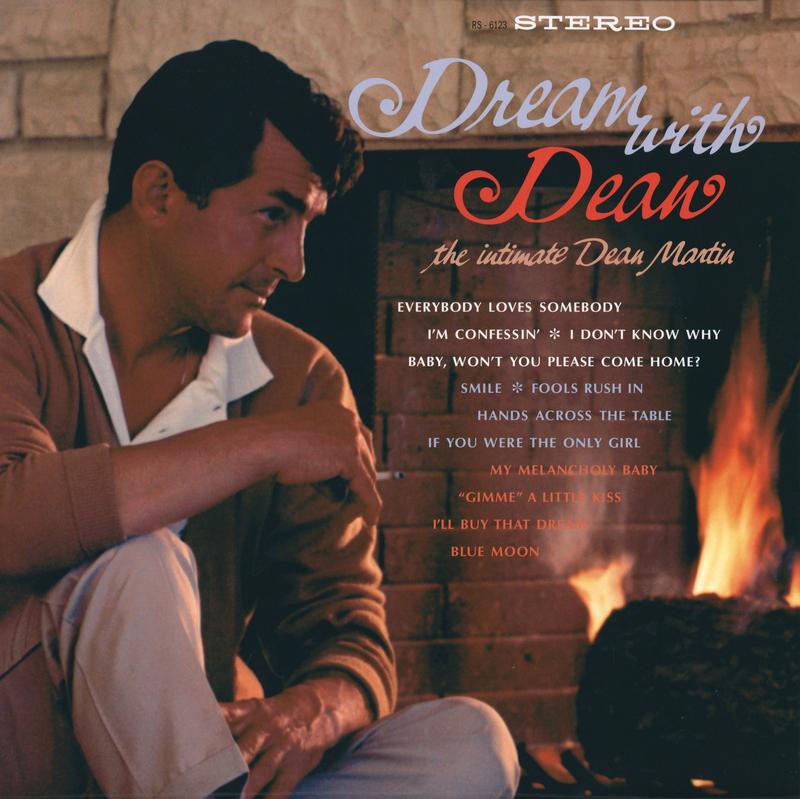
A singer, four accompanists and twelve songs: Dream With Dean needs remarkably little to establish a world of its own. Dean Martin gives the melodies room to breathe. His voice can soften, treat a word almost casually and then carry the full weight of a line. The accompaniment leaves space around him. Listeners who associate Martin chiefly with large entertainment shows encounter a singer whose impact here depends on intimacy. The subtitle, The Intimate Dean Martin, accurately describes the scale on which this record invites attention.
Released by Reprise in 1964, the album gathers standards that already possessed musical histories of their own. Martin approaches them as familiar stories that can still be told differently. “Blue Moon,” “Smile” and “My Melancholy Baby” bring different associations; his way of singing draws them together. An unhurried phrase, a slight delay before a significant word and the ability to make a melody seem entirely natural all matter here. In a small ensemble, those decisions become especially noticeable because a large arrangement is not competing for attention.
Jimmy Bowen produced the record, with Eddie Brackett responsible for engineering. Its documented accompanists are Ken Lane on piano, Barney Kessel on guitar, Red Mitchell on double bass and Irv Cottler on drums. These names explain much more than the personnel in the small print. The quartet can provide a definite rhythmic framework while remaining restrained. It establishes a setting in which Martin can position his lines without requiring every pause to be filled. The group’s apparent simplicity gives the singer considerable freedom.
A useful way into the album is to accept its quiet scale on its own terms. Tension develops within a melody, through the relationship between voice and accompaniment and in the exchange between a sung statement and an instrumental response. Twelve short selections form a coherent programme. The perspective does not need to expand dramatically as the record progresses: this small company already offers sufficient room for changes of feeling. Paying attention to those changes reveals how much expressive variety can exist within a deliberately limited setting.

Ken Lane and the art of accompaniment
Ken Lane has a particularly close relationship with this music. Martin’s longstanding accompanist also co-wrote “Everybody Loves Somebody” with Irving Taylor. One of the song’s two authors is therefore at the piano when Martin sings it here. This small-group performance should be distinguished from the more lavishly arranged hit recording. Anyone who arrives with the successful single in mind can discover how much of the song remains when its setting is reduced to just a few instrumental voices. The quartet version has its own identity and purpose.
Lane’s work extends beyond supplying the harmony. Between vocal lines, the piano can pick up a movement, prepare a turn or leave a thought suspended. For a singer whose delivery depends so strongly on the placement of words, this responsiveness is essential. Try attending first to the space between voice and piano. When does the accompaniment enter, when does it withdraw, and how does that affect the next sung phrase? Following those relationships offers a more revealing route into the performance than simply waiting for familiar melodies to arrive.
Barney Kessel’s guitar adds a second harmonic colour. Its articulation and the shape of its notes differ from the piano’s, allowing the two instruments to work together in a compact setting. Red Mitchell anchors the movement on double bass, while Irv Cottler supplies a rhythmic framework without turning the group into a show orchestra. Their roles remain distinct even as they serve the vocal line. The album can consequently be approached as a study in attentive accompaniment as well as a portrait of a celebrated singer.
The credits identify this quartet for the album without documenting a change of personnel. That does not require us to imagine every instrument occupying equal space at every moment. The more interesting question concerns the ensemble’s choices. With a small number of available colours, a slight adjustment can carry considerable meaning. Martin benefits from players who support his apparent ease. Making music seem effortless requires sensitivity to weight, placement and patience, particularly when the arrangement leaves so much of the singer’s phrasing exposed.

Familiar songs with different shades of feeling
“I’m Confessin’ (That I Love You)” opens the programme with a direct declaration. Its title already suggests a conversational stance from which Martin’s singing can develop. “Fools Rush In” brings a different emphasis, acknowledging love’s lack of reason while accepting the temptation to follow it. “I’ll Buy That Dream” completes the first side of this edition. Three short songs establish the record’s basic materials: recognisable melodies, compact forms and a singer who makes their words feel addressed to someone in particular.
The second side contains “If You Were The Only Girl,” “Blue Moon” and “Everybody Loves Somebody.” “Blue Moon” is especially useful for following Martin’s treatment of a familiar melodic line. Knowing the song’s route makes the small choices in its delivery easier to notice. Lane’s presence gives “Everybody Loves Somebody” an additional connection to the song’s authorship. The quartet performance belongs to the album’s own story and rewards attention as a distinct reading, even for listeners whose strongest association is with the famous hit version.
“I Don’t Know Why,” “Gimme A Little Kiss” and “Hands Across The Table” occupy the third side. Their titles move between puzzled affection, a modest request and an image of physical closeness. Such differences help the restrained setting accommodate more than a single emotional register. A phrase can invite humour, while the next song allows a more vulnerable feeling to emerge. The band does not need to grow larger to support that change. A different accent or a differently placed response can alter the listener’s perspective within the same intimate musical space.
The final side brings together “Smile,” “My Melancholy Baby” and “Baby Won’t You Please Come Home.” “Smile” combines Charlie Chaplin’s melody with the words later supplied by John Turner and Geoffrey Parsons. Its encouragement already contains an awareness of sadness. That makes it particularly appropriate here, where composure and vulnerability can occupy the same performance. The following standards keep the programme within its close, familiar setting to the end. On a return visit, the accompanists deserve a turn at the centre of attention: their restraint can be easy to take for granted on a first hearing.
Analogue Productions on two 45 RPM records
The edition offered here carries catalogue number AAPP 076-45. Analogue Productions spreads the original twelve-song programme across two stereo records playing at 45 RPM. Ryan K. Smith handled mastering at Sterling Sound, with analogue tapes identified by the label as the source. Quality Record Pressings is responsible for plating and pressing. The records are housed in a Stoughton tip-on gatefold jacket. These details describe the particular vinyl release rather than the album’s other available formats.
Each side holds three songs. Hearing the complete programme therefore involves more side changes than a single LP, while providing four compact sections. The sequence remains intact, from “I’m Confessin’” through the small-group “Everybody Loves Somebody” to “Baby Won’t You Please Come Home.” This arrangement adds no bonus material and does not reconstruct the programme as a compilation. It gives the existing album a different physical presentation, with the practical rhythm of four sides becoming part of the listening experience.
Different pressing weights have been documented for this title. The current label listing specifies 180 grams, while an earlier edition catalogued by Discogs is described as 200 grams. The identification of the actual supplied batch therefore matters; this description does not assume an unverified weight for the copy in hand. Nor are observations from reviews of older copies transferred automatically to current stock. The product described here is the 45 RPM double LP, which should be distinguished from the separately released hybrid SACD.
For listeners seeking Dean Martin in a concentrated musical setting, this is an album whose accompanists are as carefully chosen as its songs. Voice, piano, guitar, bass and drums give familiar melodies a shared home. Dream With Dean invites attention to small things: a restrained accent, a guitar response or the moment when a sung phrase continues to resonate even as the next line begins. Its scale allows these details to remain central throughout, making a return to the opening song an invitation to listen from a slightly different position.
You order from Michael 45 in Germany. We arrange the US import and dispatch from Hilden.
Customer question: Buying Analogue Productions records in Europe
Musicians
Participants and documented credit status. Track references correspond to the tracklist.
- Dean MartinPortrait reference: 1960vocalsParticipation: Vocals on all twelve tracks
- Ken LanepianoParticipation: Album accompaniment; co-writer of B3
- Barney KesselPortrait reference: 1957guitarParticipation: Album quartet accompaniment
- Red MitchellPortrait reference: 1957double bassParticipation: Album quartet accompaniment
- Irv CottlerdrumsParticipation: Album quartet accompaniment


Jimmy Bowen: producer; Eddie Brackett: engineering; Stan Cornyn: sleeve notes. Reprise album, 1964. Quartet credited at album level; exact recording date unconfirmed. Ryan K. Smith / Sterling Sound: mastering. Current label listing 180 g, earlier documented pressing 200 g; actual stock batch unconfirmed.

Reviews
There are no reviews yet.