
A conversation between familiar partners
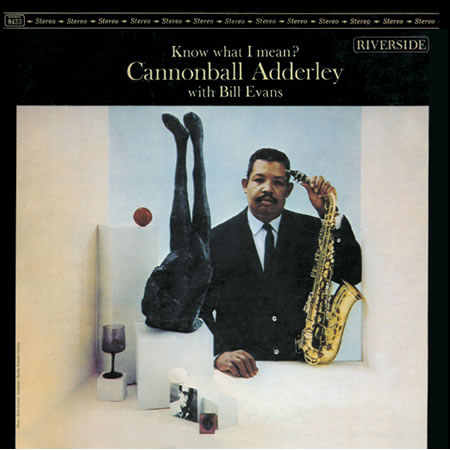
Cannonball Adderley and Bill Evans had already worked together with Miles Davis when they entered the studio for Know What I Mean? in 1961. Two years after Kind of Blue, they meet here in a smaller setting. Adderley’s alto saxophone takes the lead, while Evans contributes both piano and arrangements. Percy Heath on bass and Connie Kay on drums, both members of the Modern Jazz Quartet, complete the group. Four distinct musical personalities share a repertoire that leaves room for careful adjustments.
The recordings took place over three dates between January and March 1961 at Bell Sound Studios in New York. Orrin Keepnews produced, with Bill Stoddard engineering. Adderley leads the album, although the selection clearly reflects Evans’ interests as well. Even the title suggests personal familiarity: “Know what I mean?” was one of Adderley’s conversational expressions. Applied to Evans’ title composition and then to the record, the question suits music built around the musicians’ ability to understand and respond to one another.

Another voice for “Waltz for Debby”
Evans’ “Waltz for Debby” opens the album. Anyone familiar with the celebrated trio performance can follow how the melody changes when carried by a wind instrument. The saxophone sustains and shapes notes differently from the piano, allowing Evans to establish other relationships between the tune and its underlying chords. This quartet version was recorded in the same year as the famous Village Vanguard performances. It offers an independent view of the composition, with the additional voice changing the accompanists’ roles too.
A second connection comes through Earl Zindars’ “Elsa”, which Evans also recorded for Explorations in 1961. Here it appears alongside Gordon Jenkins’ “Goodbye”, the Gershwins’ “Who Cares?” and Clifford Jordan’s “Toy”. John Lewis’ concise “Venice” adds another compositional perspective. The eight selections do not amount to a succession of interchangeable ballads. They move through different moods and kinds of motion, while the consistent lineup maintains a sense of continuity across the changes in the material.

Four voices leaving room
Heath and Kay provide more than discreet support for the two prominent names on the cover. Listen to the bass maintaining direction and the drums preparing an entrance or completing a phrase. Their Modern Jazz Quartet background establishes an important connection, but this record places them in a different musical conversation. The quieter passages make it particularly clear how little an attentive player sometimes needs to do to keep that conversation moving without forcing it toward a predetermined result.
Adderley’s melodic approach and Evans’ harmonic attention offer two distinct routes through the performances. Follow the saxophone first, then return to the chords beneath it. “Nancy (With the Laughing Face)” invites this kind of listening as readily as the closing title track. The players’ familiarity becomes something concrete: they do not need to say the same thing. An idea can be offered by one musician, recognized by another and carried forward, with each contribution remaining identifiable inside the collective performance.
This edition
Analogue Productions presents Know What I Mean? in its Fantasy Series as a stereo double LP on 180-gram vinyl at 45 RPM. Kevin Gray and Steve Hoffman handled mastering at AcousTech Mastering. The publisher describes the chain as AAA from the original master tapes and names RTI as the pressing plant. Catalog number AJAZ 9433 contains the original album’s eight selections. The title also forms part of Analogue Productions’ Bill Evans Riverside releases.
Artist page: All titles with Bill Evans
Customer question: Buying Analogue Productions records in Europe
Musicians
Documented selection of participating musicians. Personnel may vary by track; this list does not claim to be complete.
| Name | Instrument / role |
|---|---|
| Cannonball Adderley | Alto saxophone |
| Bill Evans | Piano |
| Percy Heath | Bass |
| Connie Kay | Drums |
🎧 Review video: 15 Amazing New Reissues you might want in your Collection
This video is hosted by YouTube (Google). It only loads once you switch on “Functional” in the cookie settings.

Reviews
There are no reviews yet.