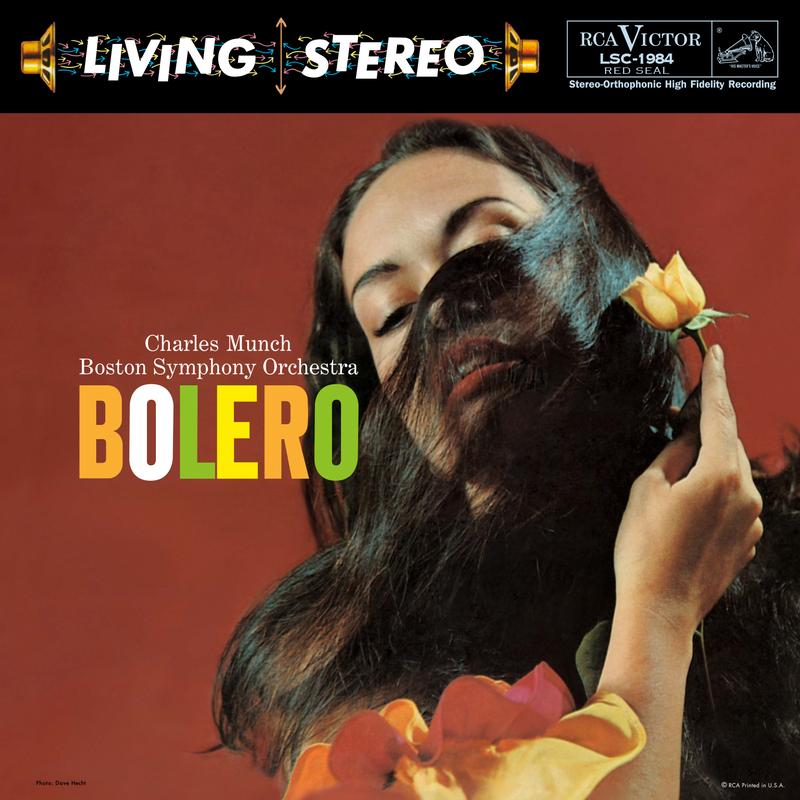

Four works behind the title “Boléro”
The short album title names Ravel and his Boléro, but the programme extends further. Charles Munch and the Boston Symphony Orchestra also perform La Valse and the Rapsodie espagnole. Claude Debussy’s Prélude à l’après-midi d’un faune follows on the fourth side. Three Ravel works and one by Debussy provide four different conceptions of what an orchestra can express.
The historical LP appeared in 1958. For this reissue, each of the four works receives a side of its own. That makes the arrangement easy to navigate: dance, Spanish associations and a poem by Stéphane Mallarmé occupy successive parts of the programme. Boléro provides the opening, but it is only one part of the album.

Repetition as a structural idea
Ravel wrote Boléro in 1928 for Ida Rubinstein. The initial proposal had been different: an orchestration of music from Albéniz’s Iberia. Instead, he created a new work built around repetition and the gradual enlargement of the orchestral forces. It was premiered at the Paris Opéra in November 1928.
The design allows you to concentrate on something other than the arrival of new themes. Which instruments take over the melody, which groups enter, and how does the balance of the ensemble change? La Valse provides another model of musical movement. Written in 1919–20 and described as a choreographic poem, it takes the waltz as its starting point. Ravel resisted attempts to treat it simply as a political commentary on contemporary Vienna; the dance itself remains a more concrete reference for approaching the score.

Ravel beside Debussy
The Rapsodie espagnole contains four parts. One of them, the “Habanera,” predates the orchestral collection: Ravel originally wrote it for two pianos in 1895, adding the surrounding pieces later. The album therefore presents not only different compositions but different routes by which keyboard ideas and dance forms could become orchestral music.
Debussy’s Prélude turns, on the final side, towards Mallarmé’s poem about a faun’s afternoon. Premiered in 1894, the work opens with a flute solo. After the three Ravel works, it offers a useful moment to redirect your attention towards individual instrumental entries and the way a phrase is passed on. Munch, music director in Boston from 1949 to 1962, conducts the same orchestra in all four works. The coupling lets you follow changing compositional ideas within a shared performing partnership.
One work on each side
AAPC 1984-45 comprises two 180-gram stereo LPs playing at 45 RPM, pressed at Quality Record Pressings, with an accompanying insert. Acoustic Sounds identifies the original master tapes as the source. The running order is Boléro — La Valse — Rapsodie espagnole — Debussy’s Prélude, keeping each work together on a single side. These details belong to the two-LP edition rather than earlier single records or other versions of the coupling. The Debussy work is explicitly part of the included programme.
Michael 45 stores the set in Germany and dispatches it from Hilden, removing the need for a personal US import and its customs wait.
More from the series: RCA Living Stereo Series
More by Charles Munch: Ravel: Daphnis And Chloe · Saint-Saens: Symphony No. 3 – A Stereo Spectacular
Customer question: Buying Analogue Productions records in Europe
Series: RCA Living Stereo – all 25 titles, conductors and soloists
Musicians
Documented selection of participating musicians. Personnel may vary by track; this list does not claim to be complete.
| Name | Instrument / role |
|---|---|
| Charles Munch | Conductor |
| Boston Symphony Orchestra | Orchestra |

Reviews
There are no reviews yet.