
Two stories about appearances and reality
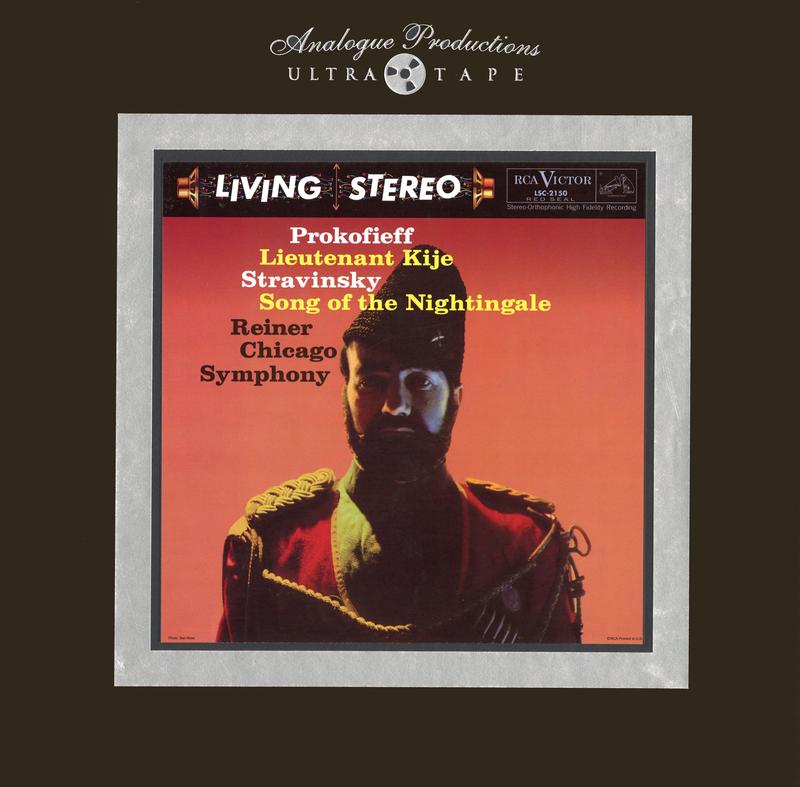
An officer who does not exist and a nightingale whose living song competes with a mechanical substitute: this coupling brings together two unusual narratives. Sergei Prokofiev's Lieutenant Kijé and Igor Stravinsky's Song of the Nightingale do not require a stage to introduce their characters. Both rely on clearly differentiated gestures and instrumental colours. Under Fritz Reiner, the Chicago Symphony Orchestra becomes a storyteller concerned not only with large events, but also with the small and sometimes unsettling details through which those events acquire their meaning.
The recordings were made on separate dates at Orchestra Hall in Chicago: Stravinsky's symphonic poem on November 3, 1956, and Prokofiev's suite on March 2, 1957. RCA released the coupling in 1958. Richard Mohr produced the sessions, with Lewis Layton responsible for recording engineering. The shared album therefore brings together two recording occasions as well as two composers. Reiner's orchestral direction provides the connection, negotiating between the definition of an individual instrumental line and the rapid transformations of the ensemble around it.

Lieutenant Kijé's extraordinary career
Prokofiev's suite grew out of film music written in 1934. In the story, a clerical error creates an imaginary lieutenant. Because nobody dares admit the mistake to the tsar, the administration has to invent an entire life for him. The suite's five movements trace this absurd career through birth, romance, marriage, a sleigh ride and burial. The orchestra can sound ceremonial while exposing the questionable basis of the ceremony itself. Its central character acquires a musical presence despite never having existed as a person.
The distinctive instrumentation includes tenor saxophone and cornet, while the “Troika” adds gestures associated with a sleigh ride. Not every solo player on this recording has been securely identified, however. A precise account of the score should therefore be distinguished from a fully established personnel list. You can follow the changing instrumental colours without assigning uncertain names to them. Individual themes have also travelled well beyond the concert hall: the “Romance” entered Sting's “Russians”, while the “Troika” provided material for Greg Lake's “I Believe in Father Christmas”.

A nightingale becomes an orchestral voice
Stravinsky assembled Song of the Nightingale in 1917 from parts of his opera Le Rossignol. The symphonic poem is not simply the complete opera with its singers removed, but a new form created from selected material. Behind it lies Andersen's tale of the Chinese emperor, the real bird and an artificial nightingale. The contrast between living expression and mechanical repetition establishes a different narrative world from Prokofiev's satire of bureaucracy. Yet the two works belong together: both use music to examine something whose apparent authenticity becomes questionable on closer inspection.
It can be rewarding to resist assigning every passage immediately to a character. Begin instead with changes in movement, colour and density. What happens when a single line emerges from a larger group? Which gestures seem recurrent, and which sound like interruptions? These observations make the piece approachable without requiring detailed knowledge of the entire plot. The tape presents Stravinsky's work as a continuous symphonic poem. Subdivisions familiar from a CD edition should consequently not be mistaken for additional separate tracks on this release.
Reiner's programme on tape
Catalogue number RRAP 0010 identifies this Analogue Productions Ultra Tape. It uses quarter-inch tape at 15 ips, with two-track or half-track recording and IEC equalisation. The two works are distributed across two reels. A suitable playback machine must support the track configuration, speed and equalisation. The original sessions were recorded on three tracks, whereas this consumer edition is a two-track stereo product. That distinction alone does not establish whether a particular historical stereo mix or a subsequently prepared one was used for the release.
The publisher describes real-time duplication on an ATR-modified Ampex machine, using a copy of the original analogue master tape. A separate mastering credit and the complete sequence of tape generations are not clearly specified for this edition. Its musical identity is much more firmly defined: two narrative orchestral works recorded by Reiner's Chicago ensemble in 1956 and 1957. Between an invented military biography and a fairy-tale bird, the programme repeatedly places accuracy, wit and small differences of expression alongside the orchestra's capacity for power.
You order from Michael 45 in Germany. We arrange the US import and dispatch from Hilden. Editions not currently in stock are dispatched after the goods arrive.
Also on SACD: Prokofiev: Lieutenant Kije / Stravinsky: Song of the Nightingale
More by Fritz Reiner: Respighi: Pines Of Rome & Fountains Of Rome · Rimsky-Korsakoff: Scheherazade
Artist page: All titles by Fritz Reiner
Customer question: Buying Analogue Productions records in Europe
Musicians
Documented participants in this recording. Publisher-only credits are identified; track references correspond to the tracklist.
| Name | Instrument / role | Participation |
|---|---|---|
| Fritz Reiner | conductor | Album personnel |
| Chicago Symphony Orchestra | orchestra | Album personnel |
| Adolph Herseth | principal trumpet | A1, A2, A3, A4, A5, B1 |
Cornet, tenor saxophone and violin soloists are not securely identified.

Reviews
There are no reviews yet.