
A trio after hours
In March 1957, Sonny Rollins, Ray Brown and Shelly Manne came together in Los Angeles for an unusually late recording session. Work began around three in the morning, after the musicians had completed other commitments. Lester Koenig produced and Roy DuNann recorded the date. Sources differ over the exact calendar day, while the month and circumstances are clear. The meeting became Way Out West, an album with a lineup as memorable as its title: tenor saxophone, double bass and drums.
There is no piano or guitar in this trio. More space opens between the voices, but harmonic movement does not disappear. Brown can establish it through bass lines and Rollins through melodic choices, while Manne shapes pulse, transitions and responses. The three musicians must make the unfolding form intelligible using their individual resources. That distribution of responsibilities offers a productive starting point for listening. The question concerns the concrete organization of melody, harmony and time within a small group, rather than an abstract notion of freedom.

Western songs in another setting
Rollins brought “I’m An Old Cowhand” and “Wagon Wheels,” material associated with the American West and its popular imagery. His enthusiasm for Western films forms part of the background to the choice. Here those songs meet three jazz musicians who can treat recognizable themes as flexible material. A familiar melody makes it possible to follow a soloist’s handling of expectation. Sometimes a fragment is enough to keep the theme present while an improvised line is already heading in another direction.
The Western idea is only one part of the program. Duke Ellington’s “Solitude” and “There Is No Greater Love” offer other points of reference. Rollins adds his own “Come, Gone” and “Way Out West.” The album thus combines several kinds of material: popular songs with geographical associations, established standards and original compositions. The shared lineup provides continuity. Reading the titles only as a concept can obscure how different their melodic starting points are, and how those differences generate distinct forms of interaction among the players.

Three simultaneous perspectives
One approach is to follow each musician for an extended stretch. With Rollins, the focus can be the development of a line: which small figure does he retain, transform or repeat? With Brown, it is possible to trace how bass movement provides orientation while becoming melodic in its own right. Manne can clarify transitions, answer an accent or carry movement forward. Without a continuously chordal accompanist, these relationships can be easier to identify as separate voices. That does not guarantee a particular result on every playback system, but it gives a specific focus for listening.
The original album contains six pieces. “I’m An Old Cowhand,” “Solitude” and “Come, Gone” form the first side; “Wagon Wheels,” “There Is No Greater Love” and “Way Out West” make up the second. Familiar songs and original material alternate through the sequence. The overnight session supplies the historical setting, but the music does not require a legend of exhaustion or spontaneous magic to sustain interest. Three experienced musicians meet in a clearly defined ensemble and use the tunes as common ground. That is enough to revisit the record from a different perspective each time.
The Contemporary Series stereo LP
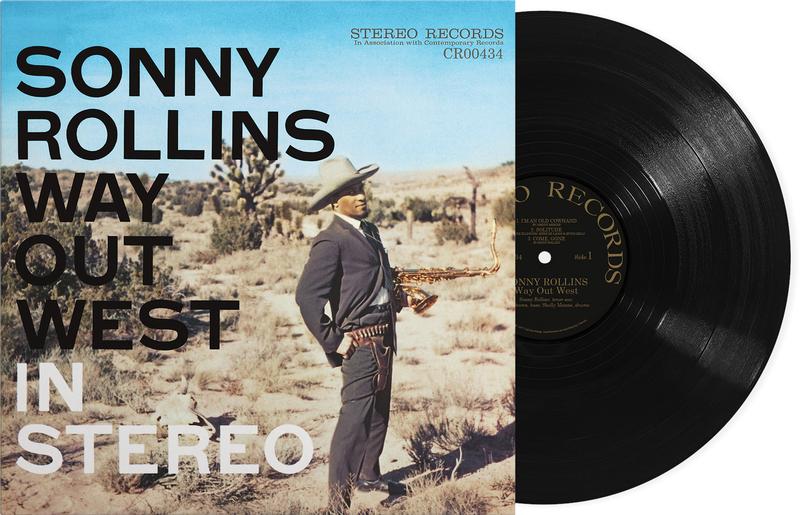
This edition belongs to the Contemporary Records Acoustic Sounds Series from Craft Recordings and Acoustic Sounds. The stereo album is presented on one 180-gram LP at 33⅓ RPM. Bernie Grundman handled the cutting; Craft identifies the original tapes and describes the production as AAA. It should be distinguished from other versions, particularly 45-RPM double albums and UHQR releases. The product number is ACONC 599, and the contents are the six original tracks.
There is a documented pressing variation: early copies associated with this release carry CR00434 and an RTI attribution, while later CR00599 copies are associated with QRP. A specific pressing plant therefore cannot be promised without checking the individual copy. Packaging includes a Stoughton tip-on jacket. The musical reference remains clear: Way Out West in its original stereo album sequence on one LP. Keeping the manufacturing variant separate from the recording history leaves the central relationship where it belongs, with Rollins, Brown and Manne working as a trio.
You order from Michael 45 in Germany. We arrange the US import and dispatch from Hilden.
Also on 45 RPM vinyl: Way Out West
More by Sonny Rollins: Rollins Plays For Bird · Saxophone Colossus
Artist page: All titles by Sonny Rollins
Musicians
Participants and documented credit status. Track references correspond to the tracklist.
- Sonny Rollinstenor saxophoneParticipation: Album personnel
- Ray Browndouble bassParticipation: Album personnel
- Shelly MannedrumsParticipation: Album personnel


Trio without piano or guitar. March 1957 is established; the precise session date is disputed.

Reviews
There are no reviews yet.