

A meeting before the landmark sessions of 1959
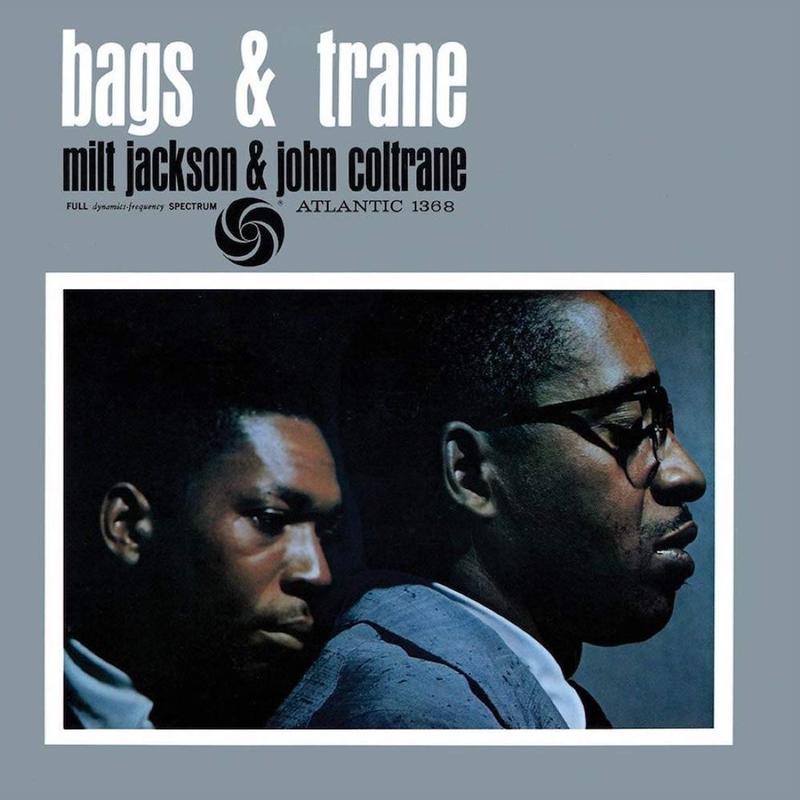
On January 15, 1959, Milt Jackson and John Coltrane met at Atlantic Studios in New York. Jackson led the date, joined by Hank Jones on piano, Paul Chambers on bass and Connie Kay on drums. Nesuhi Ertegun produced and Tom Dowd engineered. The date precedes the Kind Of Blue sessions and the central recordings for Giant Steps. It places Coltrane in a setting different from his later Atlantic albums as a leader: alongside a vibraphonist whose melodic language was deeply connected with blues and bebop.
Bags & Trane was not released until July 1961. Its title joins the familiar names of the two featured players, but the music had been recorded on a single day more than two years earlier. That chronology helps avoid treating the album as a direct statement about Coltrane’s musical position in 1961. Here two musicians with individual histories meet within a particular quintet. Jackson and Kay had worked together in the Modern Jazz Quartet, while Chambers and Coltrane knew one another through Miles Davis. Existing musical relationships therefore intersect within the group.

Vibraphone and tenor saxophone in conversation
Vibraphone and tenor saxophone set notes in motion differently. A vibraphone note begins with an attack and then decays; a saxophonist can shape and sustain a note as it continues. These possibilities make the pairing interesting without imposing fixed roles. Jackson can compress a line, while Coltrane extends or thickens one; a saxophone phrase can equally invite a short vibraphone response. Giving the transitions between soloists as much attention as the solos themselves is one way to follow the exchange.
Hank Jones, Paul Chambers and Connie Kay provide a complete rhythm section. Piano adds another harmonic voice alongside the vibraphone, bass guides movement through the form, and drums organize the temporal connection. Because several instruments can offer chords or harmonically explicit lines, the allocation of space becomes an important question. Who accompanies, answers or temporarily steps aside is part of the arrangement as it unfolds. These five names identify the session group throughout the album; later compilations containing additional tracks do not change that original recording context.

Five pieces between blues and bebop
The original album opens with Jackson’s “Bags & Trane” and closes with his “The Late Late Blues.” Between them are “Three Little Words,” “The Night We Called It A Day” and Dizzy Gillespie’s “Be-Bop.” Two Jackson compositions form the outer frame, while the middle selections place different demands on melody, timing and agility. A familiar song and a bebop composition offer distinct starting points for improvisation. The interest lies in following the same five musicians as those conditions change from piece to piece.
The session produced eight tracks in total, but this edition follows the original LP selection. “Stairway To The Stars,” “Blues Legacy” and “Centerpiece” are not included. They appeared later in other releases and can be found in expanded digital or CD programs. When comparing tracklists or running times, the scope of each release therefore matters. The five pieces on Bags & Trane form a deliberately bounded album sequence. On this 45-RPM edition, “Be-Bop” occupies one side, as does the closing blues; “Three Little Words” and “The Night We Called It A Day” share the second side.
The Atlantic 75 Series edition
Analogue Productions presents the stereo album on two 180-gram LPs playing at 45 RPM. Ryan K. Smith at Sterling Sound handled mastering, with the publisher identifying the original master tape as the source. The records come in a Stoughton gatefold jacket. QRP is specified within the series, with RTI also used for later copies. The product number for this edition is AAPA 063-45. Its format and five-track contents distinguish it from expanded releases of the session material.
The focus remains the original five-piece program, without the three subsequently added recordings. It offers a contained approach to a meeting in which blues, song interpretation and bebop develop from the same personnel. Both dates belong to the record’s history: January 1959 for the session and summer 1961 for the release. Keeping that interval in mind makes the music easier to place. Jackson and Coltrane meet on common material, accompanied by three players whose experience connects different parts of their working worlds. The title names the featured soloists; the recording tells the story of a quintet.
You order from Michael 45 in Germany. We arrange the US import and dispatch from Hilden. Editions not currently in stock are dispatched after the goods arrive.
More from the series: Atlantic 75 Series
Also on SACD: Bags & Trane
Artist page: All titles by John Coltrane
Customer questions: Atlantic 75: which titles are worth buying? · Buying Analogue Productions records in Europe
Series: Atlantic 75 Series – all 75 albums, time journey and the people behind Atlantic
Musicians
Participants and documented credit status. Track references correspond to the tracklist.
- Milt JacksonvibraphoneParticipation: Album personnel
- John Coltranetenor saxophoneParticipation: Album personnel
- Hank JonespianoParticipation: Album personnel
- Paul Chambersdouble bassParticipation: Album personnel
- Connie KaydrumsParticipation: Album personnel


The same quintet on the five original tracks. The three additional session pieces are not included.
🎧 Review video: 20 Albums to start an Audiophile Jazz Collection
This video is hosted by YouTube (Google). It only loads once you switch on “Functional” in the cookie settings.

Reviews
There are no reviews yet.