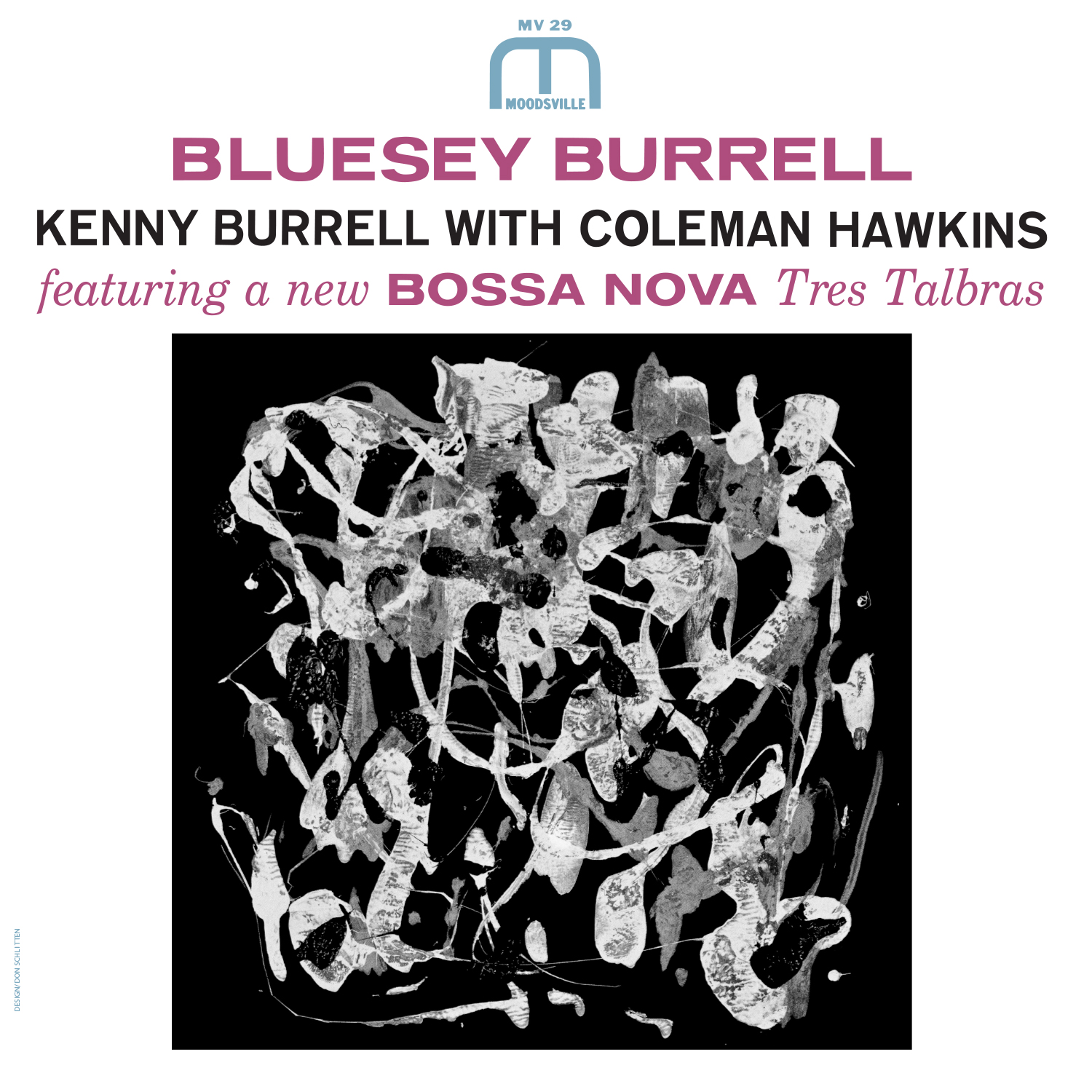

Kenny Burrell and an album of changing distances
Six musicians appear in the personnel for Bluesey Burrell, but this is more than a straightforward sextet date. Kenny Burrell plays alone on one selection, with just bass and drums on another, and elsewhere with piano and additional voices. The size of the ensemble changes repeatedly across seven pieces. That is central to the record’s appeal: the guitar remains its focus while the surrounding space shifts. A short solo performance can acquire a character of its own between larger ensembles without requiring the programme to abandon its underlying mood.
The session took place on September 14, 1962, at Van Gelder Studio in Englewood Cliffs, New Jersey. Rudy Van Gelder engineered the recording, with Ozzie Cadena supervising the production. The original album followed in January 1963 on Moodsville, Prestige’s subsidiary, as MVLP 29 or MVST 29. The publisher places it within the tradition of the label’s ballad programmes. The word “mood” is useful here: atmosphere can be established through the changing number of participants in a musical conversation as much as through the choice of tempo or repertoire.
Alongside Burrell are Coleman Hawkins on tenor saxophone, Tommy Flanagan on piano, Major Holley on double bass, Eddie Locke on drums and Ray Barretto on conga. Those names belong to the album without all appearing on every track. Knowing the distinctions makes the sequence easier to follow. No More presents the guitar alone; Guilty uses the trio of guitar, bass and drums. The remaining pieces open out into two different quintet configurations and the complete sextet. Changes in personnel are therefore part of the programme’s musical design.

Coleman Hawkins and Burrell’s Detroit connection
Coleman Hawkins brings another generation of jazz into the session. His tenor saxophone is one of the defining voices in the instrument’s history; here it meets a guitarist with an established musical language of his own. Familiar colleagues help connect the two. According to the publisher, Hawkins’ rhythm section at the time consisted of musicians from Burrell’s home city of Detroit. Flanagan, Holley and Locke are consequently more than an interchangeable accompaniment. Barretto joins that circle, giving selected pieces a different rhythmic colour through his conga playing.
Hawkins appears on Tres Palabras, Montono Blues, I Thought About You and It’s Getting Dark. These precise assignments prevent the expectation of a saxophone where Burrell is working without one. The album’s idea can already be understood through its changing line-ups: on I Thought About You, Hawkins belongs to a quintet without Barretto. Out of This World offers another quintet, with Barretto but without Hawkins. The same number of players does not create the same instrumental colour. A horn and a conga contribute in fundamentally different ways.
All six musicians come together on three selections: Tres Palabras, Montono Blues and It’s Getting Dark. The guitar can contribute single lines as well as chords, while piano, bass and drums retain their own roles. It is rewarding to turn attention occasionally away from the featured soloist and towards the exchanges between voices. Where is space left, when does another instrument answer, and how does Barretto change the rhythmic surface? These questions lead directly into the identity of this particular group, beyond the broad description of a relaxed jazz album.

From the solo No More to the full sextet
Osvaldo Farrés’ Tres Palabras opens side one. The frame then becomes much smaller with No More, by Bob Russell and Tutti Camarata. Burrell plays alone, and at under two minutes it is the programme’s briefest selection. Bass and drums join him for Guilty, written by Harry Akst, Gus Kahn and Richard A. Whiting. Within the first three tracks, the album moves from sextet to solo and then to trio. That ordering makes the guitar’s changing possibilities particularly tangible, with the same lead voice placed in distinctly different surroundings.
Montono Blues, one of Burrell’s own compositions, closes the first side with the complete ensemble. The label also documents the spelling Montuno Blues; the form used here follows the cover and offered edition. Side B opens with I Thought About You, by Jimmy Van Heusen and Johnny Mercer. It is followed by Out of This World, the song by Harold Arlen and Johnny Mercer. Mercer thus appears as lyricist on two consecutive standards whose melodies came from different composers. Their shared background in song remains a point of connection in these instrumental performances, while the exchange of Hawkins for Barretto changes the ensemble itself.
It’s Getting Dark closes the album with another Burrell composition and a return to the sextet. Standards and original pieces are interwoven throughout. There are several routes into the programme: Hawkins’ tenor, Burrell’s guitar, the repertoire or the rhythmic changes with and without conga. The same recording was reissued in 1968 under the title Out of This World. For collectors, that later title provides a useful connection within the catalogue; it does not turn these seven selections into a different session. Their source remains the encounter of September 1962.
The Analogue Productions Prestige stereo edition
This reissue is APRJ 29, a single stereo LP playing at 33⅓ RPM from Analogue Productions. Kevin Gray handled mastering at Cohearent Audio, with the publisher identifying the original analogue master tapes as the source. The record was pressed at Quality Record Pressings and comes in a tip-on jacket on substantial board. Van Gelder’s recording and Gray’s later mastering are distinct stages in the same release history. Assigning them precisely says more than making a general promise about the sound of every reissue.
At 33⅓ RPM, the album retains two sides containing four and three pieces respectively. That arrangement has a musical logic here. The first side allows the ensemble to contract and expand several times; the second connects the two quintet configurations with the concluding sextet. There is no need to turn the record between each of these changes. The sequence can retain its proportions over a longer span. This is a practical attraction of the single-LP format, without using playback speed to establish a hierarchy over other editions.
Different weights are documented under this catalogue number: an earlier 200-gram release and the publisher’s current 180-gram specification. A particular weight or numbered copy is therefore not promised for every individual shop copy. The personnel overview also distinguishes directly documented track assignments from those derived through the session line-up and the descriptions of the solo and trio performances. That keeps the account of the recording as carefully defined as the description of the edition. You order from Michael 45 in Germany. We arrange the US import and dispatch from Hilden.
More by Kenny Burrell: Guitar Forms · “Kenny Burrell”
Customer question: Buying Analogue Productions records in Europe
Series: Analogue Productions Prestige – all 50 records, musicians and session paths
Musicians
Participants and documented credit status. Track references correspond to the tracklist.
- Kenny BurrellguitarParticipation: All 7
- Coleman Hawkinstenor saxophoneParticipation: A1, A4, B1, B3
- Ray BarrettocongaParticipation: A1, A4, B2, B3
- Tommy FlanaganpianoParticipation: A1, A4, B1, B2, B3
- Major Holleydouble bassParticipation: A1, A3, A4, B1, B2, B3
- Eddie LockedrumsParticipation: A1, A3, A4, B1, B2, B3


Hawkins and Barretto have documented track assignments. Assignments for Flanagan, Holley and Locke are derived from the session personnel and publisher’s description (solo on A2, trio on A3), not separately documented individual track credits.

Hifi 1965 –
Hallo, im Grunde eine Anti – Highend LP, da es keine aufgesetzten Effekte gibt. Alles hört sich mühelos, natürlich, ausgewogen und vor allem souverän an!
Ein größeres Kompliment fällt mir, auch nach längeren Nachdenken nicht ein.
Auch und gerade für diejenigen, die dieses Hobby schon lange pflegen (weit über 35 Jahre in meinen Fall) eine echte Empfehlung!