
Two people, fourteen different kinds of tension
Elephant opens with a riff that has acquired a life far beyond its parent album. Yet “Seven Nation Army” is only the doorway. Behind it are fourteen tracks in which Jack and Meg White repeatedly change the possibilities of their small group. Guitar, drums, voice and occasional piano do not have to perform the same functions throughout. The record can become dense and then strip almost everything away. These changes prevent the restriction to two central musicians from turning into a single formula repeated across an entire programme.
Released in 2003, the album was recorded predominantly at Toe Rag Studios in London, where Liam Watson worked with Jack White on recording and mixing. The programme also includes “I Just Don’t Know What to Do with Myself”, recorded at the BBC’s Maida Vale studios with Miti Adhikari. The convenient image of an album made entirely in one place is therefore incomplete. Different recording situations were assembled into a sequence whose coherence comes from musical decisions rather than an absolutely uniform studio history. The distinction matters when discussing an album so frequently surrounded by production mythology.
The London sessions took place in November 2001 and April and May 2002. Jack White is the album’s producer. The path from those recordings to release combines the immediacy of a small group with deliberate choices about sequence and contrast. Between the concise opening and the longer forms, there is room for different voices and textures. The White Stripes’ fourth studio album can consequently be approached both as a collection of individual songs and as a connected programme.

Analogue recording without the equipment legend
The Toe Rag sessions are central to Elephant‘s identity. They also generated the often-repeated claim that every piece of equipment used dated from before 1963. That absolute formulation is not reliable; Watson has disputed it. The actual working question is more interesting than such a label: how can a small band be recorded while preserving different degrees of intimacy, motion and density? The album supplies musical examples without requiring every item of equipment to serve as a historical symbol or proof of authenticity.
Another frequently misunderstood detail concerns “Seven Nation Army”. Its low riff is not an additional bass guitar but a pitch-shifted guitar. A change of instrumental colour does not necessarily mean that another player has joined the group. With the White Stripes, it is useful to separate an instrument from the function it seems to perform. A guitar figure can supply the foundation; a pause can increase the significance of a drum accent. Following these relationships reveals movement even where the individual elements seem especially simple. Reduction demands decisions rather than making them unnecessary.
An eight-track tape machine was used at Toe Rag. A limited track count requires arrangement, recording and eventual mixing to be considered in relation to one another. This is a specific working framework rather than an automatic guarantee of quality. In listening, it is more productive to follow the allocation of space within a song: when do the drums carry a steady pulse, when does the guitar answer, and where does the voice lead? The recording history provides background for those questions without reducing the musical result to its technology.

Meg’s voice and the spaces between riffs
“In the Cold, Cold Night” brings Meg White forward as a singer. “You’ve Got Her in Your Pocket” is a Jack White solo performance, while “Ball and Biscuit” opens a more extended blues setting. These distinctions are as important to the album as its celebrated riffs. Remembering only the opening can obscure how often Elephant changes its dimensions. The tracks are not all constructed alike, nor do they all share identical personnel. Album-level credits should consequently not be treated as a blanket claim that both musicians play the same instruments on every selection.
Holly Golightly joins the closing “It’s True That We Love One Another”. “Little Acorns” also features Mort Crim’s recorded speaking voice, which does not make him another musician attending the same studio session. Such details give the fourteen-track programme a more precise identity. This UHQR edition follows the regular album sequence, without regional bonus tracks. It moves from its widely recognised opening towards a conclusion that introduces another kind of exchange. There is a substantial album between those points, and much to discover beyond the melody that has become its public shorthand.
The piano colours belong to this shifting perspective too. Jack White is credited at album level with vocals, guitar and piano; that does not mean every instrument appears on every song. Meg’s credits are drums and vocals. In the Cold, Cold Night and the shared singing at the end make her role beyond rhythm visible. Holly Golightly’s guest appearance changes the conversational setting of the closing song again. A small core ensemble is a starting point, rather than a rule requiring every track to take the same shape.
Four sides of Elephant: the UHQR edition
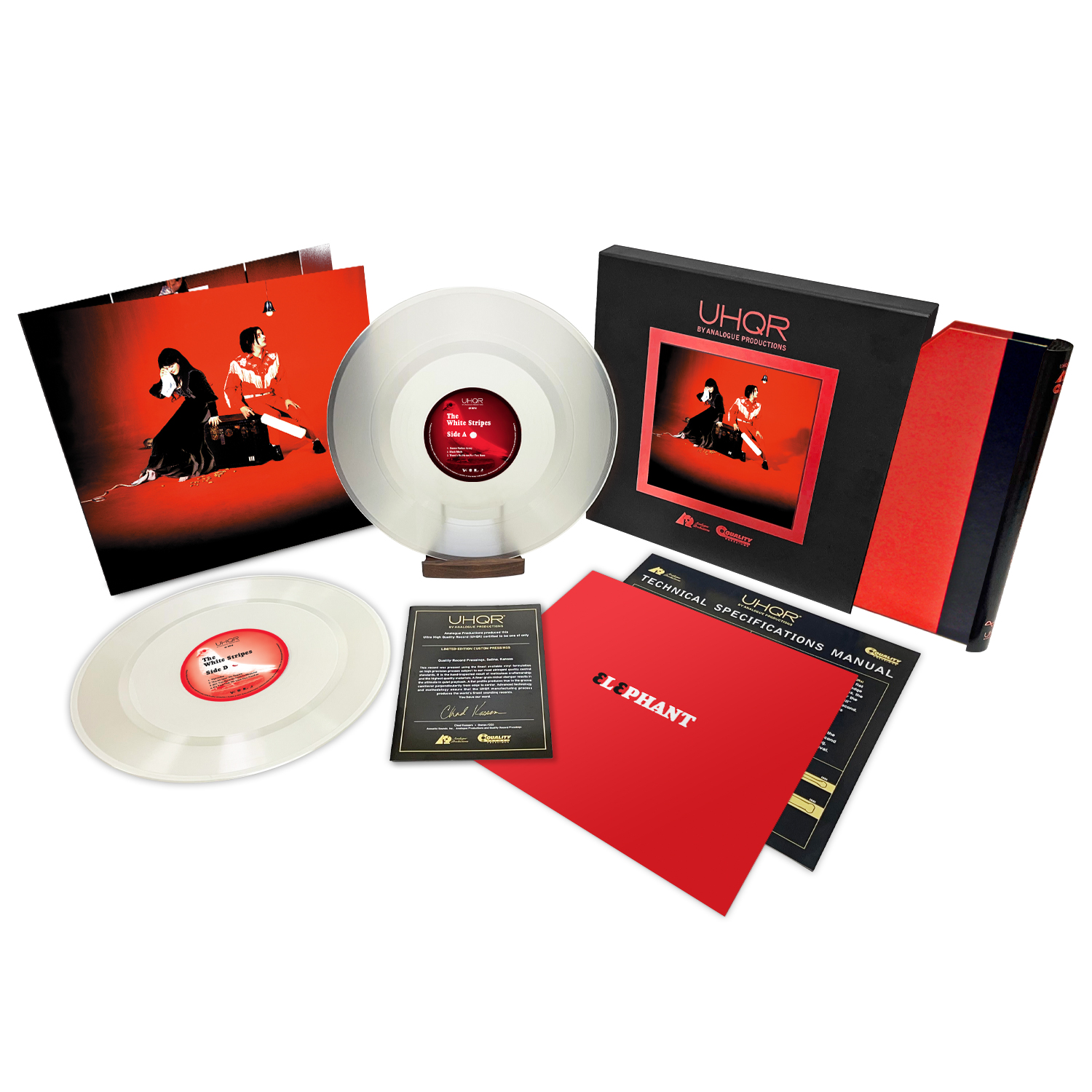
The edition offered is AUHQR 0019-45 from Analogue Productions: two 200-gram stereo LPs playing at 45 RPM, manufactured at Quality Record Pressings. Ryan K. Smith at Sterling Sound in Nashville is responsible for mastering. The publisher identifies the original analogue master tapes as the source. These specifications belong to the UHQR release and should be distinguished from the separately available Ultra Tape edition. The tape’s transfer credit does not describe the preparation of these records.
The records use Clarity Vinyl, a formulation without the usual black carbon pigmentation. The series combines this with its own UHQR manufacturing and presentation. Colour, weight and playback speed alone cannot establish a universal judgement of sound quality. In practical terms, the album occupies four sides: A runs from Seven Nation Army to There’s No Home for You Here, and B from I Just Don’t Know What to Do with Myself to You’ve Got Her in Your Pocket. C contains Ball and Biscuit, The Hardest Button to Button and Little Acorns. D proceeds from Hypnotize to the shared closing song.
At an equivalent groove position, the higher rotational speed provides greater linear velocity than 33⅓ RPM. Together with the distribution across four sides, this changes the conditions available for cutting; it also means more side changes during playback. Knowing that division is useful for an album with such varied shapes and degrees of tension. Ball and Biscuit opens a side of its own, while the restrained solo performance You’ve Got Her in Your Pocket closes the preceding one. The regular sequence is retained, with interruptions determined by the physical edition.
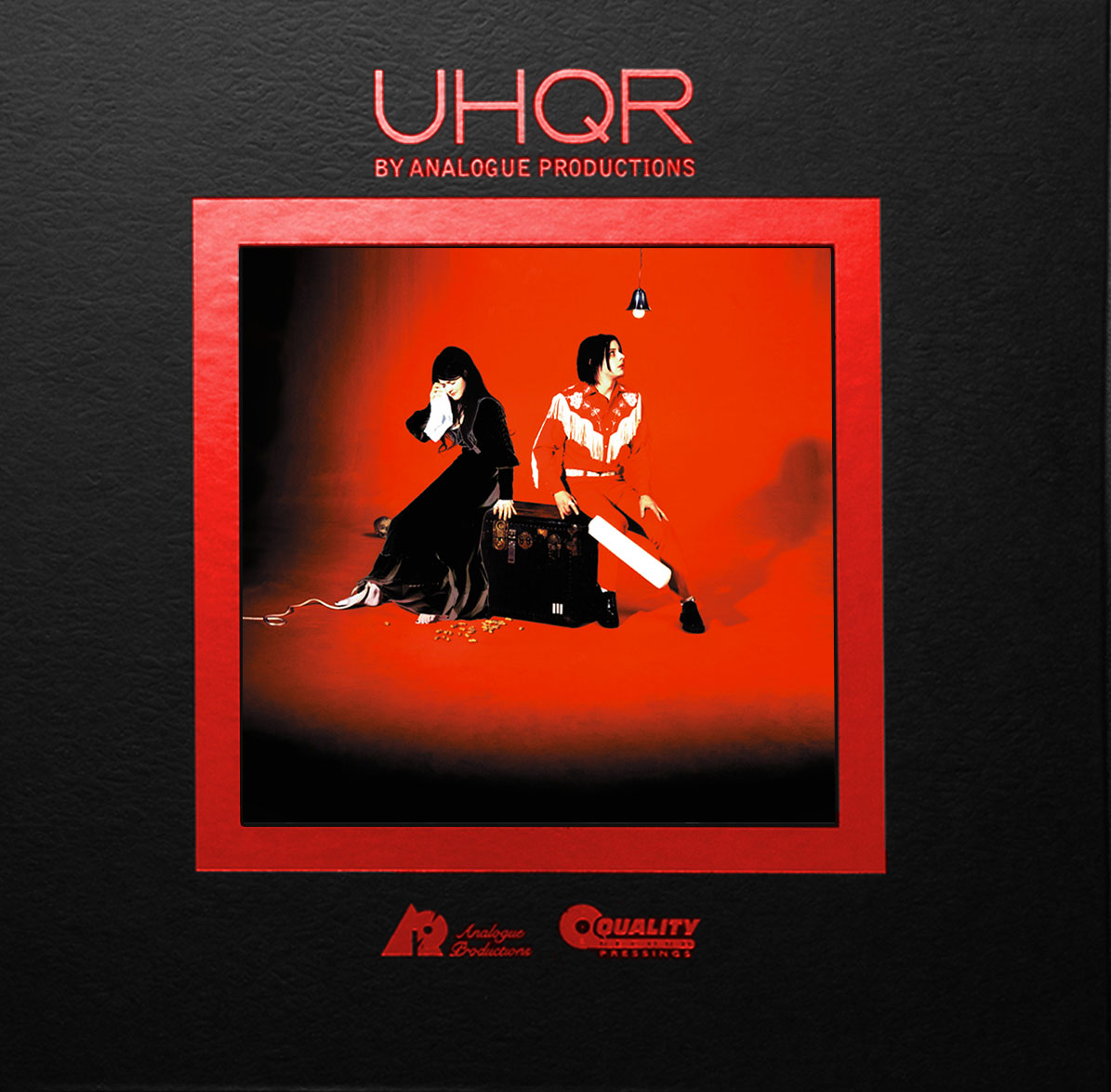
The release is limited to 10,000 numbered copies and presented in a substantial slipcase with the wooden spine element described for this edition. A twelve-page booklet includes notes by Ben Blackwell and photographs by David Swanson. The limitation identifies the edition; it is not a statement of the number currently remaining. The release can therefore be placed accurately in a collection: fourteen regular album selections, four record sides and specifically documented mastering. You order from Michael 45 in Germany. We arrange the US import and dispatch from Hilden.
Also on SACD: Elephant
Customer question: Collecting UHQR records: limited editions of great albums
Series: UHQR – all 31 editions with pressing run and mastering
Musicians
Participants and documented credit status. Track references correspond to the tracklist.
- Jack Whitevocals, guitar, pianoParticipation: Album credit; not every instrument on every track
- Meg Whitedrums, vocalsParticipation: Album credit; B4 is Jack White solo. Lead vocals: B2; vocals also D4.
- Holly Golightlyguest vocalsParticipation: D4
- Mort Crimrecorded spoken introductionParticipation: C3


Track numbers and side references correspond to this edition. Album credits do not mean every instrument appears on every track.
How Michael hears this edition
Listening impression · paraphrased from the video
Michael prefers the UHQR to the compared UK stereo pressings and the tenth-anniversary edition. He hears more punch, dynamics and bass, plus a larger soundstage where small details are easy to follow. He explicitly excludes the mono edition from this ranking.
🎧 Review video: White Stripes Elephant UHQR First Impression!
This video is hosted by YouTube (Google). It only loads once you switch on “Functional” in the cookie settings.

Reviews
There are no reviews yet.