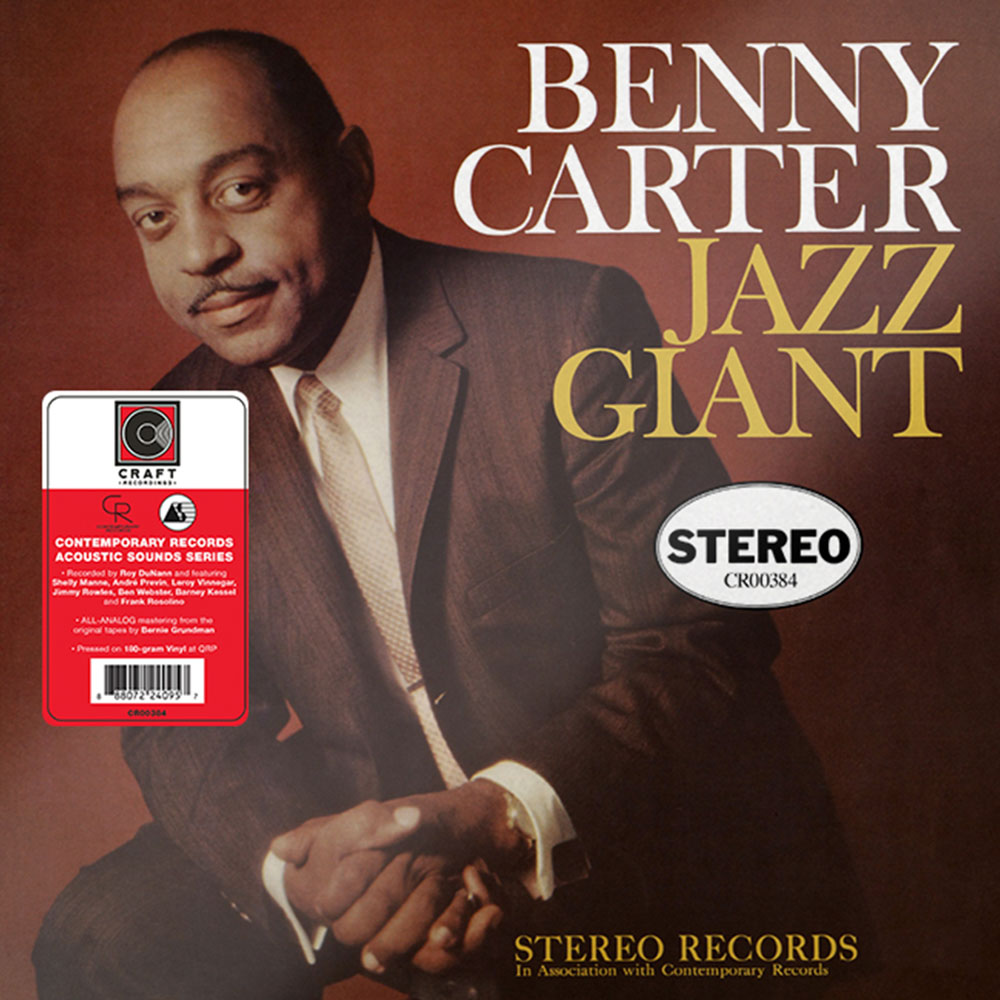
Jazz Giant: more than one side of Benny Carter
Jazz Giant places a substantial title in front of music whose attractions become clearer through its details. Benny Carter is the central figure, but the record does not depend on his name alone. It brings together changing ensembles, two pianists and a leader who moves between alto saxophone and trumpet. Ben Webster, Frank Rosolino, Barney Kessel, Leroy Vinnegar and Shelly Manne also contribute. Those names already suggest why it is worth looking beyond the title. Different instrumental colours and musical personalities meet within a programme of established repertoire and two compositions written by Carter himself.
The album was not recorded during a single afternoon. Four sessions between June 1957 and April 1958 produced its seven selections. Old Fashioned Love and Blue Lou were recorded on June 11, 1957; I’m Coming Virginia and A Walkin’ Thing followed on July 22. How Can You Lose dates from October 7, while Ain’t She Sweet and Blues My Naughty Sweetie Gives to Me were recorded on April 21, 1958. Contemporary Records’ studio provides the common setting. Listening to the finished LP also offers a chance to notice how the circumstances change from one performance to the next.
That is a useful perspective on this music. Changes in personnel need not disrupt an album; they can deepen its character by allowing different selections to use different resources. The running order does not simply reproduce the chronology of the sessions, either. Earlier and later recordings are arranged into two sides with their own sequence and proportions. Listen both for the language shared by the players and for the differences between ensembles. One pleasure of a record like this is hearing returning musicians within changing relationships, discovering another aspect of a familiar voice because the surrounding conversation has shifted.

Seven selections, two originals and a change of instrument
Old Fashioned Love opens the record at 7:46, giving it the largest individual span in the programme. It is followed by I’m Coming Virginia and A Walkin’ Thing. Side A therefore contains only three pieces, each allowing time to settle into its particular musical situation. A Walkin’ Thing is Carter’s own composition. The movement between established repertoire and original material matters: the leader is not only interpreting melodies written by others, but also contributing themes whose musical design begins with him. That distinction supplies another way of approaching the record without turning it into a technical exercise.
Especially revealing are Carter’s trumpet credits on A2 and B3, I’m Coming Virginia and How Can You Lose. Alto saxophone is listed for A1 and A3 through B4, which means that the edition credits both instruments on B3. These details should not be simplified into an unsupported claim that he always plays only one instrument on each selection. What they establish is that his contribution extends beyond a single instrumental colour. Listening again with those assignments in mind can offer a different view of the leader from the one suggested by his most familiar musical identity.
Side B starts with Blue Lou, then moves through Ain’t She Sweet, How Can You Lose and Blues My Naughty Sweetie Gives to Me. How Can You Lose is the second Carter original. At 3:32, the shorter Ain’t She Sweet creates a different point of emphasis from the longer performances around it. These four selections give the second side its own movement and balance. The tracklist provides orientation; keeping the instrument and personnel assignments nearby can make the musical exploration more rewarding. Together, they offer a concrete view of ensemble playing within an album that might otherwise seem familiar at first glance.

Webster, Rosolino and a rhythm section with two pianists
Ben Webster’s tenor saxophone is documented on A1 through B3, but not on the closing selection. Frank Rosolino’s trombone is credited on A1 through B1 and on B3; it is not listed for B2 or B4. Such differences matter beyond the collector’s checklist. An additional horn changes the ensemble’s possibilities, and its absence leaves a different amount of room for the instruments that remain. You do not need to know an exact solo order to notice those changes. Simply considering which colours are available can make listening more focused while leaving the musical experience open and unforced.
André Previn and Jimmy Rowles divide the documented piano duties. Previn is assigned to A1 and B1 through B3, Rowles to A2 and A3. The source does not establish a piano credit for B4, so no name is inferred for that track here. Barney Kessel on guitar, Leroy Vinnegar on double bass and Shelly Manne on drums form the consistently listed foundation. There are eight individual musicians. Carter’s appearance twice in the source with different instruments does not turn him into two people; the musician panel keeps those roles and their individual scope together for clarity.
Try following Kessel’s guitar first, then shifting attention on the next selection towards the relationship between bass and drums. Afterwards, return to the horns. This can reveal how many levels of interaction exist within an apparently compact group. Lester Koenig produced the album and Roy DuNann engineered it, while Nat Hentoff supplied the sleeve notes. Those names establish the production setting; the musical conversation belongs to Carter and the other players. The combination of clear organisation and distinct personal voices makes the recording interesting as a complete album, rather than merely as an impressive collection of names on a sleeve.
The analogue Contemporary reissue
This edition belongs to the Contemporary Records Acoustic Sounds Series and carries the catalogue number CR00384, with shop reference ACONC 384. It presents the album on one 180-gram LP, running at 33⅓ RPM in stereo. Bernie Grundman handled the mastering, and the edition credits explicitly identify all-analogue mastering from the original tapes. Pressing was undertaken at Quality Record Pressings, with a jacket from Stoughton Printing. These details concern this particular reissue, helping distinguish it from earlier pressings and from other formats carrying the same album title, rather than making a general claim about every available version.
The division into two sides remains significant to the musical experience. Three longer selections on the first side and four differently proportioned pieces on the second create a programme that works well as two deliberate listening sessions. The record is especially appealing in a collection concerned with the relationships between soloists, accompanists and changing ensemble colours. Carter leads, but the variety comes from the connections among all the participants. That is also why the credits deserve attention: they provide specific points of orientation from which the ear can begin and then move freely back into the performance.
Jazz Giant offers an approachable introduction to Benny Carter while retaining plenty of detail for repeated listening. Two instruments for the leader, two pianists, four recording dates and seven pieces provide several possible entry points into the same music. Michael 45 dispatches orders from Hilden in Germany, allowing customers in Germany and the EU to order without importing it themselves from the United States or waiting for customs clearance. If you want to buy Benny Carter’s Jazz Giant on vinyl, this Contemporary edition is presented with its complete running order and carefully differentiated personnel credits, making the album’s particular character easier to explore.
Current availability and delivery information appear beside the purchase controls; this edition description is not a statement of stock availability.
Series: Contemporary – all 24 records: sunny jazz from Los Angeles
Musicians
Participants and documented credit status. Track references correspond to the tracklist.
- Benny CarterPortrait reference: 1976alto saxophone, trumpetParticipation: Alto saxophone: A1, A3–B4; trumpet: A2, B3. Both credits on B3.
- Ben WebsterExisting portrait; not a session depictiontenor saxophoneParticipation: A1–B3 – not on B4
- Frank RosolinotromboneParticipation: A1–B1 and B3 – not on B2 and B4
- André PrevinPortrait reference: 2012pianoParticipation: A1 and B1–B3
- Jimmy RowlesPortrait reference: BestandsporträtpianoParticipation: only A2 and A3
- Barney KesselExisting portrait; not a session depictionguitarParticipation: all tracks
- Leroy VinnegarExisting portrait; not a session depictiondouble bassParticipation: all tracks
- Shelly ManneExisting portrait; not a session depictiondrumsParticipation: all tracks


Production: Lester Koenig. Recording: Roy DuNann. Liner notes: Nat Hentoff. Cover photography: William Claxton. Design: Robert Guidi. Mastering: Bernie Grundman. Eight people, nine instrumental credits. Carter is credited with both instruments on B3; the piano credit for B4 is unassigned in this source.

Reviews
There are no reviews yet.