Seven musicians and a long shared evening
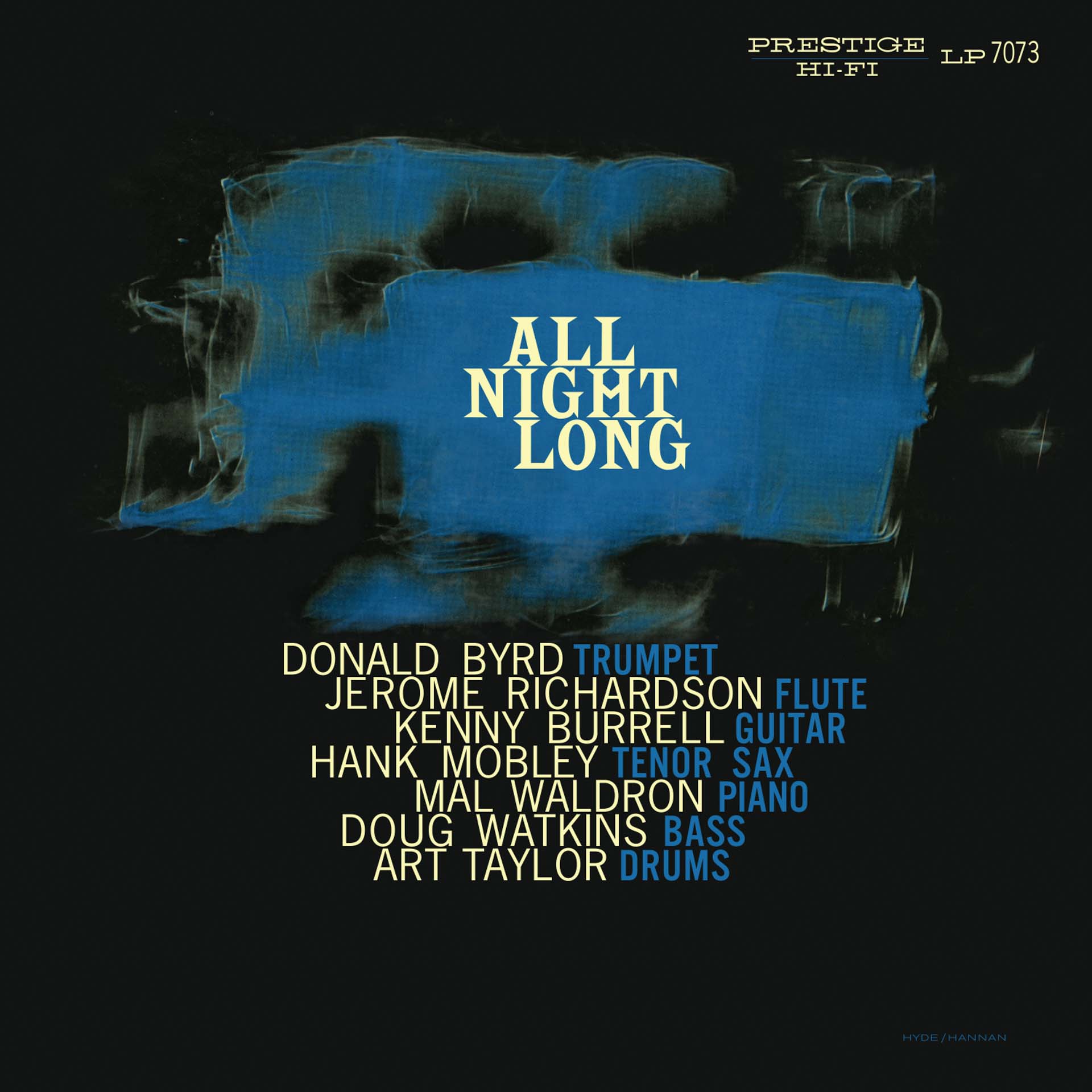
All Night Long belongs to the Prestige recordings whose personnel alone makes the prospect of the conversation inviting. Kenny Burrell’s guitar joins Donald Byrd’s trumpet, Hank Mobley’s tenor saxophone and Jerome Richardson on flute and tenor saxophone. Mal Waldron, Doug Watkins and Art Taylor supply piano, double bass and drums. Seven musicians are assembled, yet the record needs no large orchestral gesture. It begins with clearly defined forms that leave space for different voices. The title becomes an appropriate invitation: this is company with which a listener can settle in and spend some time.
The session took place on December 28, 1956, at Rudy Van Gelder’s studio in Hackensack. Prestige released the album in 1957 as a recording by the “Prestige All Stars”, with catalogue number 7073. Later editions gave Kenny Burrell the main artist credit. This explains why the same music can appear under different headings in catalogues. They are not two different sessions, but different ways of presenting a shared recording. Burrell’s role is significant, while the original All Stars designation suits an album whose attraction rests on the meeting of several independent musical personalities.
Guitar adds another colour to the ensemble. Among trumpet, saxophones and piano is an instrument whose notes begin and decay differently. Richardson further broadens the possibilities by contributing flute. This makes the instrumentation more varied than that of a conventional quintet without turning it into a big band. It is rewarding to follow changes in texture as well as the order of solos. Which voice introduces another kind of lightness? How does a plucked note alter the relationship with a sustained horn line? The personnel itself opens several routes through the music before any particular performance is singled out.
For Burrell, 1956 was a decisive year. After graduating from Wayne State University in 1955 and spending time with Oscar Peterson, the Detroit guitarist moved to New York; his first Blue Note recordings also date from 1956. All Night Long therefore belongs to the early New York period of a musician bringing his training and experience of the Detroit scene into a wider circle of collaborators. The Prestige session sits within that expansion of his musical working world.

Kenny Burrell and his partners
Kenny Burrell can be heard both as a soloist and as a connecting voice among the other instruments. A guitar can tell a melodic story while also supplying harmonic accompaniment. In an ensemble that includes piano, this double responsibility becomes especially interesting. Burrell and Mal Waldron need not occupy identical spaces. Their contrasting attacks and the different ways their notes decay can complement one another or leave room deliberately. A recording like this can therefore support repeated visits, with a different relationship inside the band brought into the foreground each time. Following the guitar is one route, rather than the only route.
Donald Byrd and Hank Mobley introduce two more distinctive voices. Trumpet and tenor saxophone are familiar partners in hard bop, but Richardson is also present to extend the palette of wind instruments. His credits list flute and tenor saxophone; that does not mean both instruments should be assumed to appear on every track. Knowing the range of possibilities is enough to begin with. Discovering the particular colour of a passage remains part of the pleasure. The ensemble continues to function as a shared group even when individual voices move in and out of prominence.
Doug Watkins and Art Taylor carry the foundation. Their work is indispensable on the long first side, where a common pulse must endure while attention passes from player to player. Waldron belongs both to the harmonic accompaniment and to the programme’s composers. This overlap of responsibilities is part of the attraction. Composer, accompanist and soloist are not rigidly separate offices. A musician may provide the form, make his own statement within it and then help another player find an individual direction. The recording makes these connections audible within a setting that remains open to immediate responses.

A side for Burrell, three pieces in reply
Kenny Burrell’s All Night Long fills the entire first side. The publisher describes its form as a blues with an added bridge. What matters is the combination of familiarity and extension: a recognisable framework supplies support without restricting the performance to one uniform movement. Its length allows the musicians to develop statements rather than merely hint at them. For listeners, it offers a chance to move attention between soloist and ensemble. An interesting event need not always occur in the foreground; the response to a phrase can be just as important in suggesting a new direction.
Side two begins with Hank Mobley’s Boo-Lu, continues with Mal Waldron’s Flickers and ends with Mobley’s Li’l Hankie. The three compositions create a varied counterpart to the expansive performance occupying the whole of the first side. Flickers uses a sixteen-bar form, while Mobley’s contributions draw on familiar thirty-two-bar harmonic patterns. Counting the bars is not a condition of enjoying the music. These details do, however, show the balance between the extended title performance and more compact starting points. Simplicity of form supplies scope for interpretation rather than making the resulting performances interchangeable or predictable.
The album should not be confused with All Day Long, recorded a week later on January 4, 1957. Frank Foster and Tommy Flanagan appear on that session: it is not simply the same group working under another time-of-day title. Nor should later CD additions automatically be treated as part of this LP. This edition retains the four pieces of the original programme. For collectors, those distinctions are useful. Connections between related sessions can be explored without merging their repertoire, personnel or editions. Each recording retains the particular identity created by the musicians and material actually present.
The Analogue Productions Prestige mono edition
This LP carries catalogue number APRJ 7073. It belongs to the Analogue Productions Prestige Mono Series, with Kevin Gray credited by the publisher for cutting from analogue master tapes and Quality Record Pressings named as the pressing plant. The current edition is described as a 180-gram record with a high-gloss tip-on jacket. The original four-piece programme remains the centre of the release. The jacket and the single record, divided into two sides, provide a clear setting for the expansive title performance and its three companion pieces. For Burrell collectors and listeners drawn to the Prestige All Stars sessions alike, that original sequence offers a rewarding starting point for following the relationships within this particular ensemble.
At 33⅓ rpm, the long title performance stays together on a single side. That is particularly appropriate to the open character of this kind of session. One solo can lead into the next without an extra side change interrupting the common movement. The reverse then presents three other forms, creating a natural change of perspective. For listeners who prefer to experience the album as a whole, this is a readily understandable advantage of the single LP. The sides are not arbitrary containers for four tracks, but two differently proportioned sections of one shared musical encounter.
The mono recording gathers seven musicians into a common image. That makes differences in attack, register and decay especially rewarding to notice: guitar beside piano, flute against saxophones, trumpet above a flexible foundation. All Night Long supplies both the time and the range of personalities needed for that exploration. A collector can approach it through Burrell, through Mobley or Byrd, or through Waldron’s work as pianist and composer. Its particular charm is that none of these perspectives excludes the others. The ensemble provides the setting in which the individual voices find their places, while the programme gives their exchanges room to unfold.
You order from Michael 45 in Germany. We arrange the US import and dispatch from Hilden.
More by The Prestige All Stars: Tenor Conclave · Wheelin’ & Dealin’
Customer question: Buying Analogue Productions records in Europe
Series: Analogue Productions Prestige – all 50 records, musicians and session paths
Musicians
Participants and documented credit status. Track references correspond to the tracklist.
- Doug Watkinsdouble bassParticipation: Album personnel
- Art TaylordrumsParticipation: Album personnel
- Jerome Richardsonflute, tenor saxophoneParticipation: Album personnel
- Kenny BurrellguitarParticipation: Album personnel
- Mal WaldronpianoParticipation: Album personnel
- Hank Mobleytenor saxophoneParticipation: Album personnel
- Donald ByrdtrumpetParticipation: Album personnel


Album credits list Jerome Richardson on flute and tenor saxophone; a track-by-track instrument assignment is not established. LP sequence: All Night Long, Boo-Lu, Flickers, Li’l Hankie.

Reviews
There are no reviews yet.