
California acquires four wheels
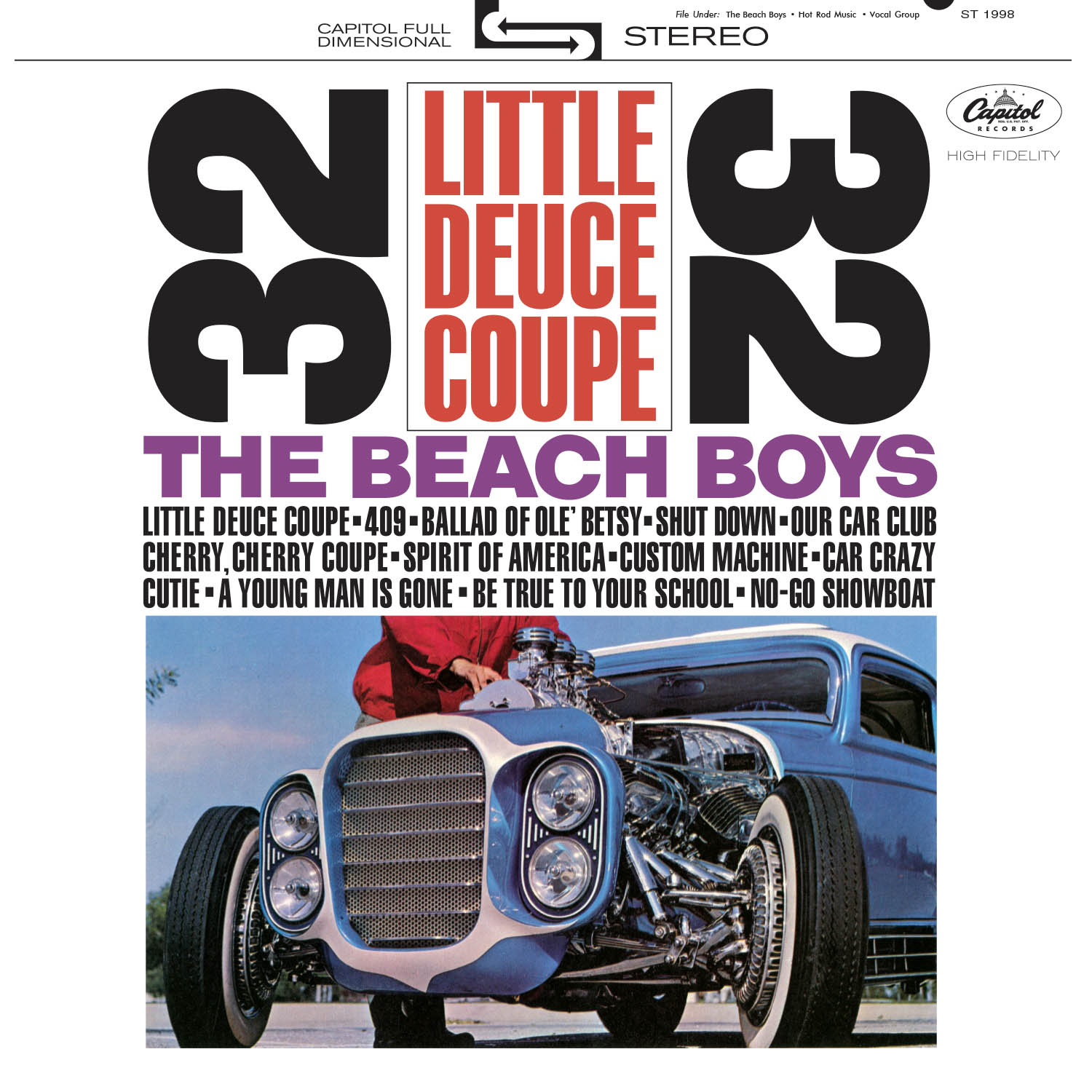
The Beach Boys moved at an extraordinary pace in 1963. Released on October 7, Little Deuce Coupe was already their fourth album, arriving only a short time after Surfer Girl. Cars now occupied the centre: mechanical details, pride in one’s own machine, speed as a promise and the shared language of a youthful scene. In this context, “deuce” means a 1932 Ford. The title therefore points to a particular part of American car culture. The music translates that world into concise songs whose energy comes from rhythm, melody and the immediately recognisable relationship between the voices.
The album combines eight then-new recordings with four previously released tracks: “Little Deuce Coupe”, “409”, “Shut Down” and “Our Car Club”. That matters when considering its thematic coherence. The common subject did not arise because every song had been recorded together in one concentrated session. Existing material and new songs were assembled into a programme. Familiar tracks provide reference points, while the additions expand the picture. For collectors, the record consequently documents the working pace and album planning of the early Beach Boys as well as a specific collection of songs about cars and the world around them.
Brian Wilson is the central musical figure, but the album depends on a group and its shared vocal expression. The combined personnel includes Mike Love, Carl Wilson, Dennis Wilson, Al Jardine and David Marks alongside Brian. This is not a claim that six members perform identical duties on every track. Changes within the band and the different origins of the recordings require a more discriminating account. With material this familiar, it is particularly useful to resist replacing the actual recording history with a single, retrospectively simplified picture of an unchanging group in one studio on one date.

Brian Wilson, Roger Christian and the language of engines
An important connection leads to Roger Christian, the radio broadcaster and lyricist whose knowledge of cars enters several of these songs. Technical vocabulary is not simply decorative scenery. It gives the music a language that could convey recognition and belonging to its original audience. Brian Wilson links such images to melodies and vocal arrangements that remain effective for listeners with no special interest in carburettors or engine capacity. That helps explain the album’s continuing appeal. Its subject retains its specificity, while its musical form can reach well beyond the scene for which that vocabulary first carried immediate meaning.
Mike Love’s voice is part of this early identity, alongside the Wilson brothers and their fellow singers. Guitars, bass and drums provide the instrumental framework, but not every proposed additional instrumental credit is equally secure. Uncertain details are therefore not presented as established individual assignments. “A Young Man Is Gone” is a clearly different case: it is sung a cappella. The vocal ensemble carries the music without instrumental backing. This is more than a technical credit. It introduces a distinct perspective into a programme otherwise strongly associated with movement, machinery and the social world of young car enthusiasts.
This early music also rewards attention beyond the familiar image of an endless California summer. The car theme brings together competition and community, affectionate exaggeration and recognisable everyday situations. Brian Wilson’s musical work creates a setting in which a concise rock song and a carefully shaped vocal arrangement can coexist. The album need not be judged only against later, more elaborate productions. Its particular strength is compression: a few minutes can establish a character, a situation and a melody that holds the expression together beyond the literal meaning of the words.

Twelve short songs and an unexpectedly quiet moment
Side one begins with the title song and proceeds through “Ballad of Ole’ Betsy” to “Be True to Your School”. “Car Crazy Cutie”, “Cherry, Cherry Coupe” and “409” complete the sequence. The songs are brief, but they consider different aspects of their subject. A car can be a status symbol, a cherished companion or an object around which a shared specialist language develops. The school setting of “Be True to Your School” extends the idea of belonging beyond the road. Every number need not describe a race for the common youthful world of the record to remain coherent.
The second side continues with “Shut Down”, “Spirit of America”, “Our Car Club” and “No-Go Showboat”. “Our Car Club” makes the programme’s social dimension particularly clear: this is about a community as well as individual machines. “No-Go Showboat” places a different emphasis on the relationship between appearance and performance. Part of these miniatures’ attraction is their ability to establish a story without a lengthy introduction. A title, a characteristic vocal entrance and a compact musical shape can be enough to suggest a complete small world. Brevity belongs to the expressive language of this early singles-and-albums culture.
“A Young Man Is Gone” appears before the closing “Custom Machine”. The tribute to James Dean introduces a reflective moment and connects the album to a vocal tradition associated with Bobby Troup and the Four Freshmen. Its unaccompanied setting encourages a different kind of attention from the automotive imagery around it. That interruption helps make the record more than a uniformly coloured set of car songs. Twelve tracks, six on each side, form a concise arc in which youthful enthusiasm and an act of remembrance can coexist without either requiring the other to disappear.
The stereo edition, including its historical exception
This Analogue Productions LP presents the original stereo mix associated with Chuck Britz. One significant exception must remain explicit: “409” appears in Duophonic, or electronically reprocessed pseudo-stereo. Describing the entire album as true stereo would therefore be inaccurate. Nor is this a later stereo reconstruction of the kind associated with some subsequent Beach Boys releases. The identity of the mix is part of the reason to choose this edition. Collectors comparing versions are considering not only pressing plants and vinyl weights, but also the historical form in which the recordings are being presented.
Kevin Gray handled mastering at Cohearent Audio, and the record is pressed at Quality Record Pressings. A Stoughton jacket forms part of the package. The current AAPP 061 edition is specified at 180 grams and runs at 33⅓ rpm; earlier listings for the 2015 release describe 200-gram vinyl. The series information refers to the most original tapes or best available sources. That should not be expanded into an unsupported guarantee about the source of every individual track. The particular case of “409” remains part of the album’s history even within a carefully prepared audiophile reissue.
Little Deuce Coupe is especially rewarding when early Beach Boys music is allowed to stand on its own, rather than being treated solely as preparation for later achievements. The album has an identity of its own: a young band’s working momentum, a thematically connected repertoire, Brian Wilson’s musical imagination and a vocal culture capable of making technical language memorable and singable. This stereo LP offers access to that particular phase and its historical mix. It does not need to be described as a flawless modern reconstruction. Part of its interest lies in preserving and clearly explaining the original programme’s distinctive characteristics.
You order from Michael 45 in Germany. We arrange the US import and ship from Hilden.
More by The Beach Boys: Pet Sounds
Customer question: Buying Analogue Productions records in Europe
Musicians
Participants and documented credit status. Track references correspond to the tracklist.
- Brian WilsonPortrait: 1966vocals, piano, organ, bassParticipation: Album personnel
- Mike LovevocalsParticipation: Album vocals; saxophone participation uncertain
- Carl Wilsonvocals, lead guitarParticipation: Album personnel
- Dennis WilsonPortrait: 1963vocals, drumsParticipation: Album personnel
- Al Jardinevocals, bassParticipation: Album personnel
- David Marksrhythm guitarParticipation: Album personnel


Combined album credits, not a claim that every musician plays throughout every track. Uncertain additional instruments are not treated as confirmed. “A Young Man Is Gone” is a cappella.

Reviews
There are no reviews yet.