A journey whose rules keep changing
A piano figure sets things in motion, and a voice enters in the middle of a city story. With The Lamb Lies Down On Broadway, Genesis move into a world that feels both tangible and dreamlike. Streets, names and gestures initially seem recognisable; before long, the spaces change and the rules governing events change with them. Rael’s journey holds the album together. The music does more than alternate between narration and illustration. It can propel a scene, interrupt it or establish a feeling whose meaning remains deliberately unsettled.
Released in 1974, the band’s sixth studio album was an unusually expansive undertaking. The original double album connects 23 tracks within a shared course and became Genesis’ final studio album with Peter Gabriel. Tony Banks, Steve Hackett, Mike Rutherford and Phil Collins provide the story with a mobile musical foundation. Short songs, extended instrumental sections and transitions with almost independent identities coexist. Some passages advance the narrative directly; others change the state of mind in which the listener encounters the next scene.
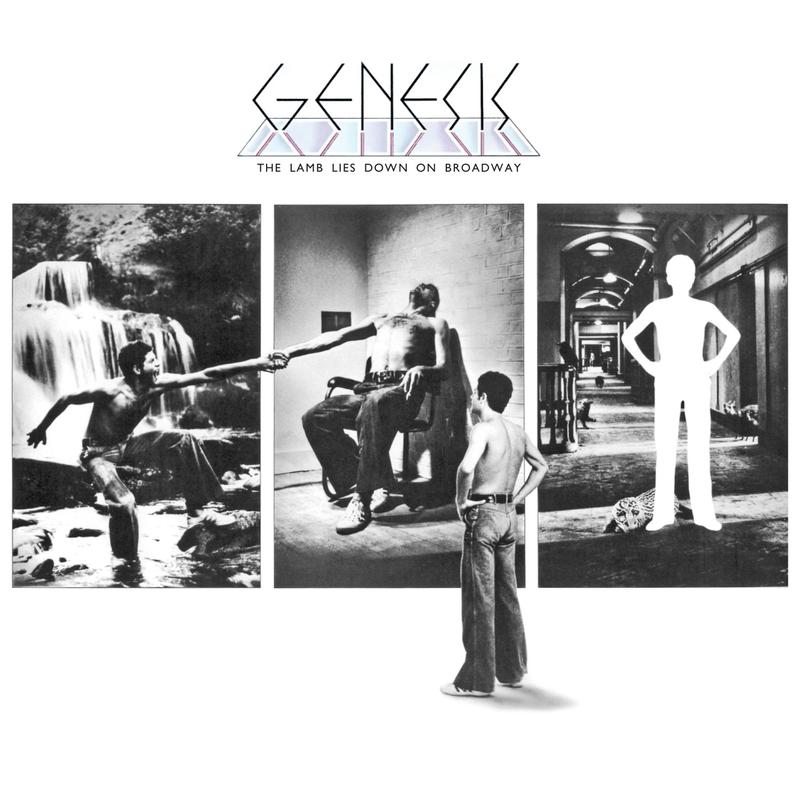
Recording took place between August and October 1974, using Island’s mobile studio at Glaspant Manor in Wales. Genesis produced the record with John Burns, while Dave Hutchins is credited as engineer. Hipgnosis supplied the distinctive sleeve design and photography, with graphics by George Hardie. The Welsh recording location and the story’s New York starting point belong to different layers of the album. Its imagined world gains much of its effect from movement between ordinary life, dream and a sense of physically immediate danger.
There is no need to decode the entire narrative before listening. A rewarding route follows the musical tensions: movement against stillness, an intimate voice against a threatening setting, melodic clarity against disorienting space. Individual songs can be compelling on their own, but the album’s particular shape becomes clear when one piece changes the expectations brought to the next. The journey can make musical sense before every element of its plot has found a definite place. Its uncertainty is part of the experience rather than an obstacle that must first be removed.

Voices, instruments and Enossification
Gabriel’s singing carries Rael’s story through its changing situations. Banks’ keyboards can establish solid ground or create a setting in which that ground becomes less secure. Hackett’s guitars and Rutherford’s bass and twelve-string guitar offer further ways to open or compress a scene. Collins contributes drums, percussion, vibraphone and backing vocals. The album credits document these roles without providing an exhaustive allocation of every instrument across all 23 tracks. They describe the players’ contributions to the record as a whole.
The transitions make their collaboration especially interesting. An instrumental section need not function as a self-contained solo feature. It can suggest a change of location, hold an action in suspension or establish the colour of the next vocal passage. Paying attention to the ends of pieces offers a useful listening route. What remains in place, which sound carries over, and where does the music make a definite break? The album’s coherence often lies as much in these connections as in its best-known melodies.
Brian Eno appears as a guest credited with “Enossification,” the processing of vocal material. Supplementary documentation associates his contribution with “In The Cage,” “The Grand Parade Of Lifeless Packaging” and “Counting Out Time.” He is not a member of the five-piece band, nor should his credit be extended indiscriminately across the album. His involvement broadens the role a voice can occupy here: narrator, character and material to be transformed. The personnel overview preserves the distinction between the band’s album-level roles and this more specific guest contribution.
Graham Bell is additionally named for a choral contribution, although a secure individual track assignment is not supplied. His name remains visible with that qualification. On an album containing so many layers, a complete credit section is valuable precisely when it retains the limits of the documentation. The record’s history includes smaller contributions as well as the principal names on its cover. Describing those contributions carefully avoids both enlarging their scope and allowing them to disappear from the account altogether.

From Broadway to the final It
The first side of this edition moves from the title track through “Fly On A Windshield” and “Broadway Melody Of 1974” to “Cuckoo Cocoon.” This opening sequence repeatedly alters the relationship between song and transition. Side B contains “In The Cage” and “The Grand Parade Of Lifeless Packaging.” As the narrative space becomes more confined, the music can become more insistent and unfamiliar. These first six tracks already offer several examples of Genesis moving between scenes without pausing to explain each change in conventional terms.
Side C joins “Back In N.Y.C.,” “Hairless Heart” and “Counting Out Time.” Physical directness, an instrumental interlude and a more compact song approach appear in succession. “Carpet Crawlers” and “The Chamber Of 32 Doors” then give side D, and the first half of the work, another emphasis. The recurring movement of “Carpet Crawlers” provides a melodic point of reference within the broader structure. An immediately memorable song can still belong to an environment whose significance is not settled by one straightforward interpretation.
The second half begins with “Lilywhite Lilith,” “The Waiting Room” and “Anyway.” They are followed by “Here Comes The Supernatural Anaesthetist,” “The Lamia” and “Silent Sorrow In Empty Boats.” The titles alone suggest how far the journey has moved from its starting point. Musically, clearly shaped songs alternate with passages whose effect depends more strongly on atmosphere, sound and the perception of time. That changing density is essential: a work of this length needs several kinds of motion if its extended form is to remain alive.
“The Colony Of Slippermen” contains three named sections: “The Arrival,” “A Visit To The Doktor” and “The Raven.” “Ravine” and “The Light Dies Down On Broadway” continue towards the final side, containing “Riding The Scree,” “In The Rapids” and “It.” The tracklist counts “Slippermen” as one composition with subdivisions, keeping the programme at 23 tracks. The ending is particularly rewarding in relation to the opening. After so many transformations, its brief final word can feel like another opening rather than a simple explanation that closes the journey down.
Four 45 RPM records for the complete work
Analogue Productions’ Atlantic 75 edition carries catalogue number AAPA 013-45 and spreads the complete album across four 180-gram LPs playing at 45 RPM. Eight sides provide the physical framework for its 23 tracks. Chris Bellman performed the cutting at Bernie Grundman Mastering, with the original master tape identified by the label as the source. An elaborate Stoughton tip-on gatefold package forms part of the edition. This is one continuous album presented on four records, rather than a collection of different Genesis releases.
The arrangement requires more side changes than the original double LP. Knowing the sequence of this particular edition is therefore useful. Side D closes with “The Chamber Of 32 Doors,” and the second half begins on E with “Lilywhite Lilith.” “The Colony Of Slippermen” opens G, while “It” concludes H. The sides can therefore be heard as short chapters within the larger journey. A complete listen rewards an unhurried approach: the transitions belong to the work, and a passage that initially seems incidental may acquire its significance from the song that follows it. The tracklist helps keep that larger sequence in view.
Numbering and manufacture at QRP are documented for the first 2,000 copies. Unnumbered editions may be manufactured by Quality Record Pressings or RTI. The history of the series alone cannot establish which batch a current order will supply, so no particular numbering is promised here. Cutting information applies to this reissue. Other releases of the album, including later revisions and digital formats, possess their own technical histories and should not be treated as interchangeable with this edition.
The Lamb Lies Down On Broadway rewards a willingness to enter an extended form. Its memorable songs provide points of entry; its transitions and unresolved meanings keep those points open. For a collection, this edition offers the complete work in an extensive 45 RPM presentation. For listening, it offers a band stretching the relationship between song, narrative and imagined environment. A return visit can place the emphasis elsewhere: on the voice, on the instrumental connections or on the way a familiar passage changes when heard in the company of everything surrounding it.
You order from Michael 45 in Germany. We arrange the US import and dispatch from Hilden.
Artist page: All titles by Genesis and Phil Collins
Customer questions: Atlantic 75: which titles are worth buying? · Buying Analogue Productions records in Europe
Series: Atlantic 75 Series – all 75 albums, time journey and the people behind Atlantic
Musicians
Participants and documented credit status. Track references correspond to the tracklist.
- Peter GabrielExisting illustration · date unconfirmedlead vocals, fluteParticipation: Album personnel; instruments not allocated track by track
- Tony BanksExisting illustration · date unconfirmedkeyboardsParticipation: Album personnel; instruments not allocated track by track
- Steve HackettExisting illustration · date unconfirmedguitarsParticipation: Album personnel; instruments not allocated track by track
- Mike RutherfordExisting illustration · date unconfirmedbass, twelve-string guitarParticipation: Album personnel; instruments not allocated track by track
- Phil CollinsExisting illustration · date unconfirmeddrums, percussion, vibraphone, backing vocalsParticipation: Album personnel; instruments not allocated track by track
- Brian EnoLater portrait reference: 2015vocal processing (“Enossification”)Participation: B1,B2,C3 · guest contribution per supplementary documentation
- Graham Bellchoral contributionParticipation: Supplementary encyclopedia credit; track unconfirmed


August–October 1974, Island mobile studio at Glaspant Manor, Wales. Genesis and John Burns: producers; Dave Hutchins: engineering; Hipgnosis: sleeve/photography; George Hardie: graphics. Brian Eno: Enossification, supplementary documentation identifies three tracks; Graham Bell: supplementary choral credit without track assignment. 23 tracks; Slippermen has three subsections. Chris Bellman: cutting.
How Michael hears this edition
Listening impression · paraphrased from the video
Compared with his British first pressings with the Porky cut, Michael hears substantially more detail and dynamics from the Atlantic 75 edition. He finds the difference unusually large, with the reissue sounding much more open. His comparison includes two early British copies, one particularly well preserved.

Pedro Gonzalez –
The music is incredible. The pressing and the sound, pristine! And the quadruple gatefold… oh – my – god!