

Eight songs and a distinctive voice
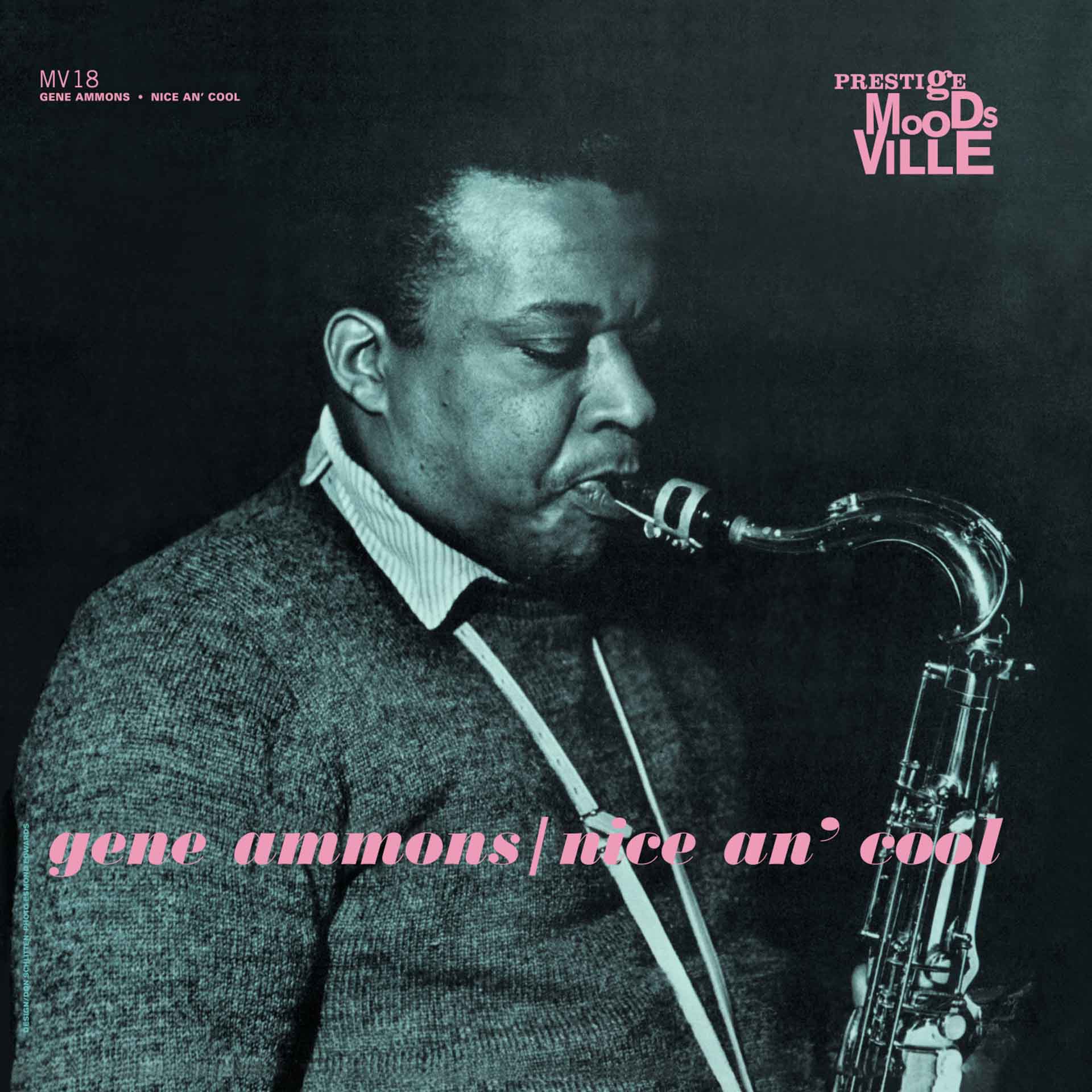
Gene Ammons did not need an extensive track list to establish a musical world of his own. Nice An’ Cool brings together eight standards, recorded at Rudy Van Gelder’s Englewood Cliffs studio on 26 January 1961. The title suits Moodsville, the Prestige subsidiary devoted to ballads and programmes built around a particular atmosphere. Yet treating the album solely as background music would miss its interest. A major tenor saxophonist encounters familiar songs in a group small enough to invite close attention. The melodies already have histories; Ammons and his three partners give them a specific new performance.
Born in Chicago in 1925, Ammons was the son of boogie-woogie pianist Albert Ammons. His nickname, “Jug”, is traced to Billy Eckstine and an ordered straw hat that did not fit. Such small stories are part of jazz history, though they cannot explain an entire musical personality. More relevant to this album is the relationship between a distinctive tenor voice and a programme devoted entirely to songs. The familiar association of Ammons with the Chicago tenor tradition provides a historical framework. It should open up the listening experience rather than dictate what every phrase is supposed to contain.
The session took place between two periods of imprisonment. Ammons had returned in 1960 after a sentence beginning in 1958; the next long interruption to his career began in 1962. These dates belong to his biography, without requiring every ballad to be interpreted as a coded autobiographical statement. Nice An’ Cool can first be understood as a deliberately assembled album by a working musician. Esmond Edwards supervised the production and supplied photography, Don Schlitten handled design and Joe Goldberg wrote the liner notes. Moodsville issued the record as MVLP 18.

A quartet that makes room for the songs
Richard Wyands plays piano, Doug Watkins double bass and J. C. Heard drums alongside Ammons. All four musicians are documented on every selection. There is no second horn, string section or change of rhythm section within the album. Ammons recorded again the following day with a different group, but that session is not part of Nice An’ Cool. When Prestige recording dates follow one another closely, precise attribution is helpful. Familiar names in the catalogue should not encourage us to combine neighbouring sessions into an ensemble that never actually made this album.
The quartet format makes the relationships between instruments relatively easy to follow. Ammons takes the principal melodic role, with Wyands as his harmonic partner. Watkins and Heard provide the rhythmic foundation. That outlines the instrumentation, but it does not yet describe the interaction. On a first attentive listen, the end of a saxophone phrase offers a useful point of focus. What does the piano do with the space that becomes available? How do bass and drums sustain the movement? In a ballad programme, small decisions can matter greatly, whereas a larger ensemble might make them less immediately apparent.
Slow or moderate song material is not simply the opposite of improvisation. A familiar melody brings firm expectations with it. Which notes are held, which transitions receive emphasis, and where is the line allowed to recede? These questions direct attention towards the treatment of the song rather than the sheer number of notes played. Nice An’ Cool supplies eight different starting points. Nor should the work of the supporting musicians be confused with an absence of activity. Carrying a song within a shared sense of time is a substantial musical responsibility in its own right.

From Broadway to Gershwin
“Till There Was You” opens side one. Meredith Willson’s song from The Music Man places the programme firmly in the world of established songs from the outset. It is followed by “Answer Me, My Love”, Ann Ronell’s “Willow Weep for Me” and Richard Rodgers and Lorenz Hart’s “Little Girl Blue”. The selection brings together different writers and traditions of stage and popular song. A tenor saxophone without a singer cannot pronounce the words, but it can make the melodic shape of a song its subject. Anyone who already knows a vocal version brings an interesting second memory to the encounter with Ammons.
Side two begins with “Something I Dreamed Last Night”. Documented labels also print the title with an additional “Up”; it is the same composition by Sammy Fain, Herb Magidson and Jack Yellen. Rodgers and Hammerstein’s “Something Wonderful” follows, then “I Remember You” by Victor Schertzinger and Johnny Mercer, and George and Ira Gershwin’s “Someone to Watch Over Me”. The album does not finish with an original blues or a fast number introduced for contrast. It remains committed to its song programme through the final selection. That consistency is part of its particular identity.
Several performances later appeared on Moodsville collections devoted to Gershwin, Rodgers and Broadway. Their suitability for those compilations shows how readily individual recordings could enter different repertoire contexts. On the original album, however, the connection is different: one recording date, one quartet and Ammons as the unifying voice. Collectors can appreciate that original shape alongside the subsequent anthologies. The later inclusion of this material in The Gene Ammons Story: Gentle Jug does not change the circumstances in which the eight performances were first made.
Nice An’ Cool offers a rewarding starting point for anyone who wants to discover Ammons beyond a single hit or an exuberant jam-session setting. Here the emphasis falls on songs and their interpretation. Listeners familiar with The Soulful Moods of Gene Ammons will recognise a related Moodsville concept, but not an identical date or an interchangeable group of players. Such relationships give a collection depth: similarities emerge while the character of each individual recording becomes clearer. This album belongs specifically to Richard Wyands, Doug Watkins and J. C. Heard as well as to its leader, and their names are worth keeping in mind throughout.
The stereo edition offered here
The Analogue Productions LP carries the catalogue number APRJ 18. Part of the Prestige Stereo series, it presents the eight-track programme on one LP playing at 33⅓ rpm. The label credits Kevin Gray with cutting and Quality Record Pressings with manufacture; Gary Salstrom is credited for plating. The presentation includes a tip-on jacket. The original Moodsville album and the later AP edition are thus connected through the title and catalogue reference, while recording and reissue manufacture remain separate stages in the production history.
The current label listing specifies 180 grams. A numbered AP edition from 2015 is documented, but the pressing entry consulted does not establish its weight clearly; a later 2023 edition is listed at 180 grams. A general promise of 200-gram vinyl would therefore be inappropriate. Historical numbering should likewise not be assumed for every copy currently in stock. Identifying the actual batch of an individual copy requires inspection of that copy. Distinguishing these points serves the collector’s interest in the particular edition rather than substituting a broad series description for specific evidence.
The two LP sides retain the original sequence of eight songs. They offer two manageable arcs, each with its own opening and close. One can first experience the record as a continuous ballad programme and then follow a single musician on a subsequent listen. Its special attraction lies in that combination: established songs, a clearly documented small band and Ammons’ place in the history of the tenor saxophone. A quiet record need not be a minor one. Nice An’ Cool gives both its material and its musicians enough space for that distinction to become apparent over time. You order from Michael 45 in Germany. We arrange the US import and dispatch from Hilden.
More by Gene Ammons: Blue Gene · Boss Tenor
Customer question: Buying Analogue Productions records in Europe
Series: Analogue Productions Prestige – all 50 records, musicians and session paths
Musicians
Participants and documented credit status. Track references correspond to the tracklist.
- Gene Ammonstenor saxophoneParticipation: Album personnel
- Richard WyandspianoParticipation: Album personnel
- Doug Watkinsdouble bassParticipation: Album personnel
- J. C. HeardPortrait 1946drumsParticipation: Album personnel


Recorded 26 January 1961, Englewood Cliffs. Rudy Van Gelder, engineer. Analogue Productions: Kevin Gray, cutting; QRP, pressing. Personnel on all tracks.

Reviews
There are no reviews yet.