Three instruments, one unmistakable voice
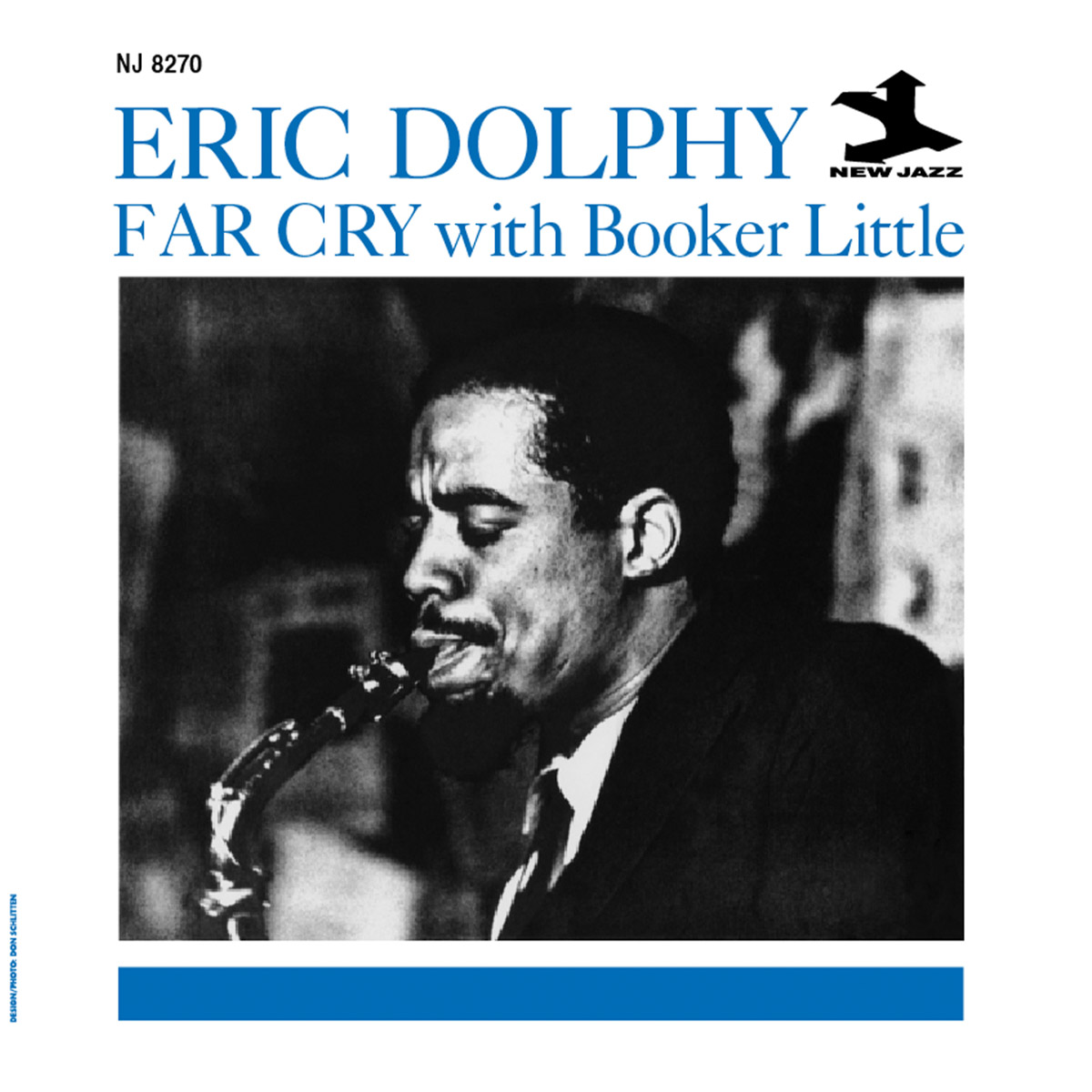
Some jazz albums tell a story before the first note through the musicians assembled for them. Far Cry brings Eric Dolphy and Booker Little together with Jaki Byard, Ron Carter and Roy Haynes: five individual artists meeting at a particularly fruitful moment. The session took place on December 21, 1960, at Rudy Van Gelder’s studio in Englewood Cliffs, with Esmond Edwards producing. By the album’s appearance on New Jazz in 1962, that moment already belonged to history. The music itself invites attention to something more immediate: a small group connecting familiar songs, original compositions and unusual instrumental perspectives.
Dolphy plays alto saxophone, bass clarinet and flute. This is more than a list of interchangeable colours. Each instrument changes the relationship between melody, articulation and movement. The bass clarinet’s lower register establishes different possibilities from the alto’s concentrated brightness; the flute shifts the balance again. Listeners who mainly associate Dolphy with saxophone can encounter three expressions of his musical personality within one album. The continuing question is how a melodic line might be carried forward while retaining a meaningful relationship with where it began.
The first side makes an explicit connection with Charlie Parker. Jaki Byard wrote both “Mrs. Parker of K.C.” and “Ode to Charlie Parker”; the former refers to Parker’s mother and Kansas City. Dolphy’s own “Far Cry” completes the side. This connection does not prescribe a single way of looking back. It places the music within a tradition whose possibilities these players continue to explore. Respect for an earlier musician and independence of imagination can coexist, leaving room for five clearly differentiated musical voices.
That makes the album especially rewarding within a collection built around relationships in jazz history. Far Cry can be considered alongside Parker’s work, but also alongside Dolphy’s later club recordings with Little. It has a character of its own beyond any role as a transitional document. The changing group sizes across its seven tracks are fundamental to that character. A quintet gives way to smaller combinations and, eventually, to one musician alone. These decisions help determine how the record unfolds from beginning to end.

Booker Little and three independent partners
Booker Little plays trumpet on the first side’s three selections and on “Miss Ann.” His prominent billing beside Dolphy is entirely appropriate: the album presents a genuine meeting between two melodic personalities. It is equally useful to know where Little does not appear. The remaining three selections on side two use other configurations. Variety grows partly from the decision to let each piece find its own scale instead of applying the same five-piece instrumentation to every title.
Jaki Byard contributes two central compositions as well as his work at the piano. He helps define the material itself, taking a role that extends well beyond accompaniment. His playing offers a way to consider the relationship between harmonic orientation and rhythmic response. How much grounding does a horn line require, and when can an unexpected accent open another path? Questions like these direct attention towards the pianist even when Dolphy or Little initially occupies the listener’s foreground.
Ron Carter plays double bass on this album. The distinction matters for a musician whose early recording history also includes cello. Roy Haynes completes the rhythm section on drums. Like Byard, both participate throughout the programme except on “Tenderly.” Following these three musicians in turn is a useful way into the recording: the direction of a bass line, the piano’s replies, and the ways a drummer can establish a pulse while allowing other movements to work around it.
The personnel names suggest the quality of the encounter, but the actual distribution of roles explains its shape. All four partners are absent from “Tenderly,” while elsewhere Dolphy’s instrument changes alter the balance even within an otherwise unchanged group. Far Cry rewards repeated listening from different vantage points. Themes can guide one encounter, the dialogue between the horns another, and the supporting voices a third. That flexibility is one of the enduring pleasures of a thoughtfully assembled small jazz group: the musicians remain active participants even when they are not taking a featured solo.

From the Parker connection to an unaccompanied standard
The sequence of instruments is particularly revealing. “Mrs. Parker of K.C.” opens with Dolphy on bass clarinet. “Ode to Charlie Parker” introduces his flute, and “Far Cry” brings the alto saxophone into focus. All three instruments therefore appear on the first side. Little remains the second horn voice on trumpet, with Byard, Carter and Haynes providing the shared setting. The change affects the relationships inside the quintet, giving each selection a distinct instrumental starting point.
On side two, Dolphy’s “Miss Ann” continues with alto saxophone in the quintet. “Left Alone,” associated with Mal Waldron and Billie Holiday, then moves to flute and a group without Little. Walter Gross and Jack Lawrence’s “Tenderly” follows as an unaccompanied alto performance. This is the programme’s most decisive change of scale. Melody, breath, the passage of time and the significance of each pause become the responsibility of a single player. A familiar standard provides an unusually concentrated setting for hearing what a wind instrument can communicate without harmonic accompaniment.
Jule Styne and Sammy Cahn’s “It’s Magic” closes the album with bass clarinet and rhythm section. Returning to the low woodwind voice creates an instrumental connection with the opening, although the ensemble is now smaller. Originals, tributes and songs form a sequence that preserves the distinctions between them. The tracklist is therefore useful for more than recognising titles: the question of who plays which instrument on each selection belongs directly to the musical account.
These seven performances constitute the original LP programme. Material subsequently added to other editions is not folded into this release. For collectors, that boundary provides a clear object of attention: an album arranged across two record sides. It also offers a reliable starting point for considering other Dolphy releases. The emphasis remains on the choices made for this session and this selection, rather than treating every later expansion as if it had always belonged to the same original record.
The Analogue Productions edition at 33⅓ RPM
This Analogue Productions stereo LP, catalogue number APRJ 8270, belongs to the label’s Prestige series. Kevin Gray mastered it from the original analogue tapes. Quality Record Pressings is named for manufacture, with Gary Salstrom credited for plating. A traditional tip-on jacket accompanies an edition retaining the historical seven-track programme. These identifiable production details provide a more useful basis for understanding the release than an unqualified promise that any particular reissue must surpass every earlier pressing.
At 33⅓ RPM, the music occupies one LP and two sides. The Parker-related opening side and the more varied configurations of the second retain their individual continuity. Collectors who enjoy following an album in longer stretches can experience that design with one side change. The format is part of the practical relationship with the music: a sequence of themes, instrumental changes and shifting ensemble sizes develops within the proportions of the original album.
Far Cry combines an exceptional multi-instrumentalist with a distinctive trumpeter and three partners whose contributions cannot be reduced to background support. Its central attraction is that specific musical meeting, complemented here by a documented reissue and the preserved original programme. You order from Michael 45 in Germany. We handle the US import and ship from Hilden. For listeners interested in Dolphy’s adventurousness alongside his melodic imagination and his connection with the jazz tradition, this is a particularly revealing album to explore.
More by Eric Dolphy: Out There · Outward Bound
Customer question: Buying Analogue Productions records in Europe
Series: Analogue Productions Prestige – all 50 records, musicians and session paths
Musicians
Participants and documented credit status. Track references correspond to the tracklist.
- Eric Dolphyportrait reference 1960bass clarinet A1/B4; flute A2/B2; alto saxophone A3/B1/B3Participation: All tracks
- Booker Littlecirca 1960/61trumpetParticipation: A1–A3, B1
- Jaki Byardportrait reference 1965pianoParticipation: All except B3 (Dolphy solo)
- Ron Carterportrait reference 1967double bassParticipation: All except B3
- Roy Haynesportrait reference 1954drumsParticipation: All except B3


Original seven-track LP. Tenderly (B3): Eric Dolphy on unaccompanied alto. Booker Little only A1–A3/B1; no Serene bonus track. Recorded December 21, 1960, Van Gelder Studio; produced by Esmond Edwards.

Reviews
There are no reviews yet.