One evening at the Five Spot, three expansive pieces
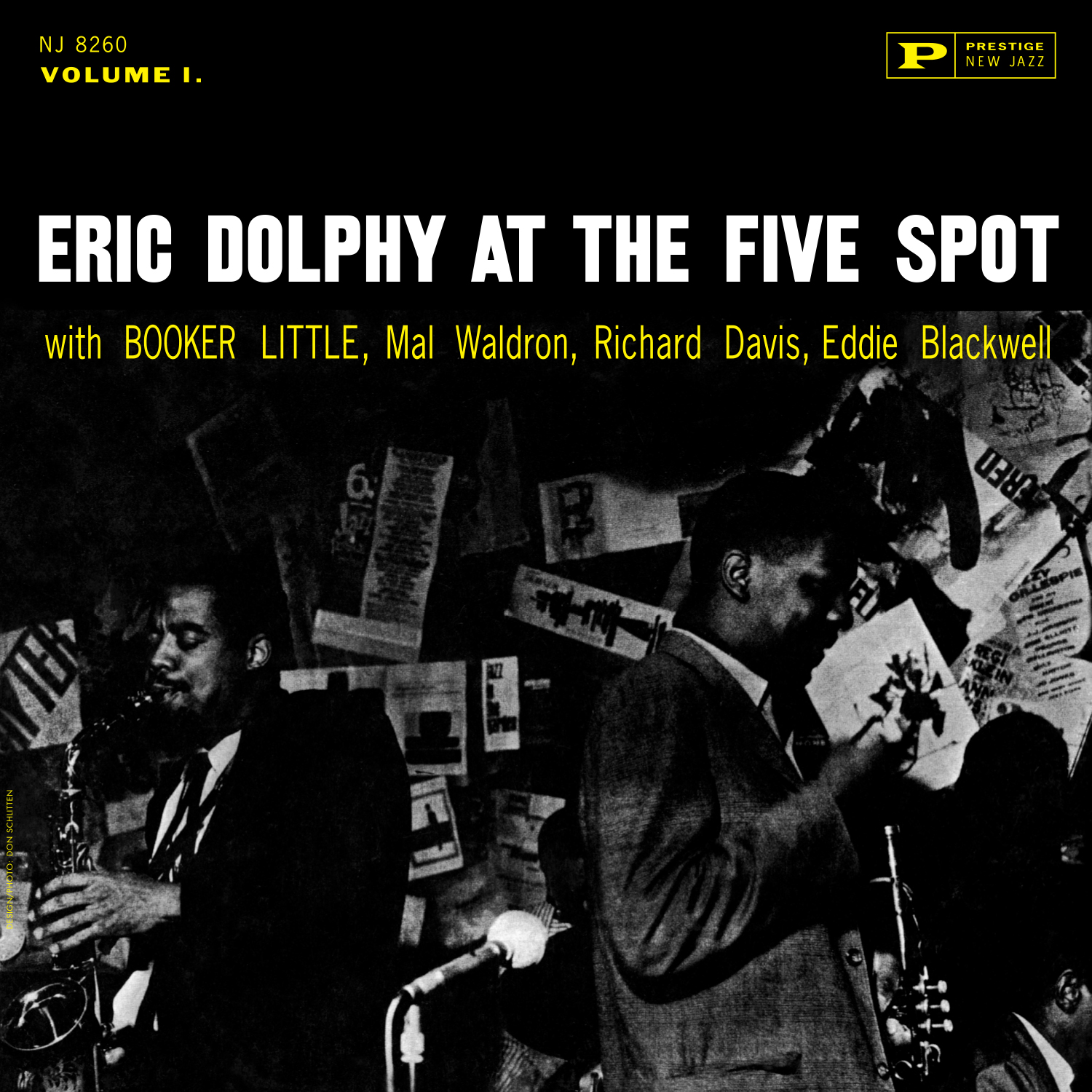
At the Five Spot, Volume 1 points to a particular place and date: July 16, 1961, at New York’s Five Spot Café. Eric Dolphy appears with Booker Little, Mal Waldron, Richard Davis and Ed Blackwell. Esmond Edwards produced the recording, which New Jazz released later that year. The LP contains just three pieces, but their extended forms allow substantial room for developing themes, establishing relationships and passing musical responsibility from one voice to another.
The venue has an important place in modern jazz history; the immediate attraction of this record is the encounter between these five musicians. A club performance offers different circumstances from a sequence of tightly proportioned studio selections. An idea can be pursued at greater length, with players responding to what develops inside the group. A composition still supplies a point of departure. Duration alone does not explain musical freedom: the interesting questions concern what the musicians do with that space and how they maintain a meaningful continuity.
Dolphy plays alto saxophone and bass clarinet on this first volume. None of its three selections features flute. That distinction is useful because his wider instrumental range and the other releases associated with the Five Spot recordings can easily blur the identity of a particular album. Here, alto is his instrument on “Fire Waltz” and “The Prophet,” while “Bee Vamp” features bass clarinet. The change adds another dimension to the contrast between the first side’s two compositions.
Within a collection, Volume 1 is therefore a clearly defined document. It works as an individual album while also offering a route into the partnership between Dolphy and Little. Both were composers and horn players with independent ideas. Their interaction need not be understood as agreement on a single musical language. Differences themselves create opportunities for response and development. The extended pieces allow those relationships to be followed beyond an opening theme or an isolated solo passage.

Five players, three composers, one unfolding performance
Booker Little plays trumpet on all three selections and contributes “Bee Vamp” as a composer. His role is visible at two levels: he supplies part of the material and takes part in its immediate development during performance. The Little–Dolphy connection is one of the recording’s principal attractions. A useful listening approach is to consider their lines separately before attending to moments when an idea from one player appears to invite a response from the other.
Mal Waldron plays piano and supplies the opening composition, “Fire Waltz.” His contribution prevents the album from being reduced to a meeting between two horn players. The pianist helps shape the repertoire as well as the performance. The relationship between repetition, harmonic orientation and new movement offers a distinct avenue into the music. A restrained figure can acquire considerable significance during an extended improvisation when other voices establish a relationship with it.
Richard Davis on double bass and Ed Blackwell on drums complete the quintet. Both participate throughout the original programme. The length of the pieces gives their responsibilities particular importance: a shared sense of time must continue as foreground voices and directions change. Following bass and drums consciously reveals more than accompaniment behind the soloists. It directs attention towards the circumstances in which those solo lines develop. Within a quintet, relatively small rhythmic decisions can substantially alter the character of a passage.
The three compositions are by Waldron, Little and Dolphy. Three members determine the starting material, and all five determine how it develops in performance. This distribution helps account for the record’s internal variety. Several compositional perspectives stand alongside one another, with the group creating continuity between them. For listeners who value small-group jazz, the combination of individual authorship and collective work is a substantial part of the appeal. Each musician contributes to the identity of the whole while retaining an audible role of his own.

“Fire Waltz,” “Bee Vamp” and an entire side for “The Prophet”
“Fire Waltz” opens the LP with Dolphy on alto saxophone. The documented tracklist gives it approximately thirteen and a half minutes. That scale creates different proportions for the theme and individual contributions than a compact song performance would allow. Keeping the opening material in mind offers a useful reference as the music develops. One can follow how far the players move from that beginning and how they establish connections again. The theme remains a point of orientation throughout the larger form.
Little’s “Bee Vamp” follows at roughly twelve and a half minutes, with Dolphy switching to bass clarinet. Another composer and another horn colour change the approach while the remaining personnel stay the same. This is one of the first side’s distinctive features: the quintet does not need a change of membership to alter the relationships among its voices. Listeners who know Dolphy’s bass clarinet mainly from studio records can hear it here within a clearly defined, extended live group performance.
The whole second side belongs to Dolphy’s “The Prophet,” running a little over twenty-one minutes. He returns to alto saxophone for a performance that occupies the physical space of a complete record side. That is a tangible feature of listening to this LP. After turning it over, the listener can follow one piece without another interruption. The long form encourages attention to transitions and developments whose significance emerges through their relationship with what came before.
This LP contains exactly these three original selections. An alternate “Bee Vamp” from later expanded editions is not included, nor are “Like Someone in Love” and “Aggression” from Volume 2. Preserving that distinction maintains the identity of the first album. Collectors can separate releases drawn from the same recording context while focusing on this volume’s specific design: two compositions on the first side and one extended work on the second. The catalogue relationship becomes clearer without making the individual record feel incomplete.
The Analogue Productions Prestige reissue
Catalogue number APRJ 8260 identifies this Analogue Productions Prestige-series edition as a stereo LP at 33⅓ RPM. Kevin Gray is credited with mastering from the original analogue tapes. Manufacture is by Quality Record Pressings, with Gary Salstrom named for plating. The traditional tip-on jacket places the presentation within the physical conventions of the historical LP. These are specific details of this release and provide a practical way of distinguishing it from other editions of the same music.
The single-LP format preserves the original division particularly clearly. “Fire Waltz” and “Bee Vamp” share the first side, while “The Prophet” occupies the second on its own. For listeners who prefer to experience an extended jazz performance as a continuing development, this is a sympathetic arrangement. Comparison with other pressings remains a separate matter; format and manufacturing specifications alone cannot establish a universal sonic winner. They do provide a transparent basis for choosing the edition that fits an individual collection and listening routine.
The limited programme also encourages a focused encounter. Three pieces allow repeated attention to the differences between Waldron’s, Little’s and Dolphy’s material, and to the ways a single rhythm section responds across all three. Returning to the LP can mean choosing another musician to follow rather than seeking additional material. That is one of the quiet rewards of an album whose scope is substantial but clearly bounded.
At the Five Spot, Volume 1 documents five musicians meeting within extended forms. Dolphy and Little are prominent, while Waldron, Davis and Blackwell remain equally essential to the recording’s identity. You order from Michael 45 in Germany. We handle the US import and ship from Hilden. This is an album for listeners willing to give the group’s interaction time and attention, and for collectors who appreciate the possibilities of a complete record side as musical space.
More from the series: Analogue Productions Prestige
More by Eric Dolphy: Far Cry · Out There
Customer question: Buying Analogue Productions records in Europe
Series: Analogue Productions Prestige – all 50 records, musicians and session paths
Musicians
Participants and documented credit status. Track references correspond to the tracklist.
- Eric Dolphyportrait reference 1960alto saxophone A1/B1; bass clarinet A2Participation: All tracks
- Booker Littlecirca 1960/61trumpetParticipation: All tracks
- Mal WaldronpianoParticipation: All tracks
- Richard Davisdouble bassParticipation: All tracks
- Ed BlackwelldrumsParticipation: All tracks


Only the three original Volume 1 tracks. Recorded July 16, 1961, Five Spot Café, New York; produced by Esmond Edwards. No flute on these three tracks; Like Someone in Love and Aggression belong to Volume 2. No alternate Bee Vamp.

Reviews
There are no reviews yet.