Two saxophones and a shared musical language
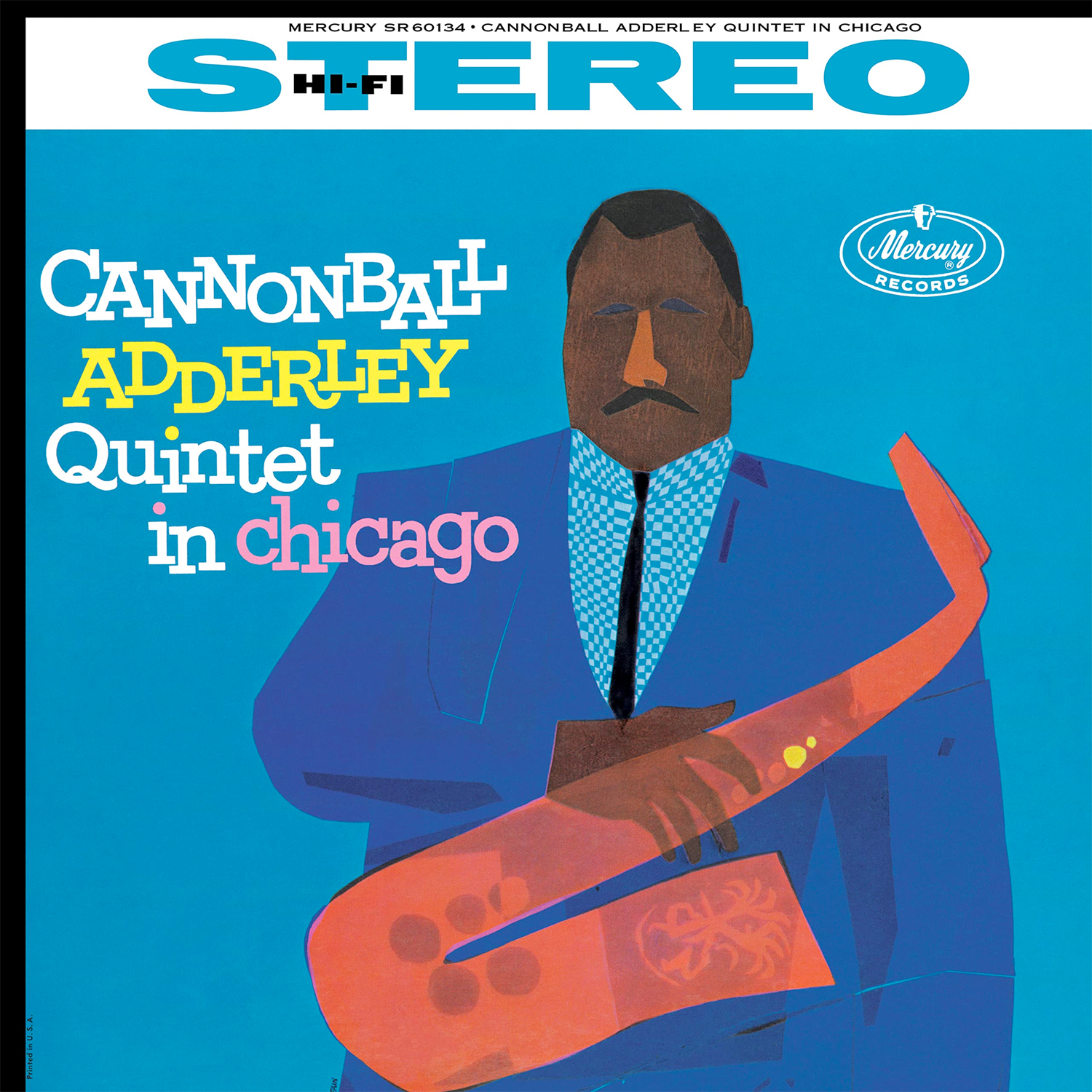
In Chicago brings Cannonball Adderley and John Coltrane together in a particularly clear setting: two saxophones, piano, double bass and drums. Recorded at Universal Recording in Chicago on February 3, 1959, the album appeared on Mercury in 1960. If you want to buy Cannonball Adderley’s In Chicago on vinyl, this Acoustic Sounds Series edition presents its six tracks on one 180-gram stereo LP at 33⅓ RPM. At its centre is a group whose members already knew one another through their work with Miles Davis.
There is no cornet beside Adderley’s alto here. John Coltrane’s tenor takes the second horn position; Nat Adderley is not part of the personnel. Wynton Kelly plays piano, Paul Chambers double bass and Jimmy Cobb drums. Miles Davis himself does not appear either. That distinction opens an interesting musical perspective: familiar partners step out of another band setting and organise their conversation around two different saxophone voices. The record can therefore be approached through Adderley, through Coltrane or through the musicians supporting them.
The date adds another point of interest. This session preceded the recordings for Kind Of Blue, on which the same musicians participated, although Bill Evans played piano on most of that album. In Chicago is nevertheless a separate undertaking, with its own repertoire, horn combination and bandleader. Standards share the programme with one Adderley composition and two pieces by Coltrane. The result is a self-contained six-track album whose interest extends beyond its proximity to another famous recording.
That clearly defined personnel makes an inviting starting point. You can follow the two horns on one playing and deliberately listen to Kelly, Chambers and Cobb on the next. A theme is introduced, a phrase continues and the accompaniment offers a new emphasis. Relationships of this kind are easy to follow in a small group. The record brings the musicians into focus without requiring their individual ways of playing to fit a single convenient label.

Limehouse Blues, a ballad and Wabash
Limehouse Blues opens side one. Philip Braham and Douglas Furber’s standard precedes two differently focused pieces: Stars Fell On Alabama and Wabash. The sequence gives the side an intelligible shape. First comes the group, then a setting that places one saxophone voice more directly in the foreground, followed by a composition from the leader. Each performance has room to develop beyond a brief statement of its theme, while the three together remain a manageable listening span on one side of the record.
Stars Fell On Alabama is an especially useful point of orientation. The supplementary personnel documentation lists this performance without Coltrane: Adderley plays in a quartet with the rhythm section. The ballad consequently offers an opportunity to follow his phrasing without moving directly between two horn voices. A melody takes on character through the spaces between notes as well as through the notes themselves, and through its relationship to the accompaniment. With a familiar standard, those decisions can be followed without first having to learn the shape of an unfamiliar piece.
Wabash is Cannonball Adderley’s own composition. Following material by other writers, it gives the leader a presence in the programme as a composer too. That role matters: Adderley is more than the name on the cover or one soloist among several celebrated musicians. One of the pieces begins with his own musical proposition. Alongside Coltrane’s contributions on the second side, it makes the album a more individual selection than a routine collection of standards chosen for a famous line-up.
Kelly, Chambers and Cobb provide continuity through these changes. They meet different melodic demands without the foundation having to be recast for each performance. A listener initially drawn to the saxophones can return to the record and concentrate on how the accompaniment makes transitions possible. There is no need to assign an immediate stylistic category to every contribution. The attraction is the interaction of distinct musical personalities, supported by a rhythm section that remains intact when the front line becomes smaller.

Coltrane’s compositions and another quartet perspective
Grand Central begins side two and is the first of Coltrane’s two compositions on the album. The Sleeper, also his, closes it. Between them sits You’re A Weaver Of Dreams, by Victor Young and Jack Elliott. The reverse side therefore has a shape of its own: two pieces by the tenor saxophonist frame a standard. This makes an appealing counterpart to side one, where Adderley’s Wabash follows two compositions by other writers. Both horn players contribute to the repertoire without dividing the record into two unrelated halves.
You’re A Weaver Of Dreams makes the change in perspective particularly clear. According to the supplementary encyclopedia, Adderley sits out while Coltrane plays with Kelly, Chambers and Cobb. Taken together with Stars Fell On Alabama, it creates an illuminating pair: the same rhythm section, each time with only one of the two saxophonists. Although the album is called Quintet In Chicago, it does not feature five musicians simultaneously throughout. The smaller combination is part of its design and should remain visible when considering the personnel.
At a little over seven minutes, The Sleeper is the edition’s longest track. It gives Coltrane’s writing further space at the end and closes the record without an added bonus performance or an unrelated session appended to the programme. The six pieces retain the character of a concentrated selection. Three tracks on each side invite you to hear a complete side before turning the record and changing perspective. The tracklist below brings the sequence and the documented timings together.
There are several routes into In Chicago for a collector. Listeners who mainly know Coltrane as a leader can hear him as a partner in Adderley’s session. Those arriving through Cannonball encounter a clearly identifiable rhythm section whose members appear on many other records. Kelly, Chambers and Cobb are not incidental names in the credits. They connect the contrasting pieces and give the shifts between quintet and quartet a common musical basis. Following those names can be as rewarding as following either horn player.
The Acoustic Sounds Series edition
This reissue carries catalogue number AMER 83201. Part of the Verve/UMe Acoustic Sounds Series, it was released in 2023. Ryan K. Smith handled the mastering at Sterling Sound from the original analogue tapes. Quality Record Pressings manufactured the single 180-gram LP, with the gatefold jacket made by Stoughton Printing. These details identify this particular edition. They should not be substituted for the original Mercury catalogue numbers or for the production specifications of other reissues of the same album.
The record runs at 33⅓ revolutions per minute, dividing its six performances across two sides. That preserves the sequence as a continuous album rather than breaking it into shorter groups. Record weight or the name of a pressing plant alone cannot guarantee a particular result on every playback system. The identifiable edition, complete programme and participating musicians are firmer starting points for choosing a copy. Here those details come together in a clearly specified release.
In Chicago belongs naturally in a collection organised around musical encounters as well as individual soloists. The movement between the two-horn group and the two quartet performances offers concrete ways to approach it again. You might begin with Adderley and stay with Kelly’s accompaniment, follow Coltrane’s own themes, or turn your attention to bass and drums. Its personnel is small enough to offer an immediate point of entry and varied enough to support several different listening perspectives over time.
You order from Michael 45 in Germany. We arrange the US import and dispatch from Hilden.
Artist page: All titles with John Coltrane
Musicians
Participants and documented credit status. Track references correspond to the tracklist.
- Cannonball AdderleyPortrait reference: 1958alto saxophoneParticipation: A1, A2, A3, B1, B3 · supplementary encyclopedia
- John ColtraneExisting portrait; not a session depictiontenor saxophoneParticipation: A1, A3, B1, B2, B3 · supplementary encyclopedia
- Wynton KellyPortrait reference: 1962pianoParticipation: All six tracks
- Paul ChambersPortrait reference: 1958double bassParticipation: All six tracks
- Jimmy CobbExisting portrait; not a session depictiondrumsParticipation: All six tracks


Cannonball Adderley is absent on B2 and John Coltrane on A2 according to the supplementary encyclopedia; edition credits list both without track assignments. Nat Adderley and Miles Davis do not perform here. Jack Tracy: production per encyclopedia and liner notes; Bernie Clapper: recording. Ryan K. Smith / Sterling Sound: mastering from original analogue tapes; QRP: pressing; Stoughton: jacket.

Reviews
There are no reviews yet.