


A different view of Evans, not a disguise
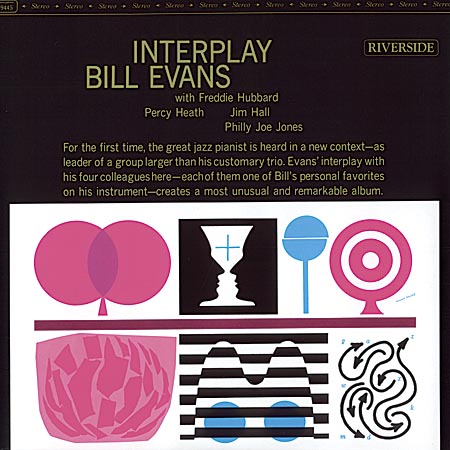
Interplay is an excellent way to broaden an overly narrow picture of Bill Evans. Freddie Hubbard’s trumpet and Jim Hall’s guitar join his piano, with Percy Heath on bass and Philly Joe Jones on drums. A horn changes the perspective immediately. Evans remains recognisable, but this is not the familiar world of his trio. He works inside a group with several melodic routes open at once.
Produced by Orrin Keepnews, the sessions took place in New York on 16 and 17 July 1962. The line-up deserves attention in its own right. Hubbard brings a different presence from a saxophonist, while Hall’s guitar offers an attack and decay unlike the piano’s. Those differences are not problems to be overcome by making everyone phrase alike. They are the materials from which the quintet builds its music.

Jim Hall: partner and independent voice
Evans and Hall also recorded the duo album Undercurrent in the same year. That connection helps explain their understanding without making the two projects interchangeable. Two instruments in a duo can share an entire musical structure between them. Here they must also leave room for trumpet, bass and drums. With two harmony instruments, restraint can be as important as invention.
Hall does not need to confirm every piano chord. His guitar can follow a single line, occupy another register or withhold an immediate reply. Evans can likewise provide a supporting figure without filling the whole harmonic space. These decisions make the album’s title tangible. Interplay does not mean everyone contributing constantly; it means remaining aware of what another musician is doing and choosing a useful response.

Familiar songs, changed relationships
“You and the Night and the Music”, “When You Wish Upon a Star”, “I’ll Never Smile Again”, “You Go to My Head” and “Wrap Your Troubles in Dreams” share the programme with Evans’s own “Interplay”. Recognisable melodies provide orientation. At the same time, the listener can notice how a song changes when trumpet outlines its shape and piano or guitar reshapes the surroundings.
The repertoire also identifies the two recording days. “When You Wish Upon a Star”, “You Go to My Head” and “Wrap Your Troubles in Dreams” were made on the first day; the remaining three pieces followed on the second. This need not support an invented story of hesitant beginnings and eventual perfection. It simply makes the practical scale of the sessions clear: a compact period of work yielded an album with several distinct moods.
Interplay and the later Sessions
Listeners familiar with The Interplay Sessions may have a larger release in mind. That collection combines this album with further recordings from August 1962, featuring Zoot Sims and Ron Carter in place of Hubbard and Heath. It contains a different line-up and additional music. The pressing offered here presents the original Interplay programme, so the two titles should not be treated as alternative names for identical contents.
Heath and Jones are especially rewarding to follow beneath the changing foreground voices. They keep the music mobile without flattening the individual characters of trumpet, guitar and piano. The album consequently welcomes both a melodic first encounter and closer listening. Starting with the standards, one can gradually discover how much personality lies in a concise accompaniment or an intentionally unfilled moment. Evans’s musical language has not been replaced; it has become visible from another direction.
More from Analogue Productions
More by Bill Evans: New Jazz Conceptions · Quintessence
Artist page: All titles by Bill Evans
Customer question: Buying Analogue Productions records in Europe
Musicians
Personnel checked against album sources.
- Bill EvansPiano
- Freddie HubbardTrumpet
- Jim HallGuitar
- Percy HeathBass
- Philly Joe JonesDrums



Reviews
There are no reviews yet.