
The piano takes its place in the conversation
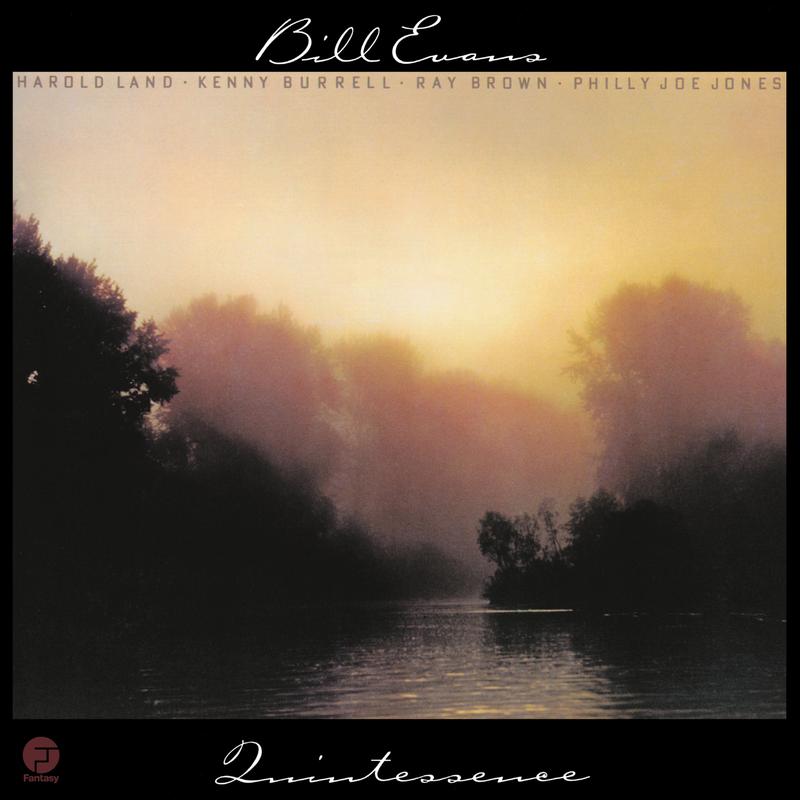
Quintessence places Bill Evans in surroundings that illuminate his playing differently from the familiar trio. Harold Land’s tenor saxophone and Kenny Burrell’s guitar add melodic voices, with Ray Brown and Philly Joe Jones completing the rhythm section. The piano does not have to introduce every thought or explain every transition. Evans can accompany, respond and place a contribution where the developing exchange invites it.
Recorded in May 1976 at Fantasy Studios in Berkeley and released in 1977, the album belongs to a different period from the early Riverside recordings. Helen Keane produced, with Phil Kaffel engineering. Keane, Evans’s manager and producer over many years, was working with a musician whose language was already distinctive but could still find fresh possibilities in a changed ensemble.

Familiar musicians, a new combination
These were Evans’s first recordings with Harold Land, Kenny Burrell and Ray Brown. The names may be familiar, but the particular combination was not simply an established touring band entering a studio. That creates its own interest. Five individual musicians bring extensive experience without relying on a long-settled set of shared routines. How they distribute the musical responsibilities becomes part of the record’s identity.
Philly Joe Jones connects the session with an earlier quintet project: he had played on Interplay in 1962. The parallel should not conceal the differences. Here a tenor saxophone joins the guitar; there it was Freddie Hubbard’s trumpet. Burrell is not Jim Hall, either. Quintessence is not an old formula populated with replacement names. Different instrumental colours and musical personalities alter the conversation itself.

Five pieces with room to develop
The programme begins with Kenny Wheeler’s “Sweet Dulcinea Blue”, followed by Michel Legrand’s “Martina”, “The Second Time Around”, Thad Jones’s “A Child Is Born” and Burrell’s “Bass Face”. Evans does not define the direction through a sequence of his own compositions. Material from several writers gives the group opportunities to explore contrasting forms and melodic characters.
At around ten minutes, “Bass Face” is the most extended performance. Its title alone draws attention to an area too easily overlooked when discussing a pianist’s album. Ray Brown’s role belongs near the centre of the listening experience. Following his part can be as revealing as hearing Burrell move between support and an independent line. Five musicians do not have to mean five simultaneous attempts to occupy the foreground.
Another route through Evans’s music
The sessions also produced “Nobody Else but Me”, subsequently issued elsewhere and included as a CD addition. It is not part of the original five-track programme presented on this LP. Such distinctions matter in Evans’s catalogue, where original albums, expanded CDs and later collections often sit beside one another. Quintessence is most clearly understood through its specific musical selection.
Listeners who primarily associate Evans with an inward-looking trio sound can discover more of his work as an ensemble pianist here. When does he allow a horn phrase to stand? Where does the guitar add colour without duplicating the piano? The answers emerge through practical musical decisions rather than a stated theory. This album provides an appealing alternative route through his work: not another instalment of the same trio story, but a chance to hear a strongly individual pianist in sustained exchange with four equally individual colleagues.
More from Analogue Productions
More by Bill Evans: Riverside Recordings · At Town Hall Vol. 1
Artist page: All titles by Bill Evans
Customer question: Buying Analogue Productions records in Europe
Musicians
Personnel checked against album sources.
- Bill EvansPiano
- Harold LandTenor saxophone
- Kenny BurrellGuitar
- Ray BrownBass
- Philly Joe JonesDrums


How Michael hears this edition
Listening impression · paraphrased from the video
Quintessence was a surprising discovery for Michael. He places this edition among the five best-sounding Bill Evans records he had heard up to that point and explicitly praises the mastering. This is his personal sonic assessment; he was unable to make a direct comparison with other editions of this album.

Reviews
There are no reviews yet.