Between Miles Davis and a new direction
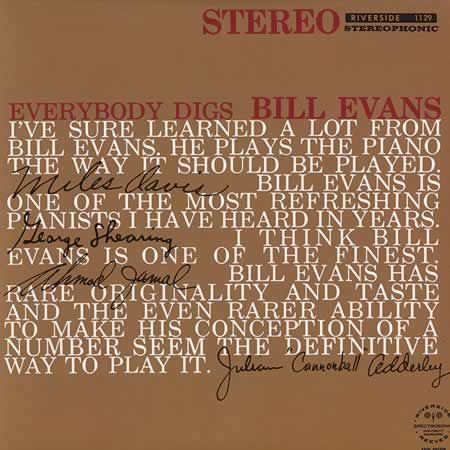
On December 15, 1958, Bill Evans recorded his second album as a leader at Reeves Sound Studios in New York. He had left Miles Davis’s sextet the previous month. “Everybody Digs Bill Evans” appeared on Riverside in March 1959, before the later trio with Scott LaFaro and Paul Motian made its first album. It captures an earlier combination of musicians and musical possibilities.
His partners here are Sam Jones on bass and Philly Joe Jones on drums. Their shared surname should not obscure their individual histories. Philly Joe and Evans knew each other through Miles Davis’s musical circle. Producer Orrin Keepnews assembled endorsements from fellow musicians for the cover, including Davis, Ahmad Jamal, George Shearing and Cannonball Adderley. Those recommendations gave the confident album title a very literal counterpart on the sleeve.

An introduction becomes a composition
For many listeners, “Peace Piece” is the first point of contact with this record. Evans developed the improvisation from an introduction to Leonard Bernstein’s “Some Other Time”. The repeating accompaniment took on a character of its own, and an independent musical form emerged above it. A passage intended to lead into a familiar song became something that could stand by itself.
“Peace Piece” is a solo performance. “Lucky to Be Me” and the short “Epilogue” passages also feature Evans alone at the piano, so the programme alternates between trio and unaccompanied playing. “Epilogue” appears twice in the track list because it closed both sides of the original LP. The repetition belongs to the album’s design; it is not an accidental duplication in the listing.

Beyond the famous solo
Gigi Gryce’s “Minority”, Cole Porter’s “Night and Day” and Sonny Rollins’s “Oleo” provide other settings. They give Sam Jones and Philly Joe Jones roles quite different from the silence around the solo pieces. That contrast makes the album a useful early portrait of Evans: he works inside a rhythm section, then takes complete responsibility for the timing of an unaccompanied performance.
In “Peace Piece”, follow the relationship between the repeating pattern and the freer movement above it. At what point does the tension change even though the accompaniment remains familiar? Then turn to “Oleo” and listen for the contributions of bass and drums. These are different ways of organising musical time. Selecting only the celebrated solo piece leaves out the neighbouring performances that help define its place on the original record.
About this edition
Analogue Productions’ AJAZ 1129 is a stereo double LP at 45 RPM on 180-gram vinyl, distinct from the similarly numbered single LP APJ 1129. The publisher lists Kevin Gray and Steve Hoffman at AcousTech Mastering in the mastering credits. All ten original programme entries are included, with “Epilogue” appearing twice. “Some Other Time”, subsequently added as a CD bonus, is not included. Distribution across four record sides necessarily differs from the original single LP’s layout.
Michael 45 stores the records in Germany and sends them from Hilden, removing the need for a personal US import and the related customs wait.
More by Bill Evans Trio: Explorations · Moon Beams
Artist page: All titles by Bill Evans
Customer question: Buying Analogue Productions records in Europe
Musicians
Documented selection of participating musicians. Personnel may vary by track; this list does not claim to be complete.
| Name | Instrument / role |
|---|---|
| Bill Evans | Piano |
| Sam Jones | Bass |
| Philly Joe Jones | Drums |
“Peace Piece” is a piano solo. Conflicting numerical track assignments in the secondary source are not retained.

Reviews
There are no reviews yet.