The complete ballet
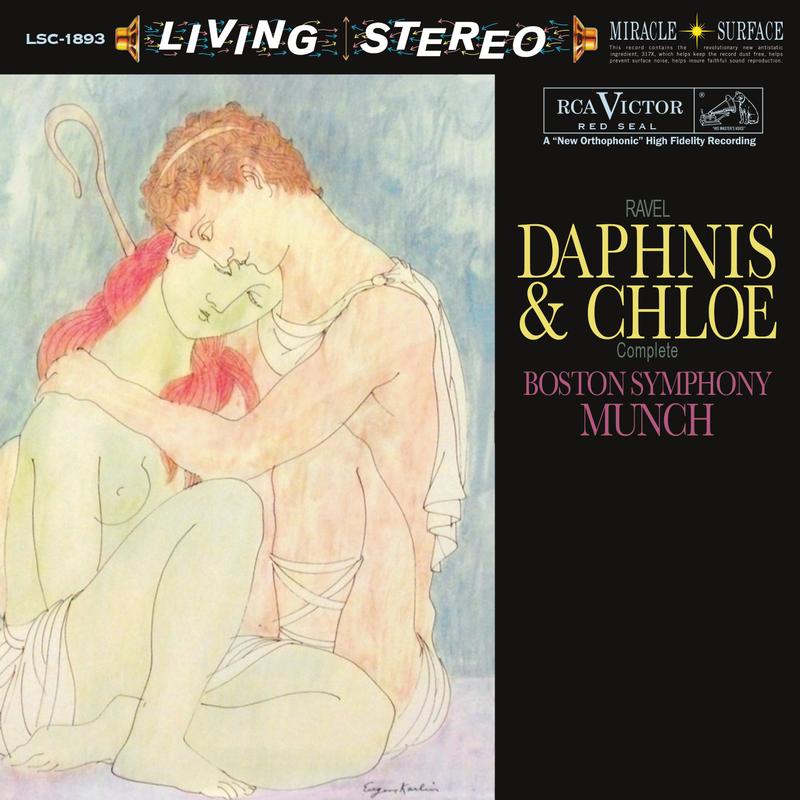
Many listeners meet Daphnis et Chloé through Ravel's second suite. Here, Charles Munch and the Boston Symphony Orchestra perform the complete ballet. Familiar passages regain their wider setting within a sequence of encounters, danger and reunion lasting almost an hour. The celebrated daybreak belongs to a much longer musical journey.
Recorded at Boston's Symphony Hall on January 23 and 24, 1955, the performance includes the New England Conservatory Chorus and Alumni Chorus. John Pfeiffer produced the sessions, with Leslie Chase engineering. The voices are part of this complete recording's performing forces, extending the possibilities of Ravel's orchestral writing.

Voices without a text
Ravel uses the chorus without sung words. Human voices become another colour within the large ensemble. Listen for the moments when they register as a separate group and the places where they merge with the instruments. No translation is needed: their contribution comes through entries, pitches, movement and the relationships between the parts.
Munch served as Boston's music director from 1949 to 1962 and worked extensively with French repertoire. This recording brings his relationship with the orchestra into contact with Ravel's varied instrumental resources. There are many opportunities to follow a single line before returning to the complete musical span. Transitions from quieter passages into more active dances offer particularly useful points of orientation.

An ancient story for the Ballets Russes
The source is the pastoral romance attributed to the ancient writer Longus. Ravel composed the music for Serge Diaghilev's Ballets Russes, and the first performance took place in Paris in 1912. His description, “symphonie chorégraphique”, connects dance with a symphonic conception. That relationship helps explain how the score sustains a long musical narrative without requiring the listener to see a stage production.
“Lever du jour”, the pantomime and the final dance are familiar from the second suite. In the complete recording, the music leading towards them is present too. Their position within the whole changes how those recognised moments are approached. The double LP divides the ballet across four sides, introducing three side changes into its continuity. The complete work remains intact, but the physical format creates several listening sections.
This edition
Analogue Productions AAPC 1893-45 belongs to the RCA Living Stereo 45 RPM Series. It contains two 180-gram stereo LPs at 45 RPM, pressed at Quality Record Pressings. The publisher credits Ryan K. Smith at Sterling Sound with mastering from the original two-track master tapes. A two-panel insert accompanies Munch's complete January 1955 ballet recording.
More by Charles Munch: Saint-Saens: Symphony No. 3 – A Stereo Spectacular · Ravel: Bolero
Customer question: Buying Analogue Productions records in Europe
Series: RCA Living Stereo – all 25 titles, conductors and soloists
Musicians
Documented selection of participating musicians. Personnel may vary by track; this list does not claim to be complete.
| Name | Instrument / role |
|---|---|
| Charles Munch | Conductor |
| Boston Symphony Orchestra | Orchestra |
How Michael hears this edition
Listening impression · paraphrased from the video
Michael praises this Living Stereo edition’s wide dynamics. Its presentation of Daphnis et Chloé gives him a particular sense of air and movement in the listening room.

Reviews
There are no reviews yet.