

Returning to Boston
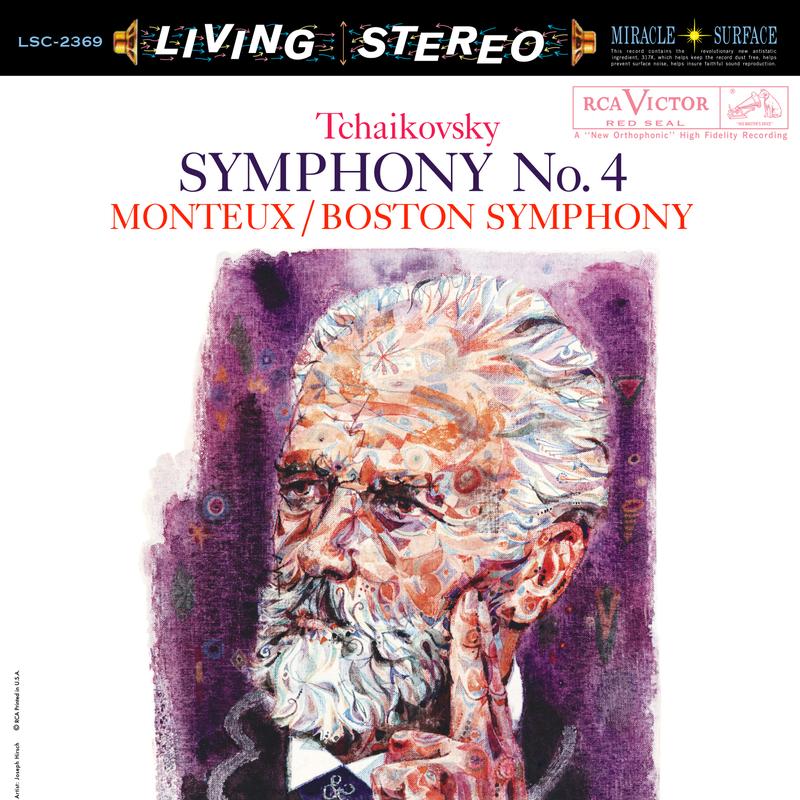
When Pierre Monteux recorded Tchaikovsky's Fourth Symphony with the Boston Symphony Orchestra on January 28, 1959, he was returning to a former musical home. He had led the orchestra from 1919 to 1924. Now, at the age of 83, he stood before it again in Symphony Hall. John Pfeiffer produced the recording, with John Crawford responsible for the engineering.
A substantial part of Monteux's career lay between those Boston years and this session. Earlier still, he had conducted the premieres of Stravinsky's Petrushka and The Rite of Spring, as well as Ravel's Daphnis et Chloé. Here the score is a symphony that builds an extended dramatic course from a number of recurring ideas. The distance from his first appointment makes the session a late reunion with the orchestra he had once directed.

A signal that returns
Tchaikovsky composed the Fourth in 1877 and 1878. He dedicated it to his patron Nadezhda von Meck without naming her in the dedication. Nikolai Rubinstein conducted the premiere in Moscow on February 22, 1878. The opening wind proclamation is one of the work's central reference points; in his explanation to von Meck, Tchaikovsky associated it with fate.
There is no need to turn that explanation into a fixed programme for every passage. A more concrete approach is to follow the idea's returns and notice what happens immediately before and after them. The first movement covers considerable ground, passing through different kinds of motion and expression. In this edition, it does not fit on a single side: after side A, the same movement continues on side B. This is an interruption within the movement itself.

Oboe, plucked strings and a folk song
The second movement opens with an oboe melody. The scherzo that follows features plucked strings and exchanges between different orchestral groups. Attention shifts from an extended melodic line to shorter impulses and their distribution around the ensemble. These two movements occupy the third side together, allowing them to be heard consecutively without turning the record.
In the finale, Tchaikovsky uses the Russian folk song “In the Field Stood a Birch Tree”. The opening idea also returns. Listen for the way that recollection intervenes in the last movement's course. The symphony's continuity depends on relationships between widely separated passages as well as on the contrast between its four movements. Monteux and the Boston players are the interpreters here of a score whose connections can be followed in increasing detail on subsequent hearings.
The opening movement occupies two sides
Analogue Productions presents this stereo recording on two 180-gram LPs at 45 RPM, pressed at Quality Record Pressings and supplied with an insert. The publisher credits Bernie Grundman with mastering from the original master tapes. Movement I occupies sides A and B, movements II and III share side C, and movement IV fills side D. The side change within the opening movement is therefore part of the practical choice involved in this format. The catalogue number is AAPC 2369-45.
Michael 45 keeps the records in Germany and sends them from Hilden, removing the need for a personal US import and the associated customs wait.
More from the series: RCA Living Stereo Series
Customer question: Buying Analogue Productions records in Europe
Series: RCA Living Stereo – all 25 titles, conductors and soloists
Musicians
Documented selection of participating musicians. Personnel may vary by track; this list does not claim to be complete.
| Name | Instrument / role |
|---|---|
| Pierre Monteux | Conductor |
| Boston Symphony Orchestra | Orchestra |

Reviews
There are no reviews yet.