Thirteen string players, no conductor
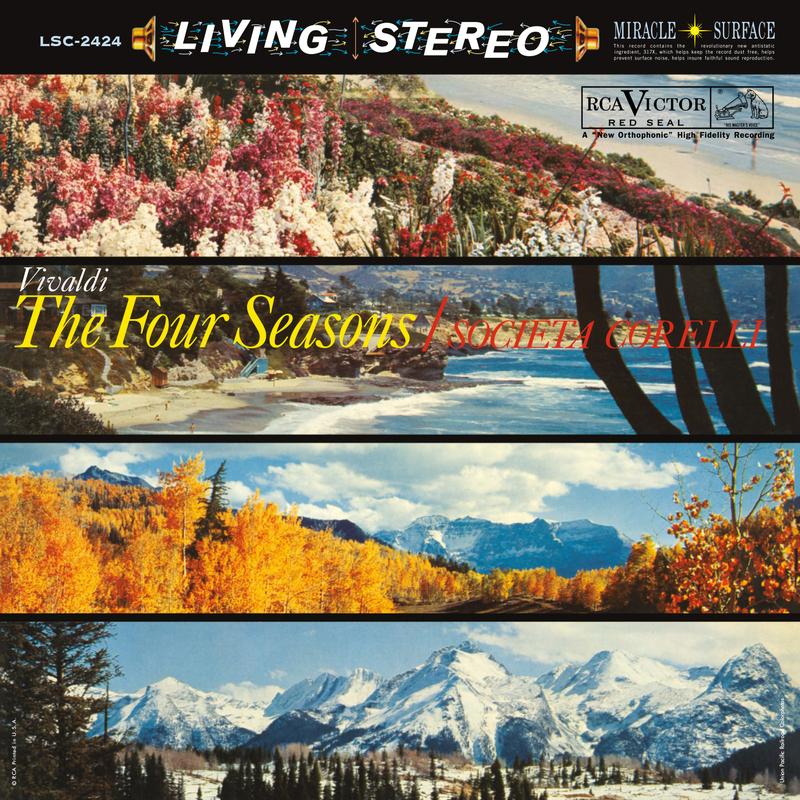
Società Corelli performs Vivaldi's Four Seasons as an ensemble of thirteen string players without a conductor. This is the compact group behind the RCA album issued in 1960. Recorded in Italy, it brings together four independent concertos now generally heard as a cycle. An exact recording date is not securely established for this edition.
The size and organisation of the ensemble provide a concrete starting point for listening. Follow the exchanges between the solo violin and the collective entries. Vivaldi does not simply place a tune over an unchanging accompaniment. Sometimes the individual violin comes forward; elsewhere the ensemble determines the course of events. Here, the players coordinate those changing responsibilities without a conductor standing in front of them.

Four concertos from a collection of twelve
The Seasons were published in Amsterdam in 1725 as the first four concertos in a collection of twelve, designated Opus 8. A sonnet accompanies each of these four concertos. The authorship of the poems is not securely known. They sit alongside music whose images of nature are explicitly marked in the score at numerous points.
Each concerto has three movements. Spring is in E major, Summer in G minor, Autumn in F major and Winter in F minor. These are therefore not four movements of a single symphony. Their individual three-part forms make hearing a complete season in one sitting particularly sensible. The layout of this edition preserves that unit: each record side contains one whole concerto, rather than dividing a season across a side change.

A dog, summer heat and sleeping revellers
The imagery extends beyond birdsong and thunderstorms. In the slow movement of Spring, a barking dog is part of the scene described alongside the music. Summer begins under oppressive heat. In Autumn's slow movement, the revellers settle into rest. Such indications offer a way to notice particular accompaniment figures and changes in the music's motion more closely.
You can keep the poems beside you, or begin with the musical devices alone. Which part maintains a repeated figure while another moves on? When does motion arise from short exchanges, and when from a longer solo line? The four concertos offer different answers. Even listeners already familiar with their best-known themes can use these small shifts of responsibility to follow the complete works with fresh attention. The natural images are points of reference within the composition, rather than a requirement to translate every note into a single fixed narrative.
One season on each side
This Analogue Productions stereo edition comprises two 180-gram LPs at 45 RPM, pressed at Quality Record Pressings, with an insert. The publisher identifies the original master tapes as the source and credits Matthew Lutthans at The Mastering Lab with lacquer cutting. Spring, Summer, Autumn and Winter each occupy a separate side, so no concerto requires turning the record partway through. The catalogue number is AAPC 2424-45.
Michael 45 keeps the records in Germany and dispatches them from Hilden, so customers can avoid organising a personal US import and waiting for customs processing.
More from the series: RCA Living Stereo Series
Also in another edition: Vivaldi: The Four Seasons
Customer question: Buying Analogue Productions records in Europe
Series: RCA Living Stereo – all 25 titles, conductors and soloists
Musicians
Documented selection of participating musicians. Personnel may vary by track; this list does not claim to be complete.
| Name | Instrument / role |
|---|---|
| Società Corelli | Ensemble |

Reviews
There are no reviews yet.