An advance changes the direction
When the Wailers found themselves stranded in London in the early seventies, an international album career was far from certain. Difficulties surrounding their work with Johnny Nash had left the group without the money to return home. Road manager Brent Clarke introduced them to Chris Blackwell. The Island founder provided a £4,000 advance for the journey back and the recording of an album. That opportunity led to Catch a Fire, released in 1973.
This background helps explain the record's particular place in the Wailers catalogue. An experienced Jamaican group gained the opportunity to make an album for a different distribution network. Marley, Tosh and Bunny Wailer already had a shared history, repertoire and working relationship. They brought distinct voices and established musical experience into the project. What changed was the framework in which those resources would be recorded, presented and heard by an international audience.

Nine songs forming a complete journey
The sequence opens with “Concrete Jungle”. “Slave Driver” leads into Peter Tosh's “400 Years” and “Stop That Train”, before “Baby We've Got a Date” closes the first half. The second begins again with “Stir It Up”, moving through “Kinky Reggae” and “No More Trouble” towards “Midnight Ravers”. Following that full progression gives familiar songs neighbours that change their emphasis. The album has relationships between tracks as well as recognisable individual performances.
Social experience, personal relationships and religious ideas coexist without requiring a single narrative tone. Tosh remains a distinct writer and singer within the programme. Bunny Wailer belongs to the ensemble alongside the Barrett brothers on bass and drums. For listeners most familiar with Marley's later albums, this configuration offers another understanding of the Wailers name. The three original singers still share a recording history here, and that relationship is essential to the album's identity.

The recording passed through several places
The foundations were recorded in Kingston during 1972, including work at Dynamic Sound, Harry J's and Randy's. Tony Platt later described the eight-track tapes, on which multiple instruments sometimes occupied a shared track. In London, he recorded additional parts by guitarist Wayne Perkins and keyboard player John “Rabbit” Bundrick. The familiar Island version emerged from those additions and the subsequent mixing work.
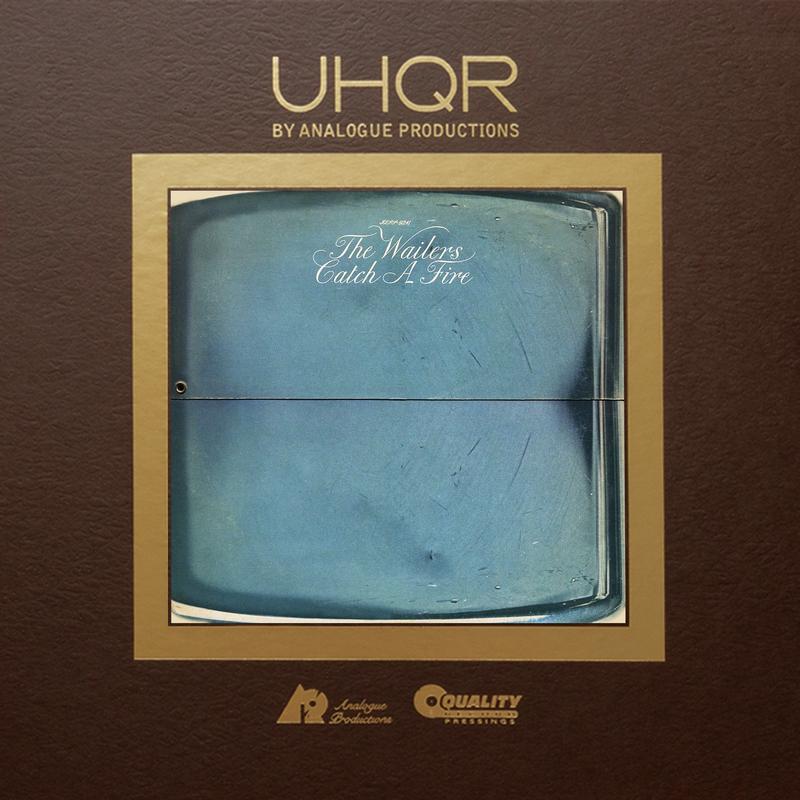
The presentation has its own history. Rod Dyer and Bob Weiner designed an opening cigarette-lighter sleeve for the first release, requiring elaborate hand assembly. The familiar Marley portrait followed later. Artwork, mixes and programmes have since appeared in different combinations across reissues. Choosing an edition by its documented specifications is therefore useful. The famous album title alone does not establish the jacket, the particular version or the arrangement of the music across physical sides. Those details belong to each individual release.
This edition: one UHQR record at 33⅓ RPM
AUHQR 0024 is the announced single-LP version on 200-gram Clarity Vinyl at 33⅓ RPM. It preserves the original division of five tracks on the first side and four on the second. The practical difference from the separate 45 RPM double LP is straightforward: the programme requires one side change. Quality Record Pressings is specified as the pressing plant, with Frank Arkwright and Ryan K. Smith at Abbey Road credited for mastering from the original master tape.
As of 10 September 2026, the publisher has not announced an arrival date. The nine-track programme points towards the Island version without explicitly confirming the mix. A particular lighter-style jacket is therefore not promised, nor is a verified listening result. This edition's defining attraction is the original two-part album sequence in the announced UHQR presentation.
You order from Michael 45 in Germany. We arrange the US import and dispatch from Hilden. Editions not currently in stock are dispatched after the goods arrive.
Also on SACD: Catch A Fire
Also on 45 RPM vinyl: Catch A Fire
Artist page: All titles by Bob Marley & The Wailers
Customer question: Collecting UHQR records: limited editions of great albums
Series: UHQR – all 31 editions with pressing run and mastering
Musicians
Documented selection of participating musicians. Personnel may vary by track; this list does not claim to be complete.
| Name | Instrument / role |
|---|---|
| Bob Marley | Vocals, Guitar |
| Peter Tosh | Vocals, Guitar, Piano, Organ |
| Bunny Wailer | Vocals, Congas, Bongos |
| Aston "Family Man" Barrett | Electric bass |
| Rita Marley | Backing vocals |
| Marcia Griffiths | Backing vocals |
| Robbie Shakespeare | Electric bass |
| Tommy McCook | Flute |
| Jean Alain Roussel | Keyboards, Piano |
| Winston Wright | Organ |
| Francisco Willie Pep | Percussion |
| Chris Karan | Percussion |

Reviews
There are no reviews yet.