A studio full of familiar voices
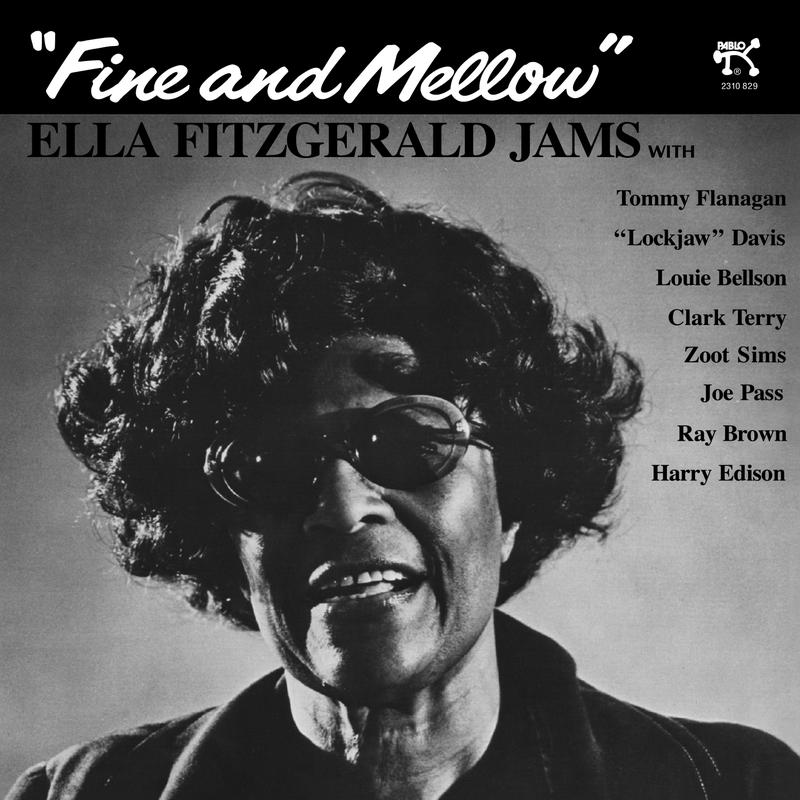
On January 8, 1974, Ella Fitzgerald joined a group in Los Angeles whose names tell a small history of jazz by themselves. Fine and Mellow was recorded at MGM Studios and released in 1979 on Norman Granz's Pablo label. Its subtitle, Ella Fitzgerald Jams, sets out the idea: a singer in direct exchange with improvising musicians, supported by shared repertoire and years of experience.
Through Jazz at the Philharmonic, Granz had spent decades bringing strong musical personalities together. That approach also informs this studio session. Harry “Sweets” Edison and Clark Terry contribute trumpet and flugelhorn voices, with Eddie “Lockjaw” Davis and Zoot Sims on saxophones. The line-up offers different ways of speaking within a shared tradition. Their individual characteristics are part of what makes the conversation with the singer worth following.

A Billie Holiday song opens the door
The title song was written by Billie Holiday. Fitzgerald takes on a blues whose history is closely associated with another great singer. Personal phrasing becomes crucial: where a line begins, how long a syllable lasts and what sort of response it allows. The form provides common ground without requiring the performers to surrender their individual expression.
The programme moves from Ellington's “I'm Just a Lucky So and So” and “Rockin' in Rhythm” to “'Round Midnight”, “The Man I Love” and “Polka Dots and Moonbeams”. Nine selections connect blues, swing and ballads. Familiar melodies provide starting points from which changes become easy to follow. Even without knowing every tune, the shifts between storytelling, rhythmic play and instrumental answers give the session its shape.

Accompaniment with room to move
Pianist Tommy Flanagan, guitarist Joe Pass, bassist Ray Brown and drummer Louie Bellson form the rhythmic foundation. They can support and comment at the same time. A piano chord answers the voice differently from a short guitar figure, while bass and drums maintain continuity. This allows the ensemble to move fluidly between close accompaniment and passages that give individual musicians more space.
The ballads reveal how many different accents a familiar melody can accommodate. In the faster numbers, the relationship between vocal phrasing and pulse becomes more prominent. Fine and Mellow consequently offers a way into Fitzgerald's work beyond a collection of celebrated songs. It lets the listener follow her within a group of distinctive soloists, where shared timing is an essential part of the album's identity.
This LP edition
Analogue Productions issues AAPJ 190 in its Pablo series as a single 180-gram LP playing at 33⅓ rpm. Matthew Lutthans mastered it at The Mastering Lab from the original analogue master tapes. Quality Record Pressings handles the pressing, and the packaging includes a single-pocket Stoughton tip-on jacket. The release presents the nine-track Fine and Mellow album, documenting the 1974 studio session.
More by Ella Fitzgerald: Take Love Easy · Clap Hands, Here Comes Charlie!
Customer question: Buying Analogue Productions records in Europe
Series: Pablo – all 30 records, musicians and the session book
Musicians
Documented selection of participating musicians. Personnel may vary by track; this list does not claim to be complete.
| Name | Instrument / role |
|---|---|
| Ella Fitzgerald | Vocals |
| Clark Terry | Flugelhorn, Trumpet |
| Zoot Sims | Tenor saxophone |
| Joe Pass | Guitar |
| Tommy Flanagan | Piano |
| Ray Brown | Double bass |
| Louie Bellson | Drums |
How Michael hears this edition
Listening impression · paraphrased from the video
On this Pablo edition, Michael particularly enjoys hearing Ella Fitzgerald and the accompanying musicians improvise together. Despite that freedom, he finds the music very accessible. Their accomplished interplay is what makes the recording so interesting and surprising to him. This is a personal impression of the performance, rather than a pressing comparison.

Reviews
There are no reviews yet.