One piano, one voice
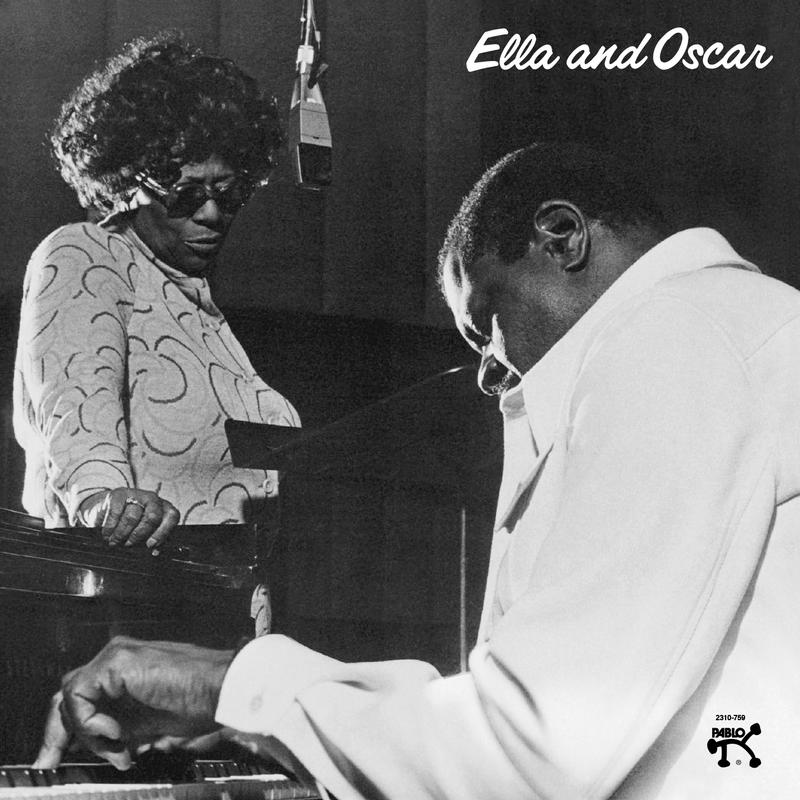
On May 19, 1975, Ella Fitzgerald and Oscar Peterson recorded nine standards in Los Angeles. Norman Granz produced the session for his Pablo label. Voice and piano remain alone throughout the first side. Such a small ensemble brings individual decisions into focus: the beginning of a phrase, a momentary delay, or the chord Peterson places after Fitzgerald's final syllable. The title Ella and Oscar describes the record's central idea with fitting simplicity.
Both artists were central to Granz's musical world. Here they meet without a horn section or drummer. Peterson can shape the harmonic movement while Fitzgerald reshapes a melodic line. Their roles remain clear but flexible. The piano takes on rhythmic responsibilities, and the singer's timing contributes to the pulse just as directly. The performance depends on what each musician leaves available for the other.

Familiar songs as common ground
“Mean to Me” opens the sequence, followed by songs including “How Long Has This Been Going On?” and “When Your Lover Has Gone”. Each arrives with a history of its own. A turn in the melody or a harmonic change gives the musicians a starting point for their personal interpretation. Even listeners unfamiliar with the repertoire can follow the exchange between a sung line and the piano's answer.
“More Than You Know” and “There's a Lull in My Life” complete the first side. Listen to the moments when accompaniment becomes an independent piano voice. Peterson may support a line with a few chords and develop the next gap more fully. Fitzgerald's breathing, phrasing and the length of a syllable help determine how much space becomes available. The small ensemble makes that shared work unusually easy to follow.

Ray Brown joins on side two
With “Midnight Sun”, Ray Brown's double bass expands the duo into a trio. He appears on all four selections on the second side, continuing through “I Hear Music”, “Street of Dreams” and “April in Paris”. Turning the record therefore brings a change of personnel as well as programme. The bass introduces another melodic and rhythmic voice, allowing attention to move among three players while the intimate scale remains intact.
As the closing selection, “April in Paris” has considerably more time to develop. At a little over eight and a half minutes, it is much longer than the preceding performances. The compact songs lead into a more extended meeting between the three musicians. The album's sequence consequently traces a straightforward but effective development from duet to trio, particularly apparent when heard one side at a time.
This LP edition
Analogue Productions AAPJ 185 presents the nine-track original programme on a single 180-gram LP playing at 33⅓ rpm. Matthew Lutthans mastered the release at The Mastering Lab, with the publisher specifying the original analogue master tape as its source. Pressing is by Quality Record Pressings, and the stereo LP comes in a single-pocket Stoughton tip-on jacket. Brown's contributions are confined to the second side; the programme does not include the additional recordings found on later CD editions.
Customer question: Buying Analogue Productions records in Europe
Series: Pablo – all 30 records, musicians and the session book
Musicians
Documented selection of participating musicians. Personnel may vary by track; this list does not claim to be complete.
| Name | Instrument / role |
|---|---|
| Ella Fitzgerald | Vocals |
| Oscar Peterson | Piano |
| Ray Brown | Double bass |
Ray Brown appears on part of the album; this is not a trio throughout.

Reviews
There are no reviews yet.