Two pianists share a session
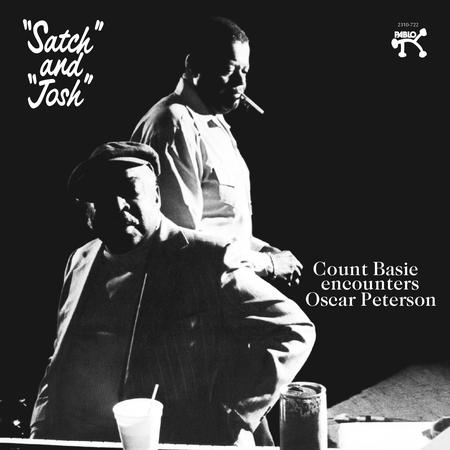
On December 2, 1974, Count Basie and Oscar Peterson met for a studio recording in Los Angeles. “Satch” and “Josh” places two markedly different piano personalities side by side. The instrumentation immediately raises a question: how do two pianists share the same musical space when both have a voice of their own and neither is simply there to accompany the other?
Three more musicians help shape the answer. Freddie Green plays guitar, Ray Brown double bass and Louie Bellson drums. Green had been closely associated with Basie’s orchestra since 1937; Brown spent many years in Peterson’s trio. The rhythm section therefore brings two musical histories into the room as well. Basie also plays some organ on the recording, extending the range of instrumental colours available within this particular encounter.

New pieces and familiar connections
Six of the album’s ten selections carry joint writing credits for Basie and Peterson. They include “Buns”, “R.B.”, “Louie B.” and the closing “S & J Blues”. Some titles point directly towards the other musicians: “R.B.” to Ray Brown and “Louie B.” to Bellson. Their partners are consequently acknowledged in the programme itself, as well as in the performances that give it shape.
“Jumpin’ at the Woodside” reaches back into Basie’s band history, while “Lester Leaps In” leads to Lester Young. Both connect the meeting with repertoire from the classic Basie era. “These Foolish Things” and “Exactly Like You” add established songs from outside that immediate circle. Original material, standards and reminders of earlier musical associates sit together, giving the two pianists several different starting points for their shared work.

The guitarist between the keyboards
With two pianists named on the sleeve, attention naturally moves towards the keyboards. For one pass through the record, try redirecting it towards Freddie Green. His rhythm guitar belongs to Basie’s musical language. Listen for its contribution while piano figures change or a soloist takes more space. The continuity of an ensemble like this is built between the conspicuous moments as well as within them.
Then return to the two featured players. How long are their responses? How do they handle a pause, and when do accompaniment and solo overlap? “These Foolish Things” and “Jumpin’ at the Woodside” provide contrasting settings for those questions. There need be no winner in the comparison. Its interest lies in how two musicians with individual vocabularies respond to the same partners and the same material.
About this edition
Analogue Productions’ AAPJ 189 is a stereo single LP at 33⅓ RPM on 180-gram vinyl. Matthew Lutthans handled the mastering at The Mastering Lab, with the publisher identifying original analogue tape as the source. Quality Record Pressings manufactures the record, and Stoughton Printing supplies the tip-on jacket. The ten selections from the original album are included. Three further recordings from the same session appeared subsequently on compilations and are not part of this LP programme.
Michael 45 keeps the goods in Germany and dispatches from Hilden, so German and EU customers can avoid a private US import and the associated customs wait.
🎧 Review video: 6 Rock, Blues, Jazz Records for Beginners and Pros
https://www.youtube.com/watch?v=lucYP_obV1c
More from the series: Analogue Productions (Pablo)
More by Count Basie & Oscar Peterson: The Timekeepers
Customer question: Buying Analogue Productions records in Europe
Series: Pablo – all 30 records, musicians and the session book
Musicians
Documented selection of participating musicians. Personnel may vary by track; this list does not claim to be complete.
| Name | Instrument / role |
|---|---|
| Count Basie | Piano, Organ |
| Oscar Peterson | Piano |
| Freddie Green | Guitar |
| Ray Brown | Double bass |
| Louie Bellson | Drums |

Reviews
There are no reviews yet.