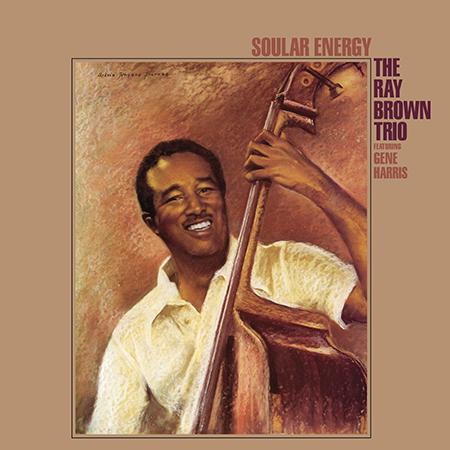





A bassist brings a pianist back on the road
Part of the story behind Soular Energy is Gene Harris's return to a wider audience. After many years with The Three Sounds, Harris had moved to Boise in the late 1970s and performed regularly at the Idanha Hotel. Ray Brown persuaded him to return to touring in the early 1980s. This album brings the pianist together with Brown on double bass and Gerryck King on drums. Recorded at Coast Recorders in San Francisco in August 1984, it belongs to the period in which Harris was establishing a new and lasting musical partnership within Brown's trio.
Brown brought experience from his years with Oscar Peterson and from extensive studio work in Los Angeles. Harris had followed a different path through the piano trio with The Three Sounds. Their histories meet on Soular Energy in a new eight-track programme. Carl E. Jefferson produced the session for Concord Jazz, while Phil Edwards handled recording and mixing. Seven selections feature the trio alone. One adds two guest musicians. That selective expansion gives the programme a particular shape, allowing the established relationship between piano, bass and drums to open briefly into another ensemble before returning to its core personnel.

Seven trio performances and one quintet
The guests are guitarist Emily Remler and tenor saxophonist Red Holloway. Both appear on Brown's composition “Mistreated But Undefeated Blues”. Within an album otherwise devoted to the trio, their presence has a distinct effect on the arrangement of the programme. Two additional melodic voices enter, creating different relationships among the players. Their contribution is best understood through that specific performance: they participate in one piece, while Harris, Brown and King form the consistent ensemble across all eight selections. The personnel therefore changes in a deliberate, limited way rather than moving through a succession of unrelated groups.
Remler was a younger guitarist with her own work for Concord, while Holloway brought a long background in rhythm and blues and jazz, including periods with Jack McDuff and Sonny Stitt. The quintet combines those experiences within one composition. “That's All” then returns the programme to the trio. On this double-LP edition, the two pieces share side C, so the change in personnel takes place within a single record side. It offers a clear development to follow: the ensemble gains two voices, explores that expanded setting, and then concentrates again on the relationship between the three principal musicians.

A repertoire of familiar meeting places
“Exactly Like You” opens the album, followed by “Cry Me A River”, “Teach Me Tonight” and Billy Strayhorn's “Take The 'A' Train”. The selection brings together standards from different backgrounds and lets the same musicians establish connections between them. “Easy Does It” points towards Count Basie, and “Sweet Georgia Brown” closes the programme. Familiar material can make interpretation easier to follow. A listener who knows the melody can retain its outline while paying attention to the choices of piano, bass and drums. The song supplies orientation; the particular combination of players determines the character of the performance taking place around it.
One useful first pass through the record is to follow Brown as an independent musical voice. His name leads the album's billing, but his role develops in relationship with Harris and King. A later listen can shift attention to the piano, then to the drummer's part in shaping the movement between them. Harris remained an important partner for Brown and recorded further albums with him. Soular Energy therefore stands early in a longer collaborative period. It captures an experienced pianist forming a new partnership and a bassist who had actively sought that musical personality for his own trio.
The Analogue Productions 45 rpm edition
Analogue Productions presents the album as AAPJ 268-45, spread across two LPs playing at 45 rpm. Kevin Gray handled the mastering at Cohearent Audio. The publisher identifies the original master tape as the source and credits Gary Salstrom with plating. Quality Record Pressings manufactures the records. The eight selections are distributed evenly, with two tracks on each side. The current publisher specification describes 180-gram vinyl and a Stoughton Printing tip-on gatefold jacket with redesigned artwork. Those details refer to the more recent version of an Analogue Productions release that has existed in an earlier form as well.
An older 200-gram edition shares the same catalogue number. The number alone consequently does not distinguish every physical version; weight and packaging provide additional identifying details on an individual copy. The connection to Kevin Gray's mastering and the complete album programme remains central. Musically, Soular Energy offers a clearly defined encounter: Brown, Harris and King as a trio, Remler and Holloway joining for one blues, and eight selections from the 1984 session. The double-LP format gives that meeting four sides while retaining the sequence through which the ensemble expands and then finds its way back to the trio.
You order from Michael 45 in Germany. We arrange the US import and dispatch from Hilden. Editions not currently in stock are dispatched after the goods arrive.
Customer question: Buying Analogue Productions records in Europe
Musicians
Participants and documented credit status. Track references correspond to the tracklist.
| Name | Instrument / role | Participation |
|---|---|---|
| Ray Brown | double bass, bandleader | Album personnel |
| Gene Harris | piano | Album personnel |
| Gerryck King | drums | Album personnel |
| Red Holloway | tenor saxophone | C1 |
| Emily Remler | guitar | C1 |
Red Holloway and Emily Remler guest on C1; the other seven selections are by the trio.

Reviews
There are no reviews yet.