Two distinctive voices inside one quartet
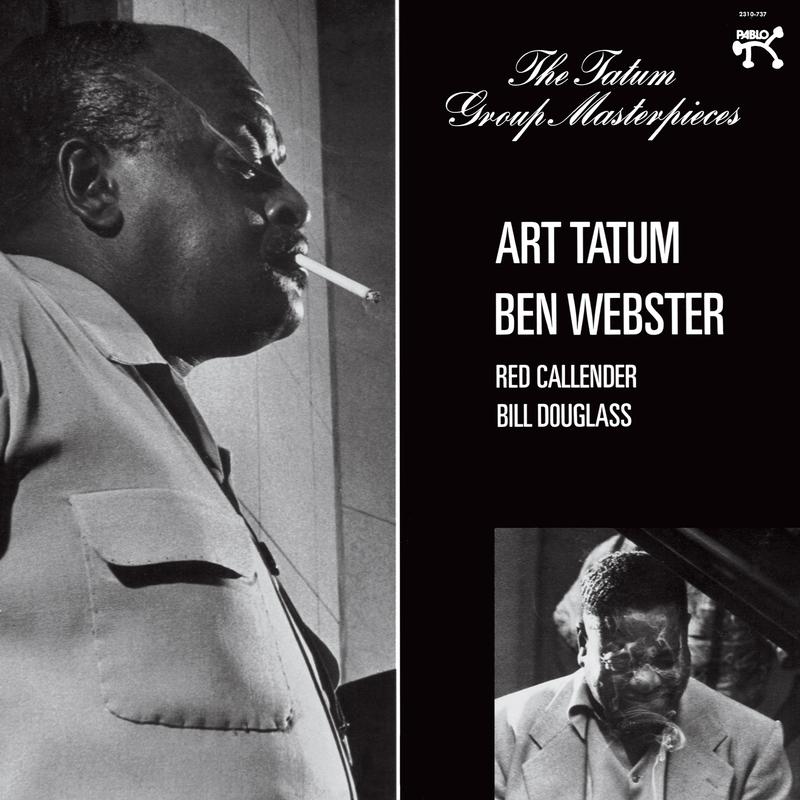
Art Tatum and Ben Webster bring markedly different musical personalities to The Tatum Group Masterpieces. The piano is not simply an accompaniment to the saxophone, and the tenor need not occupy every available space. Seven standards provide common reference points from which both musicians can depart and to which they can return. Red Callender on bass and Bill Douglass on drums complete the group. Together, they turn familiar songs into a quartet programme whose interest lies in the relationships between its voices. Move your attention between piano and saxophone and the same passage can be approached from different perspectives.
The session took place in Los Angeles on September 11, 1956, with Norman Granz producing. It was the last group date in Granz’s extensive Tatum recording project. Less than two months later, on November 5, the pianist died. That proximity gives the album historical significance, but need not transform every phrase into a retrospective farewell. The musicians perform a carefully chosen selection of standards, rather than a work announced as a final testament. The recording documents Tatum playing with three colleagues in a specific situation, which can be understood on its own terms without assigning intentions that the evidence does not establish.

The rhythm section belongs in the conversation
Callender and Douglass already knew Tatum’s playing from their participation in his quartet recording with Buddy DeFranco. That familiarity matters: they did not have to build their working relationship with the pianist from nothing. Callender was active in Los Angeles as both a bassist and a tuba player, although he plays bass here. Douglass had worked with Benny Goodman and was among the musicians who campaigned to end the racial division between the city’s local musicians’ unions. Those histories remind us that the two supporting names represent substantial careers, rather than interchangeable figures behind the featured performers.
Webster and Tatum, both born in 1909, need not be heard as contestants in a race to play the greatest number of notes. The changing allocation of musical responsibility is more rewarding. When does the tenor hold a melody together while the piano expands its harmonic surroundings? Where do bass and drums become particularly important in maintaining continuity? Such questions help reveal the ensemble as a whole. There are no vocals or additional horns in the line-up. The restricted setting makes it possible to follow the contributions of all four musicians across the record and consider how their individual decisions affect each other.

From Verve to Pablo, with a different sequence
The recording first appeared on Verve as The Art Tatum • Ben Webster Quartet. Pablo did not yet exist. Granz subsequently reissued the session in 1975 as part of The Tatum Group Masterpieces, and the running order changed. The original Verve album opened with “All The Things You Are”; the Pablo version begins with “Gone With The Wind”. This Analogue Productions LP follows that later Pablo sequence. Its title consequently reflects a new presentation of older recordings. It should not suggest that the performances were originally made for a label founded many years after the session took place.
“Gone With The Wind” is followed by “All The Things You Are”, “Have You Met Miss Jones?” and “My One And Only Love”. The second side contains “Night And Day”, “My Ideal” and “Where Or When”. The repertoire connects Broadway writers such as Jerome Kern, Cole Porter, and Richard Rodgers and Lorenz Hart with other established songwriters. All seven selections are pre-existing compositions. Later CDs added alternate takes that are not included here. This LP therefore presents a defined album programme rather than a complete record of every attempt made during the date. Its sequence is itself an editorial choice within the recording’s long release history.
A new cut of the Pablo programme
AAPJ 164 is a single 180-gram LP running at 33⅓ RPM, belonging to the first Analogue Productions Pablo reissue programme. Matthew Lutthans is responsible for mastering and lacquer cutting at The Mastering Lab. The publisher identifies the original analogue tape as the source; that wording is not expanded here into a more detailed, undocumented tape lineage. The recorded runout inscriptions support the identification of a new cut. This release is also distinct from the older two-LP 45 RPM edition. A shared album title and reissue company do not automatically mean identical mastering or an identical physical format.
Quality Record Pressings manufacture and a Stoughton single-pocket tip-on sleeve are specified. Discogs identifies the edition as mono, while the publisher does not explicitly state the channel format on its product page. Numbering applies to the initial subscriber copies and is not promised for every record. The Pablo presentation preserves the meeting of Webster, Tatum, Callender and Douglass through seven standards. Listeners drawn to the music by its celebrated soloists have an opportunity to hear their relationship as a quartet, taking the less prominent names just as seriously as the two featured on the front of the album. Michael 45 dispatches orders from Hilden, Germany, so you do not need to arrange your own US import. Please refer to the stated availability and delivery time for this item.
You order from Michael 45 in Germany. We arrange the US import and dispatch from Hilden.
Customer question: Buying Analogue Productions records in Europe
Series: Pablo – all 30 records, musicians and the session book
Musicians
Documented participants in this recording. Track references correspond to the tracklist.
- Art TatumpianoParticipation: Album personnel
- Ben Webstertenor saxophoneParticipation: Album personnel
- Red CallenderbassParticipation: Album personnel
- Bill DouglassdrumsParticipation: Album personnel


Quartet on all seven LP tracks. CD bonus takes are not included in this edition.

Reviews
There are no reviews yet.