

Three names and a complicated return
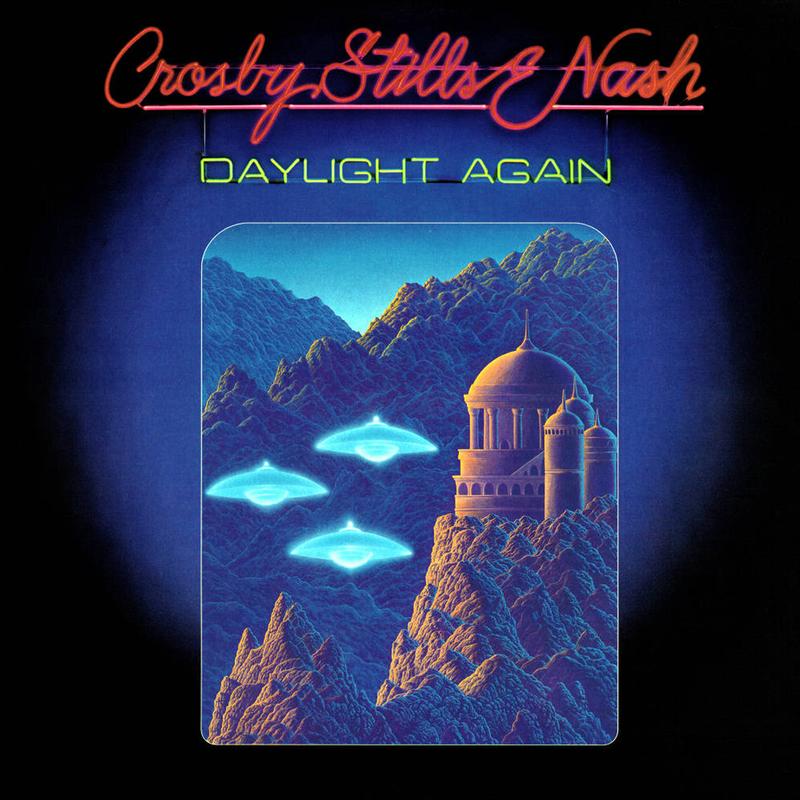
Daylight Again brings Crosby, Stills and Nash into a different musical decade without abandoning the vocal relationships at the centre of their identity. The album began around Stephen Stills and Graham Nash before David Crosby re-entered the picture, and that history can be felt in its changing perspectives. Acoustic guitars and close harmony now share space with polished keyboards and a broader studio palette.
Five years separate CSN, released in 1977, from Daylight Again. Work on the new record began with Stills and Nash during 1980 and 1981. Crosby’s later arrival matters because the sessions had already developed with other singers. Timothy B. Schmit and Art Garfunkel are part of that story, as is keyboard player and singer Mike Finnigan. The three names on the sleeve should not be read as a promise that exactly the same vocal trio appears in every song.
On his official album page, Graham Nash recalls Atlantic’s insistence on Crosby’s participation. Two recordings became particularly important to his presence: his own composition “Delta” and “Might As Well Have a Good Time”, written by Craig Doerge and Judy Henske. For “Delta”, Stills and Nash added their voices around Crosby’s existing multitracked harmonies. This was not a single fresh start on one shared studio date, but an album bringing together different stages of work.
That makes it a revealing chapter in the catalogue. Familiar vocal relationships meet music that, in 1982, no longer seeks simply to inhabit 1969. Compact pop songs, electric instruments and carefully developed arrangements are part of the change. For listeners attached to the early records, there is pleasure in following the qualities each writer retains and the new forms those qualities take.

Acoustic guitar and studio microphones: an independent illustration of songwriting and vocal arrangement, not a reconstruction of the sessions.
Songs looking outward and back
“Turn Your Back on Love” opens with urgency, using layered voices not as decoration but as the engine of the chorus. Nash’s “Wasted on the Way” is lighter in motion and more reflective in purpose, looking back at lost time while the harmonies suggest that repair remains possible. “Southern Cross” expands from Stills’s lead vocal into a wide, memorable refrain; its journey by sea becomes a way to think about heartbreak, distance and recovery. Crosby’s “Delta” changes the atmosphere again. The rhythm is more suspended, and his voice moves through the arrangement with the inward, unusual melodic logic that only he brings to the trio. At the close, the title piece connects present unease to historical conflict, then brings in “Find the Cost of Freedom” as a brief, sober coda. The album succeeds because maturity is not presented as certainty. These voices carry history, disagreement and endurance whenever they meet.
The eleven tracks can also be explored as a sequence of different storytelling perspectives. “Into the Darkness” follows “Southern Cross”, turning attention from the broad horizon inward again. After “Delta”, “Since I Met You” opens what was originally the second side. “Too Much Love to Hide”, “Song for Susan” and “You Are Alive” demonstrate how much remains beyond the two most familiar singles. One useful way in is to follow the lead singer first, then return to the responses and supporting voices on a later play.
“Southern Cross” is credited to Stephen Stills, Michael Curtis and Richard Curtis. Its voyage belongs to the song’s imagery; it is not evidence of a particular recording setting. Music videos accompanied the album, and a sailing vessel reappeared in the video for this track. Our illustration takes that association between travel and personal reorientation as an independent visual idea.
The ending reaches further back. Nash traces “Daylight Again” to Stills’ guitar picking beneath onstage stories about the American Civil War. Its movement into “Find the Cost of Freedom” connects the new album with a piece already released on the reverse of “Ohio” in 1970. Rather than simply closing with another chorus, the record leaves a question that extends beyond the immediate circumstances of its making.

Travelling with “Southern Cross”: an original illustration inspired by the song’s voyage.
The musicians behind the harmonies
Stills, Nash and Crosby are the principal artists, surrounded by a substantial group of experienced musicians. The line-up changes between tracks. Timothy B. Schmit adds vocal parts and plays bass on “Song for Susan”. Art Garfunkel contributes to the closing title track. Mike Finnigan combines backing vocals with organ and other keyboards. These contributions deserve individual names: the record’s vocal character comes from several distinct singers working together.
The rhythm sections have their own identities too. “Wasted on the Way” pairs Bob Glaub’s bass with Russ Kunkel’s drums, alongside contributions including Joel Bernstein’s acoustic guitar and Wayne Goodwin’s fiddle. For “Delta”, the credits name Leland Sklar on bass, Kunkel on drums and Dean Parks on electric guitar. Jeff Porcaro supplies the drums on “Since I Met You”. Joe Vitale, George “Chocolate” Perry and Joe Lala contribute elsewhere. The musician listing preserves these differences instead of assigning one blanket line-up to the entire record.
“Song for Susan” creates a small world of its own: Nash’s piano meets acoustic guitars, organ and three cellos. Wayne Goodwin is credited with the cello arrangement, performed by Roberleigh Barnhart, Ernie Ehrhardt and Miguel Martínez. Craig Doerge contributes several keyboard parts across the album and also co-wrote “Might As Well Have a Good Time”. Following these connections reveals a production shaped by many musical personalities, rather than anonymous accompaniment for three famous singers.
Daylight Again in the Atlantic 75 Series
The edition offered here is AAPA 022-45, part of Analogue Productions’ Atlantic 75 Series. The publisher credits Chris Bellman at Bernie Grundman Mastering with mastering directly from the original master tape. Manufacturer specifications identify Quality Record Pressings for the 180-gram vinyl and Stoughton Printing for the traditional tip-on gatefold jacket with two pockets. These details describe this particular double LP, not earlier Atlantic pressings or the separately available SACD.
The eleven original tracks occupy four sides: two tracks on A and three each on B, C and D. “Southern Cross” consequently opens side B, “Since I Met You” side C and “You Are Alive” side D. Bonus recordings from expanded CD editions are not included. Set the turntable to 45 revolutions per minute. The higher speed and distribution across two records are central to this edition’s design; they are not, on their own, proof that it must outperform every other pressing.
This edition presents Daylight Again across two LPs at 45 RPM. Four sides give the album’s meeting of classic CSN harmony and early-eighties studio texture a clearly defined physical setting. It is a thoughtful choice for collectors who want the group’s later work represented with the same attention given to its early landmarks, and for listeners drawn to “Southern Cross,” “Delta” and the deeper album sequence around them.
You order from Michael 45 in Germany. We arrange the US import and dispatch from Hilden.
The three principal musicians
 David Crosby — Vocals; “Delta”: composition and keyboards
 Stephen Stills — Vocals, guitars, keyboards, percussion; banjo on the title track
 Graham Nash — Vocals, guitars, keyboards, percussion, harmonica
Also on SACD: Daylight Again
Artist page: The whole Crosby, Stills, Nash & Young family
Customer questions: Atlantic 75: which titles are worth buying? · Buying Analogue Productions records in Europe
Series: Atlantic 75 Series – all 75 albums, time journey and the people behind Atlantic
 Joe Vitale — Drums
 Joe Lala — Percussion
 Jeff Porcaro — Drums

Reviews
There are no reviews yet.