England between imagination and everyday life
A solitary voice opens “Dancing With The Moonlit Knight.” Peter Gabriel asks a question, and from that narrow beginning grows music that repeatedly changes its scale. Guitars, keyboards and drums enter; the song acquires momentum, weight and a different direction. This opening already suggests much of the appeal of Selling England By The Pound. Genesis can tell a story while developing a musical form in which memorable melodies, sharp contrasts and extended instrumental ideas support one another. The narrative and the arrangement move together.
Released in 1973, the band’s fifth studio album features Peter Gabriel, Tony Banks, Steve Hackett, Mike Rutherford and Phil Collins. Their distinct musical interests remain unusually visible within the ensemble. Voice and flute, electric and acoustic guitars, bass, piano, organ, Mellotron, synthesizer and drums create a broad range of possibilities. The music moves between song, storytelling and instrumental development. It can take its time while keeping its shorter, immediately recognisable gestures in view. Those gestures give the listener points of orientation during the longer journeys.
The title directs attention towards England and towards the fate of a cultural identity when it becomes something to sell. The album approaches that subject through wordplay, characters, allusions and peculiar scenes of everyday life rather than a straightforward declaration. “I Know What I Like” sits alongside “The Battle Of Epping Forest,” while “Firth Of Fifth” shares the programme with the restrained “More Fool Me.” Recurring musical colours and a shared narrative sensibility provide continuity without requiring every song to belong to one continuous plot.
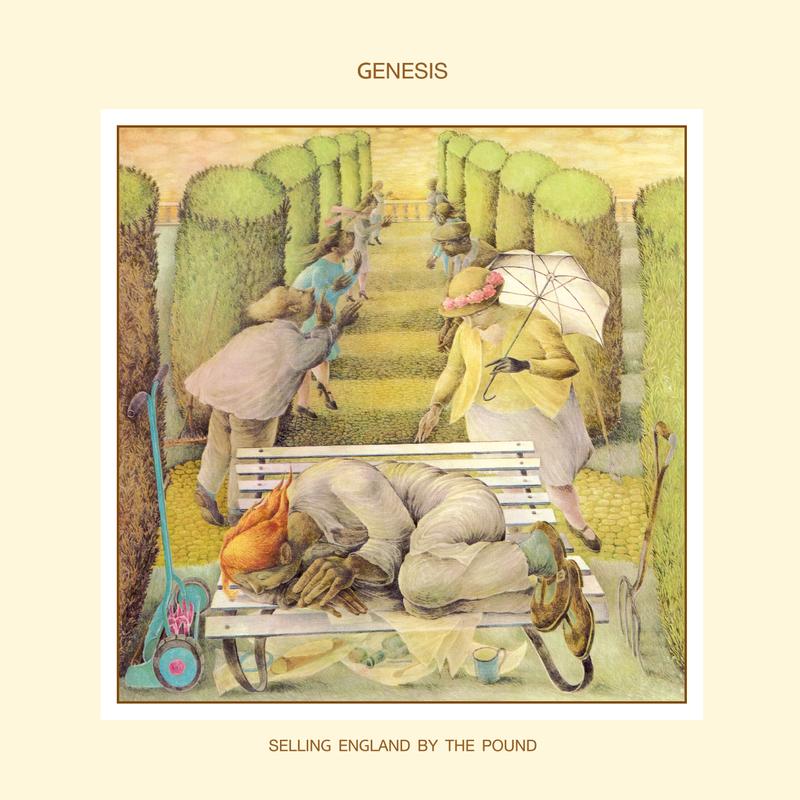
Recording took place in August 1973 at Island Studios in London. Genesis produced the album with John Burns, who also served as engineer, assisted by Rhett Davies. The cover is based on a painting by Betty Swanwick. Image and music share an interest in familiar things that become stranger under closer observation. On a first hearing, it is worth accepting those shifts of perspective. The album offers readily identifiable melodies, then opens spaces around them whose details become clearer over successive visits.

Five musicians and several routes through a composition
Tony Banks uses his keyboard instruments to give the music different surfaces. Piano can define the outline of a passage; organ and Mellotron can broaden it; a synthesizer can develop an independent melodic voice. Steve Hackett’s guitars contribute another kind of tension. “Firth Of Fifth” is particularly rewarding for following the way an idea can retain its identity while passing through different instruments. The piece gains coherence from these transformations as well as from its changes in volume and density. Its instrumental passages have a relationship with the song around them.
Mike Rutherford connects bass and twelve-string guitar with the other parts. His contribution helps explain the density of the acoustic passages before the drums become more prominent. Phil Collins responds to the changing forms with mobile, flexible rhythmic playing. An extended section need not remain tied to one unchanging accompaniment. Accents, transitions and small adjustments help the music continue moving inside its longer spans. Listening to the rhythm section reveals how much of the larger architecture depends on activity beneath the most immediately noticeable melody.
Gabriel often treats the vocal part as the voice of a character. A line can sound narrative, pointed or ironic, while his flute adds another colour to the instrumental picture. On “More Fool Me,” Phil Collins takes the lead vocal instead. That change matters: the short song supplies another vocal perspective within the same record. In this quiet moment, the relationship between voice and accompaniment is especially exposed. The music needs no extended instrumental development to establish its own place among the longer pieces. Its more intimate scale gives the surrounding arrangements a useful point of contrast.
The album credits also list instruments including oboe, electric sitar and cello, but do not provide an exhaustive track-by-track allocation of every instrument. The personnel overview therefore distinguishes album-level roles from specifically documented contributions. The music remains approachable without identifying every sound immediately. Genesis often use the boundaries between instrumental colours to alter a passage’s character, allowing a familiar idea to return from an unexpected direction. Following the relationship between parts can be more illuminating than treating the credits as a checklist of sounds to identify.

From Firth Of Fifth to The Cinema Show
“Dancing With The Moonlit Knight” and “I Know What I Like (In Your Wardrobe)” share the first side of this edition. The extended opening introduces the larger form, while the second song offers an immediate and recognisable refrain. Their contrast is integral to the album’s pacing. Genesis do not demand the same kind of attention from every selection. A compact song can complement a longer development, revealing another aspect of the group without leaving the musical world established by the opening track.
“Firth Of Fifth” begins side B. Its piano opening, vocal passages and instrumental expansion provide several approaches to a related set of musical ideas. Listeners initially drawn to Hackett’s guitar line can return to investigate the route leading towards it: the preparation in the keyboards, the flute’s role and the construction of the accompaniment. “More Fool Me” then reduces the scale. Collins’ voice and the restrained setting create a pause whose significance becomes especially clear within the complete sequence. The small song contributes to the larger balance.
Side C contains “The Battle Of Epping Forest” and “After The Ordeal.” The former concentrates the album’s storytelling into a busy character piece with numerous turns. Language and music make simultaneous claims on the listener’s attention. The instrumental that follows shifts the emphasis towards melodic lines and their accompaniment. It is not necessary to decode every verbal allusion immediately to appreciate this change. A dense narrative is followed by music that can express itself without words, providing a different way of listening within the same side.
“The Cinema Show” and “Aisle Of Plenty” conclude the album. On this particular 45 RPM edition, they appear together as a continuous side-D entry. The extended instrumental course of “The Cinema Show” rewards attention to the interaction of keyboard line, bass and drums. “Aisle Of Plenty” subsequently draws ideas from the opening back into view. The result is a sense of framing: after its many changes of direction, the record establishes a relationship between beginning and end that exceeds the simple succession of individual songs.
The Atlantic 75 edition cut by Chris Bellman
Analogue Productions presents Selling England By The Pound in its Atlantic 75 series as two 180-gram stereo LPs playing at 45 RPM, catalogue number AAPA 002-45. Chris Bellman cut the records at Bernie Grundman Mastering, with the original master tape identified by the label as the source. The distinction between the studio’s name and the engineer responsible is significant: Bellman performed the cutting for this edition. The complete album programme is retained across four sides.
The package includes a laminated Stoughton tip-on gatefold jacket with two pockets. Numbering and manufacture at Quality Record Pressings are documented for the first 2,000 copies. Unnumbered represses may come from QRP or RTI according to the release documentation, so the identification of the actual supplied batch matters. A numbered first pressing is not automatically implied by the product listing. Atlantic 75 identifies the reissue programme; the original album belongs historically to Genesis’ 1973 Charisma release.
The four sides create manageable listening sections. Side D preserves “The Cinema Show / Aisle Of Plenty” as a continuous conclusion. Consequently, this edition’s tracklist uses seven entries for the original eight-song programme. Nothing has been removed: the final two pieces are listed together. When comparing editions, that counting convention deserves attention alongside the speed and the number of records. Additional side changes are part of the practical experience of the 45 RPM format, while the musical sequence remains intact.
This edition is particularly inviting for listeners interested in the whole album: its songs, its transitions and the contributions of all five players. Selling England By The Pound holds its abundance of detail together through a strong sense of form. A refrain may become familiar immediately, while an instrumental passage reveals only on a later hearing how carefully it has been prepared. That relationship between direct appeal and gradually unfolding construction gives the return to the opening voice a continuing purpose.
You order from Michael 45 in Germany. We arrange the US import and dispatch from Hilden.
Artist page: All titles by Genesis and Phil Collins
Customer questions: Atlantic 75: which titles are worth buying? · Buying Analogue Productions records in Europe
Series: Atlantic 75 Series – all 75 albums, time journey and the people behind Atlantic
Musicians
Participants and documented credit status. Track references correspond to the tracklist.
- Peter GabrielExisting illustration · date unconfirmedvocals, flute, oboe, percussionParticipation: Album personnel; instruments not allocated track by track
- Tony BanksExisting illustration · date unconfirmedHammond organ, Mellotron, Hohner Pianet, ARP Pro Soloist, piano, twelve-string guitarParticipation: Album personnel; instruments not allocated track by track
- Steve HackettExisting illustration · date unconfirmedelectric guitar, nylon-string guitarParticipation: Album personnel; instruments not allocated track by track
- Mike RutherfordExisting illustration · date unconfirmedtwelve-string guitar, bass, electric sitar, celloParticipation: Album personnel; instruments not allocated track by track; cello in supplementary encyclopedia
- Phil CollinsExisting illustration · date unconfirmeddrums, percussion, backing vocals, lead vocalsParticipation: Lead vocals B2 · More Fool Me; other roles at album level


August 1973, Island Studios London. Genesis and John Burns: producers; John Burns: engineering; Rhett Davies: assistant. Betty Swanwick: cover painting; Barrie Wentzell: photography. Instruments credited at album level, not all on every track. Phil Collins lead vocals on More Fool Me only; incorrect side-D label attribution excluded. Chris Bellman / Bernie Grundman Mastering: cutting.
How Michael hears this edition
Listening impression · paraphrased from the video
Compared with his UK Porky first pressing, Michael hears greater openness, substantially more detail and better instrument separation, while retaining the original’s freshness and punch.

Pedro Gonzalez –
Overwhelming pressing. Cannot praise this enough. One of my top 10 albums in an immaculate edition. Thank Chad. And thank you shop team!
Manelus –
This one is perfect!
My previous Classic Records was very good, but this one, wow!
Roy Brezinski –
I own an original UK, original German and the Classic Records version.
Until the Atlantic 75 Analogue Productions release, the Classic was the best.
But this 45rpm Analogue Productions pressing smokes all others. It’s wonderful, wow, so clear, layered and dynamic.
Absolutely beautiful and worth the money.
Ralf Doerner –
Eine fantastische Platte die mit hervorragenden Klang. 🥰