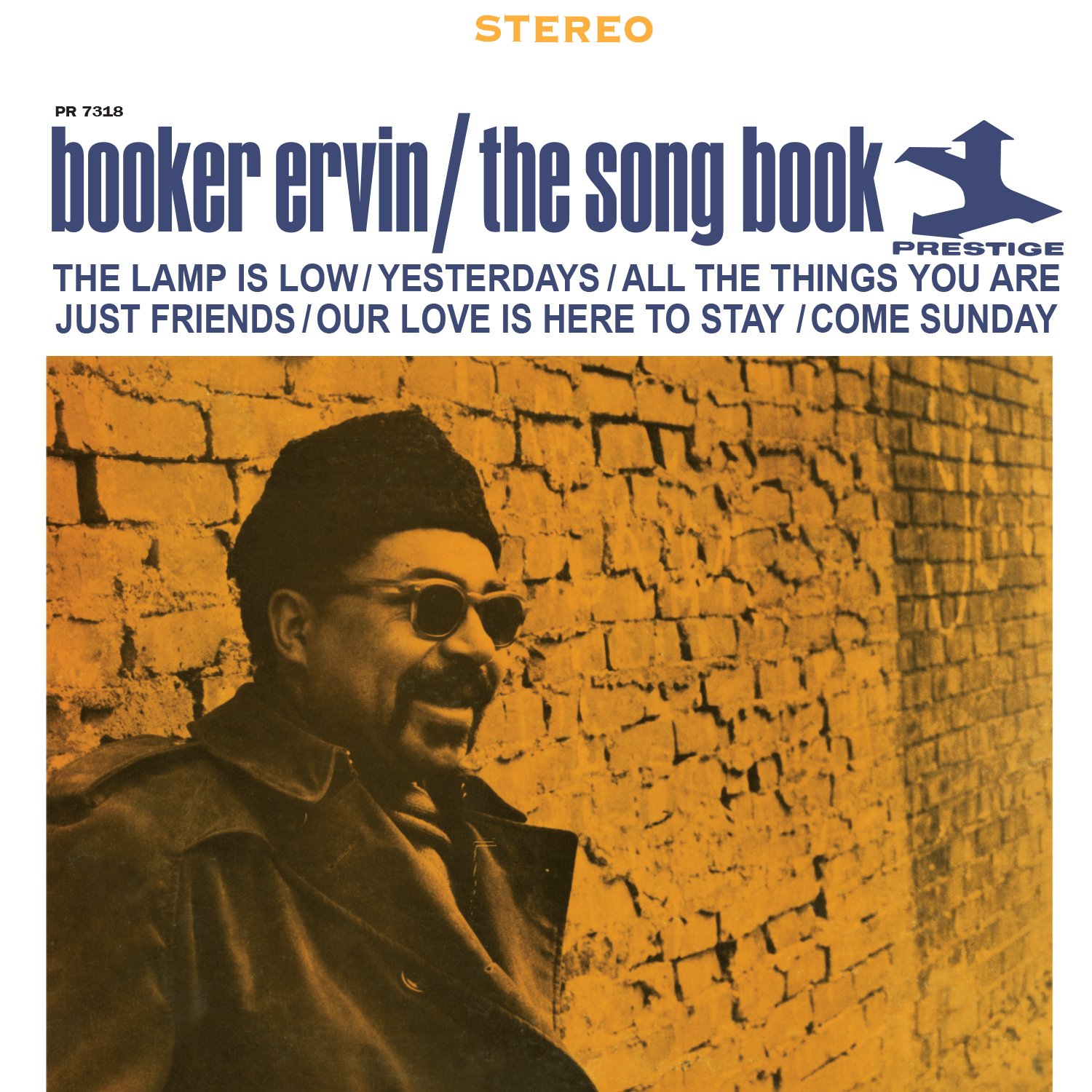



Booker Ervin opens the song book
A familiar song can be a particularly revealing measure of a jazz musician’s individuality. You may know the melody, remember another recording or have carried certain phrases with you for years. Then a different player arrives and the same composition acquires another voice. Booker Ervin’s The Song Book is built around that encounter. Six standards provide the framework for a quartet assembled at Rudy Van Gelder’s Englewood Cliffs studio on February 27, 1964: Ervin on tenor saxophone, Tommy Flanagan on piano, Richard Davis on double bass and Alan Dawson on drums.
The title has a precise meaning within Ervin’s Prestige catalogue. According to the publisher, The Song Book is the only one of his nine albums for the label devoted entirely to standards. Rather than presenting the leader’s own compositions, it places established musical forms at the centre of the programme. That does not require Ervin to set his personality aside. A song with a clear melodic identity makes it possible to notice how a soloist extends a phrase, shifts an accent or gives a familiar turn a different weight. Recognition and individuality belong together here.
The recording was made in a single day, with Don Schlitten producing. Dan Morgenstern’s liner notes are dated May 1964, and the album followed that summer. This compact history suits the record’s concentrated design: four musicians and six selected songs, with no changing guests or retrospective compilation of different groups. Listeners who chiefly know Ervin through his work with Charles Mingus encounter him on another scale. The tenor saxophone belongs to a small ensemble whose personnel remain constant, leaving space for each musical decision to register.

Tommy Flanagan and the rhythm section linking the Book albums
Tommy Flanagan is a distinctive partner for this date. The publisher identifies The Song Book as his only recording with Ervin, giving their encounter a particular place among the Book albums. The pianist’s role extends beyond supporting the saxophone: the keyboard can clarify harmonic relationships, pick up melodic thoughts and change the perspective through its own solo passages. With standards that have passed through so many musicians’ hands, the choice of what a pianist plays or leaves out becomes a substantial part of the conversation.
Richard Davis and Alan Dawson connect this session to the neighbouring Ervin recordings. The Freedom Book had been recorded on December 3, 1963; The Blues Book followed on June 30, 1964, and The Space Book on October 2. Davis and Dawson supply the common rhythm section on those albums too. For collectors exploring the sequence, this is a rewarding relationship to follow. Programme and pianist change important conditions, while bass and drums provide continuity through the players themselves. The Song Book consequently works both as a self-contained introduction and as a revealing chapter in a larger series.
The quartet remains unchanged across all six selections. Davis plays double bass and Dawson drums; there is no additional horn. That makes it possible to follow the relationships between four distinct musical roles. The saxophone need not carry the melody continuously, and the piano need not spell out every harmonic moment. Bass and drums can give different weight to pulse and forward movement. With familiar songs, the passages between obvious high points can be especially revealing: a response, a transition or the way the players return together to the theme after a solo.

Six standards and six different kinds of recognition
The Lamp Is Low opens the first side. Written by Peter DeRose, Bert Shefter and Mitchell Parish, the song draws on Ravel’s Pavane pour une infante défunte: an intriguing journey from a classical piano piece through popular song to jazz quartet. At a little over seven minutes, the opener has room to develop. Duke Ellington’s Come Sunday follows, before Jerome Kern and Oscar Hammerstein II’s All the Things You Are closes the side. Three different backgrounds meet in succession: adaptation, an Ellington composition and American musical theatre.
Side two begins with Just Friends, by John Klenner and Sam M. Lewis. Yesterdays, another Kern song, this time with words by Otto Harbach, is the longest selection on this edition at more than seven minutes. George and Ira Gershwin’s Our Love Is Here to Stay concludes the programme. Although the performances are instrumental, the pieces’ origins as songs remain a useful point of reference. A melody originally conceived for a voice can have its breath, pauses and emphases redistributed within a quartet. Knowing the songs adds another layer of recognition without being a prerequisite for enjoying the album.
The two Kern compositions on opposite sides invite comparison without turning the record into a lesson. They set different tasks in melody and harmonic movement. Equally interesting is the contrast between the more extended performances and the relatively compact numbers. The Song Book offers a considered selection with time for individual development, rather than an endless parade of standards. Its title identifies more than a body of repertoire: it suggests the possibility of discovering familiar music again through four particular personalities. Ervin leads, but the names of his three partners belong to the record’s identity.
Kevin Gray, QRP and the album across two sides
The edition offered is APRJ 7318, part of Analogue Productions’ Prestige series: one stereo LP playing at 33⅓ RPM. Kevin Gray at Cohearent Audio mastered the release from the original analogue master tape. It was pressed at Quality Record Pressings, with the publisher crediting Gary Salstrom for plating. These details describe the reissue. Rudy Van Gelder’s original recording remains the February 1964 session; recording the musicians and preparing a later lacquer are separate stages in the album’s history.
The 33⅓ RPM edition retains a straightforward arrangement of three pieces per side. Each side allows an extended period with the quartet before the record needs turning. That suits an album whose appeal depends on consistent personnel moving through six different songs. Side A travels from The Lamp Is Low to All the Things You Are, while side B moves from Just Friends towards the Gershwin conclusion. A practical advantage of this format is the uninterrupted span of each side. Playback speed alone, however, does not replace an assessment of recording, mastering and pressing quality.
The record is presented in a tip-on jacket on substantial board. An earlier 200-gram issue and later 180-gram pressings are documented under the same catalogue number. A uniform weight for every copy, or a numbered edition, is therefore not promised here. Its musical and technical identity is clear: six standards, the complete quartet, stereo presentation and Kevin Gray’s mastering for Analogue Productions. You order from Michael 45 in Germany. We arrange the US import and dispatch from Hilden.
More by Booker Ervin: Exultation!
Customer question: Buying Analogue Productions records in Europe
Series: Analogue Productions Prestige – all 50 records, musicians and session paths
Musicians
Participants and documented credit status. Track references correspond to the tracklist.
- Booker Ervintenor saxophoneParticipation: All 6 (A1–B3)
- Tommy FlanaganpianoParticipation: All 6 (A1–B3)
- Richard Davisdouble bassParticipation: All 6 (A1–B3)
- Alan DawsondrumsParticipation: All 6 (A1–B3)


Track numbers and side references refer to this edition.

Reviews
There are no reviews yet.