A title that opens the door to the music
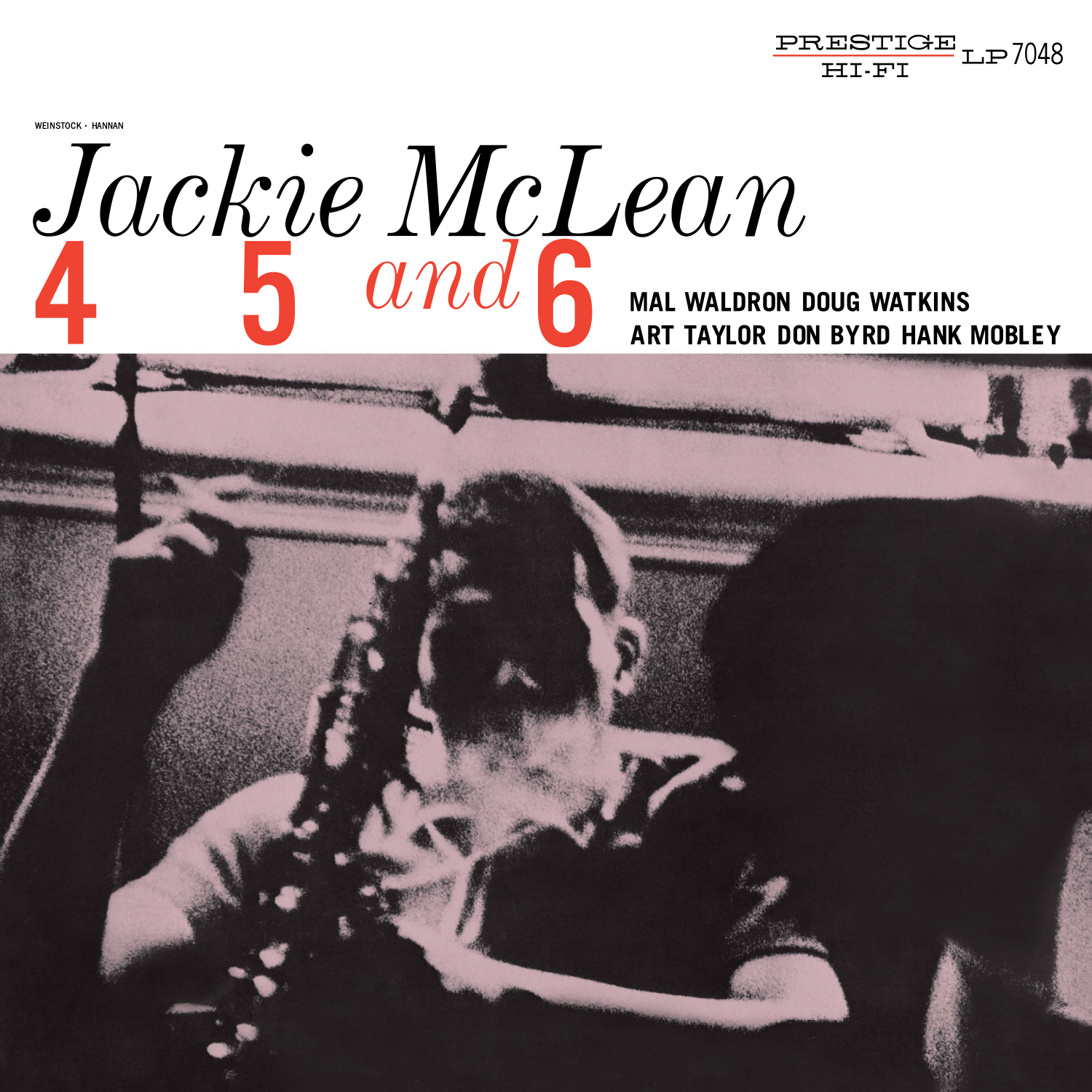
Four, five and six musicians: Jackie McLean turns this simple sequence of numbers into the organising idea of an album. Recorded in the summer of 1956, 4, 5, and 6 presents the alto saxophonist in three differently sized groups. The changes involve more than adding another voice. In the quartet, his alto stands alone in front of the piano trio; Donald Byrd’s trumpet creates a conversation between two horns, while Hank Mobley’s tenor expands the front line to three distinct personalities on Confirmation. A common rhythm section connects these perspectives. The six performances belong to a recognisable plan without repeating a single formula.
McLean was in his mid-twenties, part of a generation for whom Charlie Parker’s music was both a point of departure and a continuing challenge. The mobile language of bebop remained central to his playing. Yet even at this early stage, McLean’s characteristic, tensile alto sound resists being reduced to a style label. It gives a melody an unmistakably personal edge. Familiar standards make that individuality especially accessible: knowing where a tune is going allows the listener to pay closer attention to the particular way a musician travels through it.
These sessions took place at Rudy Van Gelder’s studio in Hackensack, before his move to the later premises in Englewood Cliffs. Bob Weinstock supervised the production for Prestige. Those names belong to the record’s history, but the musical attraction is more specific. McLean explores different relationships: direct contact with his rhythm section, a dialogue with trumpet, and a larger horn ensemble. The album is therefore a rewarding way of discovering a young bandleader through his choice of company as well as through his own solos. Its modest numerical title points to a thoughtful approach to the possibilities of a small group.

Mal Waldron and the rhythm section’s shared language
Pianist Mal Waldron, bassist Doug Watkins and drummer Art Taylor provide the foundation on all six tracks. Their continuous presence is essential to the concept. The group changes size, but its underlying musical environment remains familiar. Comparing the quartet performances with the larger combinations does not mean moving between entirely different bands. Instead, it reveals how the same three accompanists adjust when another horn needs room, or when McLean becomes the only melody instrument in front of them.
Waldron warrants particular attention. His contribution extends beyond filling harmonic space or taking a piano solo between horn choruses. A chord can support a line, emphasise its direction, or leave it room through the decision to withhold an answer. Alongside an alto sound as individual as McLean’s, that relationship becomes especially interesting. A useful listening approach is to shift attention away from the saxophone occasionally and follow the piano’s points of entry. The way an accompanist changes the pressure around a phrase is part of the performance’s expressive substance, even when that musician is not at the front of the ensemble.
Watkins and Taylor give these exchanges their mobility. The bass combines harmonic orientation with forward movement; the drums articulate that movement without adding another sustained melodic voice. Within a quartet, the interaction of the three rhythm players is particularly exposed. When Byrd or Mobley joins them, the same impulses must carry a larger number of voices. 4, 5, and 6 thus offers a compact portrait of an ensemble culture in which a rhythm section retains its character while responding to a changing front line. The names that appear lower down the personnel list are fundamental to the record’s shape, rather than simply supporting credits around its leader.

Standards, Parker and a sextet at the centre
Sentimental Journey opens the album with a familiar song transformed into a setting for improvisation. Why Was I Born? then turns to the songbook of Jerome Kern and Oscar Hammerstein II. Both are quartet performances, leaving McLean plenty of space. Keeping the original melody in mind makes it possible to follow changes in phrase length, emphasis and melodic distance. It is an inviting route into the music: the composition provides orientation while the improviser’s personal language gradually becomes the focus.
Donald Byrd joins the group for Kenny Drew’s Contour. Trumpet changes the proportions without yet turning the band into a large ensemble. Two different approaches to sound can now meet in the theme and stand apart in the improvisations. On the second side, Charlie Parker’s Confirmation brings this development to its largest formation. Hank Mobley adds tenor saxophone, placing three recognisable registers and personalities across the front line. The album’s longest performance consequently becomes the centre of its exploration of ensemble size as well.
Mobley appears only on Confirmation. The number six does not describe a fixed band throughout the record. Byrd is also absent from the three quartet tracks: his contributions are Contour, Confirmation and Abstraction. These changes help explain why the album repeatedly finds a different balance despite retaining its rhythm section. After the sextet, When I Fall in Love returns to the quartet. The contrast with Parker’s intricate composition draws attention to McLean’s treatment of a sustained, songlike melody and to the relationship between a familiar tune and a highly individual instrumental voice.
Mal Waldron’s Abstraction closes the record with Byrd in the quintet. Rather than returning to its opening formation, the programme ends with the middle of its three configurations. This is part of its particular appeal for collectors of early Prestige sessions. The record offers more than a chance meeting of notable names: its construction actively invites comparison. Listeners familiar with McLean’s later work can explore the qualities already present here; newcomers have familiar songs, a Parker composition and clearly defined small groups as approachable ways into a distinctive musical personality. The changes in personnel are not background information. They are one of the album’s principal pleasures.
The Analogue Productions mono LP
Carrying catalogue number APRJ 7048, this edition belongs to Analogue Productions’ Prestige Mono Series. It presents the album on a single LP at 33⅓ RPM. Kevin Gray cut the record from the analogue masters, and Quality Record Pressings manufactures the version currently listed at 180 grams. A high-gloss tip-on jacket retains the classic presentation. In the recording history, Rudy Van Gelder remains the engineer of the July 13 and July 20, 1956 sessions; Gray’s work belongs to the later reissue. Distinguishing those stages makes the edition’s provenance clear.
The six selections follow the documented LP sequence: Contour closes the first side, while Confirmation opens the second. The changes in ensemble size remain legible within that original two-sided structure. Each half of the 33⅓ RPM edition contains three complete performances. In particular, the extended sextet performance of Confirmation can develop without interruption before the quartet, and finally the quintet, restore different proportions. One side change is part of the album’s progress, without a further division of the programme across several records.
Earlier Analogue Productions versions were offered at 200 grams, with some early copies numbered. Those historical details are not general promises about the present 180-gram edition. This LP’s appeal rests on its clearly identified mono programme, documented analogue mastering and a sequence that preserves McLean’s ensemble concept in full. For a Prestige collection, it offers a particularly revealing encounter with McLean, Waldron and their partners in the summer of 1956. You order from Michael 45 in Germany. We arrange the US import and dispatch from Hilden.
Also on SACD: 4, 5, and 6
More by Jackie McLean: Jackie’s Pal · Lights Out!
Customer question: Buying Analogue Productions records in Europe
Series: Analogue Productions Prestige – all 50 records, musicians and session paths
Musicians
Participants and documented credit status. Track references correspond to the tracklist.
- Jackie McLeanalto saxophoneParticipation: A1, A2, A3, B1, B2, B3
- Doug Watkinsdouble bassParticipation: A1, A2, A3, B1, B2, B3
- Art TaylordrumsParticipation: A1, A2, A3, B1, B2, B3
- Mal WaldronpianoParticipation: A1, A2, A3, B1, B2, B3
- Hank Mobleytenor saxophoneParticipation: B1
- Donald ByrdtrumpetParticipation: A3, B1, B3


Quartet: A1, A2, B2. Donald Byrd: A3, B1, B3. Hank Mobley: B1 only. Recorded July 13, 1956 (side A) and July 20, 1956 (side B), Hackensack.

Reviews
There are no reviews yet.