Oliver Nelson before the famous Impulse! album
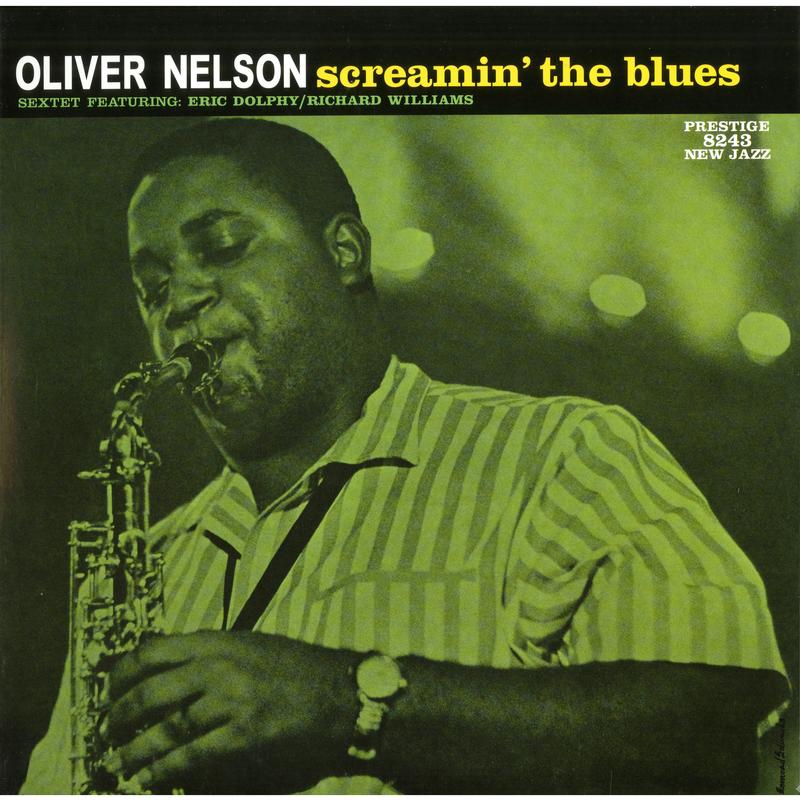
A year before The Blues and the Abstract Truth, Oliver Nelson had already entered a recording studio with Eric Dolphy and Roy Haynes. Screamin’ the Blues was recorded in Englewood Cliffs on 27 May 1960 and released early in 1961 on New Jazz, a label within the Prestige family. The connection to the better-known later album invites curiosity, but it should not reduce this record to a preliminary exercise. It has its own sextet and programme: six compositions, five written by Nelson, performed by musicians whose instruments give the small ensemble several distinct possibilities of colour.
Nelson was not yet known primarily as an arranger and conductor of larger groups. Born in St. Louis, he had played alto saxophone and arranged for Louis Jordan, served in a Marine band, and studied composition and music theory. His biography identifies an orchestral concert featuring Ravel and Hindemith during his time in Japan as an important stimulus to his interest in composition. These different experiences do not automatically explain a particular jazz language. They do help establish why Nelson the instrumentalist and Nelson the writer were so closely connected.
He began recording as a Prestige leader in 1959, and Screamin’ the Blues belongs to that early small-group period. Esmond Edwards produced the session and contributed a composition; Nat Hentoff wrote the liner notes. Rudy Van Gelder handled the recording, while Edwards supplied the cover photograph. The original catalogue number is NJLP 8243. Recording and release dates should remain distinct: the performances were made in May 1960, while the documented release falls in January 1961. For collectors placing the record alongside Nelson’s subsequent work, this is a small but useful chronological distinction.

Three horns, more than three colours
The front line consists of Oliver Nelson on tenor and alto saxophones, Eric Dolphy on alto saxophone and bass clarinet, and Richard Williams on trumpet. Richard Wyands plays piano, George Duvivier double bass and Roy Haynes drums. All six are documented for the album. The doubling broadens the ensemble’s resources without requiring additional players. A bass clarinet has a different construction, register and character from a saxophone, while the trumpet introduces a separate brass voice. The instrumentation alone suggests why reducing the group to “three horns and rhythm” would leave out an important part of its possibilities.
The sources consulted do not establish a reliable track-by-track allocation of Nelson’s alto and tenor or Dolphy’s bass clarinet. A title such as “Alto-Itis” is not a substitute for an explicit credit. These instruments are part of the confirmed album personnel, but their distribution should not be guessed from a composition’s name. That need not limit the listening experience. Different voices can be followed without treating an uncertain attribution as a prerequisite. The individual portraits and complete names in the personnel section help keep all six participants in view as musicians with their own roles.
The three players behind the horns deserve attention in their own right. Wyands, Duvivier and Haynes do not merely supply a neutral backdrop. In composed small-group music, harmony, bass movement and percussion meet written themes and space for individual improvisation. Noticing where the instruments carry a form together and where one voice moves into focus offers a useful approach to this album. Nelson’s dual role as writer and saxophonist makes the question particularly interesting. He is himself participating in a musical setting that he has helped design for the ensemble.

Five Nelson pieces and one from the producer
The title composition opens side A. It is followed by “March On, March On”, written by Esmond Edwards. The producer’s presence as the composer of one selection is an appealing detail of the session. It does not mean that Edwards joins the six instrumentalists; his contribution belongs to a different part of the album’s creation. “The Drive” completes the first side. Two Nelson pieces therefore surround his producer’s composition and establish a clear opening section for the record.
Side B contains “The Meetin’”, “Three Seconds” and “Alto-Itis”, all by Nelson. Their titles are memorable, but the deeper connection comes from the shared sextet and the composer’s writing. When approaching the music, it is worth doing more than waiting for the solos. How does a theme bring the band together? Which instruments become apparent as combined voices, and which emerge individually? How does a piece change when attention turns towards Haynes or Duvivier instead of one of the horn players on the next listen? Such changes of perspective can turn six familiar titles into fresh encounters.
The subsequent link with The Blues and the Abstract Truth provides a useful guide. Nelson, Dolphy and Haynes belong to both stories. Straight Ahead is also part of this circle of collaboration; the label points to the related line-up without Williams. Nevertheless, the albums have different programmes and should not be allowed to merge into one another. A listener who already owns the famous Impulse! record is not being offered a substitute here. The interest lies in hearing which musical relationships existed earlier and how a different set of compositions could provide those musicians with another framework.
Screamin’ the Blues also attracted attention at the time. Leonard Feather reviewed it in DownBeat in March 1961 and regarded it as Nelson’s best record up to that point. That judgement belongs to the album’s reception history, rather than replacing a listener’s own encounter with the music. For present-day collectors, the important opportunity is to meet Nelson simultaneously as player, composer and leader. His later reputation as an arranger need not overshadow this earlier chapter. The record documents a band with six names and six selections, placing his work within the immediate scale of a sextet.
Putting the Analogue Productions edition in context
The edition offered here carries the catalogue number APRJ 8243 and belongs to the Analogue Productions Prestige Stereo series. It presents the album on one stereo LP playing at 33⅓ rpm. Kevin Gray is credited with cutting, Quality Record Pressings with manufacture and Gary Salstrom with plating. The label describes the series as mastered from the analogue master tapes, with a tip-on jacket. These specifications concern the AP reissue of the New Jazz album, rather than a newly assembled collection with additional performances. The original programme remains the basis of this edition.
Documented pressings differ in their details. An earlier numbered AP issue from 2015 is listed at 200 grams with deep-groove labels. A later 2022 issue is recorded at 180 grams without the deep groove, and the current label specification also states 180 grams. Those features should not be combined into a description of a single hypothetical pressing. Without inspecting the individual stock copy, historical numbering and a particular label detail are not promises about every record currently offered. The catalogue number, stereo format and original six-track programme are the dependable starting points for identification.
With three selections on each side, the album retains a clear shape. Turning the record separates two continuous groups of compositions without changing the personnel. For music lovers, Screamin’ the Blues offers a concentrated introduction to Nelson’s early work; for collectors, it adds a specifically dated encounter to the shared history of Nelson, Dolphy and Haynes. It does not need to be assigned the status of an indispensable rehearsal for something more famous. Its own compositions, unusually flexible horn instrumentation and three rhythm-section partners provide ample reason to give it attention as an album in its own right. You order from Michael 45 in Germany. We arrange the US import and dispatch from Hilden.
Customer question: Buying Analogue Productions records in Europe
Series: Analogue Productions Prestige – all 50 records, musicians and session paths
Musicians
Participants and documented credit status. Track references correspond to the tracklist.
- Oliver Nelsontenor saxophone, alto saxophoneParticipation: Album personnel
- Eric Dolphyalto saxophone, bass clarinetParticipation: Album personnel
- Richard WilliamstrumpetParticipation: Album personnel
- Richard WyandspianoParticipation: Album personnel
- George Duvivierdouble bassParticipation: Album personnel
- Roy HaynesdrumsParticipation: Album personnel


Recorded 27 May 1960, Englewood Cliffs. Rudy Van Gelder, engineer. Analogue Productions: Kevin Gray, cutting; QRP, pressing. Nelson and Dolphy: instrument changes not established track by track.

Reviews
There are no reviews yet.