
Two voices meet again
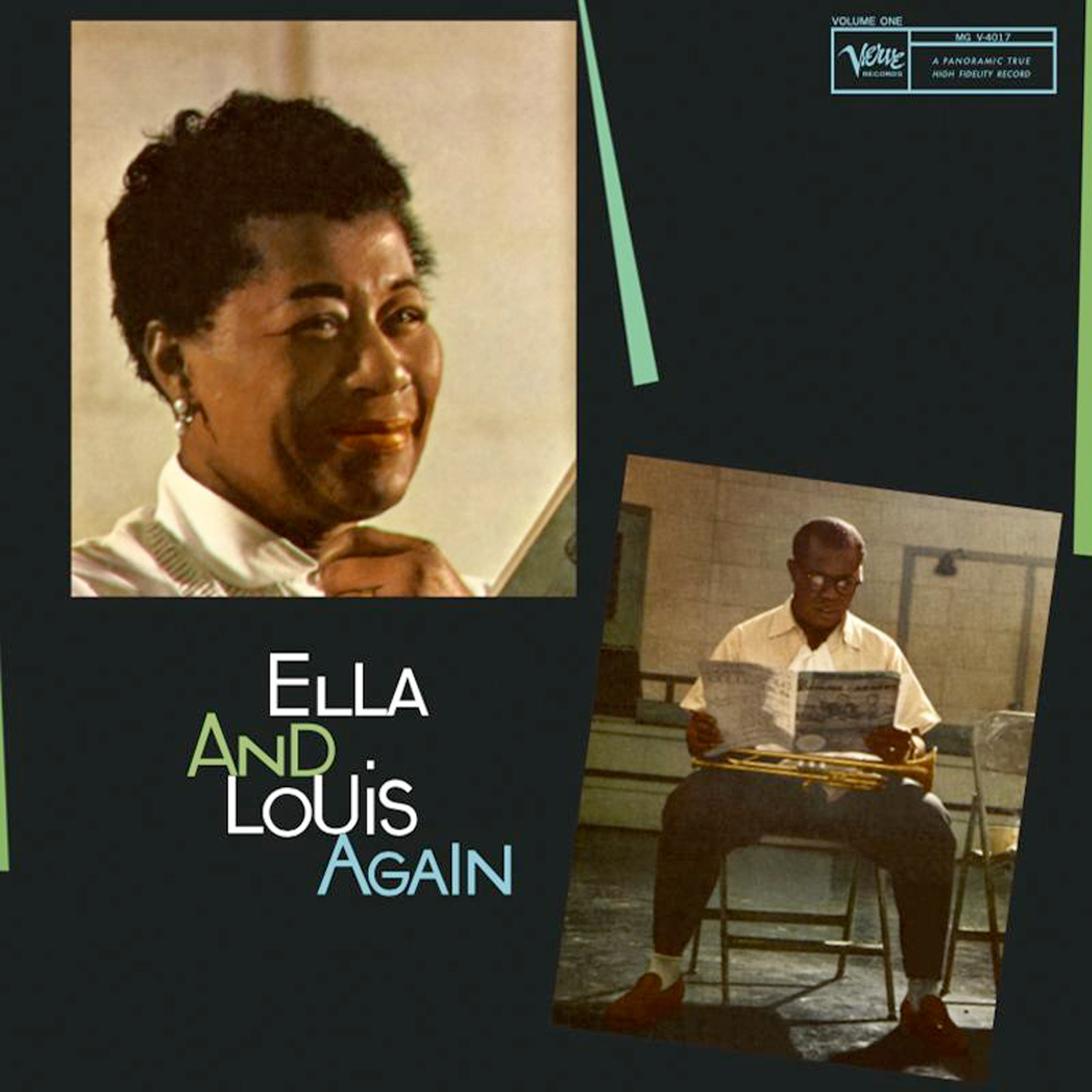
Ella Fitzgerald and Louis Armstrong return together on Ella and Louis Again, but the title promises more than a repetition of a successful idea. Their 1956 album Ella and Louis was followed in 1957 by a collaboration on a larger scale: nineteen tracks across two records. Norman Granz produced the sessions, recorded in Hollywood on 23 and 31 July and 13 August 1957. The documented studios are Capitol and Radio Recorders. Verve released the album in October of that year. The renewed encounter therefore had room for a programme that allows both partnership and independence to matter.
Fitzgerald and Armstrong bring markedly different vocal personalities. Their collaboration cannot adequately be described merely as an agreeable meeting of two famous names. A line of a song can change its meaning through the beginning of a syllable, a rhythmic displacement or the weight placed on one word. In a duet, two such ways of shaping a song meet. The repertoire supplies melodies and lyrics that already have lives beyond these recordings. The artistry lies not in erasing that history, but in adding something to it through a personal voice. The encounter is consequently as much about interpretation as it is about the pleasure of recognition.
One of the album’s defining features is that not every selection is a duet. Twelve joint vocal performances sit alongside three Fitzgerald solo-vocal tracks and four sung by Armstrong alone. “Again” also means giving each of them space independently. The alternation is part of the album’s shape: a familiar voice can first stand on its own and later be perceived anew in relation to the other. That gives the programme more flexibility than its straightforward pairing of names might suggest. It is an appealing proposition for a collection—a collaborative recording that deliberately preserves the differences between its principal figures.

Nineteen songs, changing perspectives
“Don’t Be That Way” opens the programme, followed by “Makin’ Whoopee”, “They All Laughed”, “Comes Love” and “Autumn in New York”. Duet and solo performance already alternate on this first side: Armstrong sings “Makin’ Whoopee” alone, while Fitzgerald takes “Comes Love”. Side two moves from Cole Porter’s extended “Let’s Do It (Let’s Fall in Love)” to “Stompin’ at the Savoy”, “I Won’t Dance” and “Gee Baby Ain’t I Good to You”. “Let’s Do It” is one of Armstrong’s solo-vocal selections. The sequence thus offers different relationships between the voices without abandoning the framework of a shared album.
The third side contains “Let’s Call the Whole Thing Off”, “These Foolish Things”, “I’ve Got My Love to Keep Me Warm”, “Willow Weep for Me” and “I’m Puttin’ All My Eggs in One Basket”. Fitzgerald sings “These Foolish Things” alone, with Armstrong taking “Willow Weep for Me”. The closing side comprises “A Fine Romance”, “Ill Wind”, “Love Is Here to Stay”, “I Get a Kick Out of You” and “Learnin’ the Blues”. Fitzgerald’s “Ill Wind” and Armstrong’s “I Get a Kick Out of You” once again provide individual perspectives within the duet sequence. The tracklist becomes a small map of the programme’s changing points of view.
George and Ira Gershwin, Irving Berlin, Cole Porter, Jerome Kern and other songwriters provide a broad shared background. The attraction is not confined to recognising familiar titles. A listener can follow how a solo performance creates a different conversational setting from a duet, how a pause may acquire meaning, and how the accompanying group remains responsive to distinct vocal characters. Nineteen selections allow those questions to return in several combinations. This double LP preserves the complete programme of the edition, rather than reducing the album to a later selection consisting only of the jointly sung pieces. The individual performances belong to its larger design.

An accompanying quartet with an identity of its own
Oscar Peterson on piano, Herb Ellis on guitar, Ray Brown on double bass and Louie Bellson on drums form the instrumental foundation. Some sources list Bellson as Louis Bellson; both names refer to the same musician. These four are not an anonymous backing group behind two stars. Their instruments determine the harmonic and rhythmic relationships available beneath the voices. Piano and guitar have different attacks and decays, while double bass and drums connect time with movement. Those responsibilities remain essential even when the sung word initially draws the listener’s attention. Following the instruments can reveal another set of relationships within a familiar song.
Armstrong also appears as a trumpeter, but not on all nineteen tracks. The documented trumpet credits cover “Autumn in New York”, “Stompin’ at the Savoy”, “Gee Baby Ain’t I Good to You”, “Willow Weep for Me”, “Love Is Here to Stay” and “Learnin’ the Blues”. The trumpet therefore belongs to particular points in the programme, rather than being a continuous additional voice across the entire record. This opens another perspective on Armstrong: singing and instrumental playing are two expressions of the same personality, but their actual use is specific to each recording. The musicians section retains those track assignments explicitly.
Norman Granz’s production places the participants within a manageable framework. Two principal voices, an accompanying quartet, selected trumpet contributions and a broad song programme are enough to sustain an album of considerable length. There is no need to add a large orchestra to its description. The small ensemble makes the balance between voice and instruments especially worth following. What supports a phrase when a singer holds a syllable a little longer? How does attention change when a duet gives way to a solo-vocal track? Such questions bring the accompanying musicians forward as contributors and give familiar songs something beyond their immediate recognisability.
The complete double LP in mono
This release, catalogue number AVER 74701, appears in the Acoustic Sounds Series as a double LP at 33⅓ RPM in mono. Ryan K. Smith at Sterling Sound is responsible for mastering from the original analogue tapes. The 180-gram records are manufactured at Quality Record Pressings and presented in a Stoughton tip-on gatefold jacket. Mono is an essential part of this edition’s identity. Historical jacket wording referring to “Panoramic True High Fidelity” should therefore not be read as a stereo designation. What matters is the format actually being offered, together with the specific production details attached to this reissue.
The four sides give the nineteen selections their particular arrangement: five tracks on the first side, four on the second and five on each of the remaining two. The 33⅓-RPM format preserves longer portions of the programme between side changes. For an album built around the alternation of duets and solo-vocal tracks, that is an intelligible presentation. The sequence can develop without requiring a new physical intervention after every song. This does not establish a general sonic hierarchy between different speeds; it describes the practical listening sequence of this double LP and the way its complete programme is arranged.
You order from Michael 45 in Germany. We arrange the US import and dispatch from Hilden. Ella and Louis Again invites listeners to consider two great voices as more than familiar names, attending instead to each one’s relationship with a song. The solo-vocal tracks matter as much as the duets, and Armstrong’s trumpet can be located as specifically as Peterson’s piano or Ellis’ guitar. Hearing the record as a whole allows those changes to become part of a connected encounter across four sides. For music lovers and collectors, that is an enduring attraction: the shared story gains depth precisely because each participating personality retains a place of its own.
Series: Verve – all 34 records: voices, organ and bossa nova
Musicians
Participants and documented credit status. Track references correspond to the tracklist.
- Ella Fitzgeraldlater portrait reference aus Paket 53vocalsParticipation: Solo vocals: A4, C2, D2 · Duets: remaining tracks except A2, B1, C4, D4
- Louis Armstrongportrait reference 1953vocals; trumpet on selected tracksParticipation: Solo vocals: A2, B1, C4, D4 · Other vocals except A4, C2, D2 · Trumpet: A5, B2, B4, C4, D3, D5
- Oscar Peterson1978 · later portrait referencepianoParticipation: All tracks
- Herb EllisguitarParticipation: All tracks
- Ray Brown1976 · later portrait referencedouble bassParticipation: All tracks
- Louie Bellson1978 · later portrait referencedrumsParticipation: All tracks


19 tracks: twelve duets, three Ella solo-vocal tracks and four Armstrong solo-vocal tracks. Armstrong plays trumpet on six separately identified tracks. Louie Bellson is also listed as Louis Bellson in sources.
🎧 Review video: The 20 Best Audiophile Analogue Production Editions (Still in Print 2021)
This video is hosted by YouTube (Google). It only loads once you switch on “Functional” in the cookie settings.

Reviews
There are no reviews yet.