Out of the Cool: an orchestra with room for individual personalities
A large jazz ensemble can impress through sheer force. With Gil Evans, it is equally interesting to consider how the ensemble is assembled: which instruments become neighbours, which voice emerges from the collective sound, and how a new colour changes the meaning of a melody. Out of the Cool invites that kind of discovery. Trumpets, different trombones, tuba and woodwinds stand alongside piano, guitar, bass and percussion. The instrumentation opens possibilities beyond a regular arrangement of saxophone and brass sections. Its composition is already part of the musical conception, before any individual contribution is followed in detail.
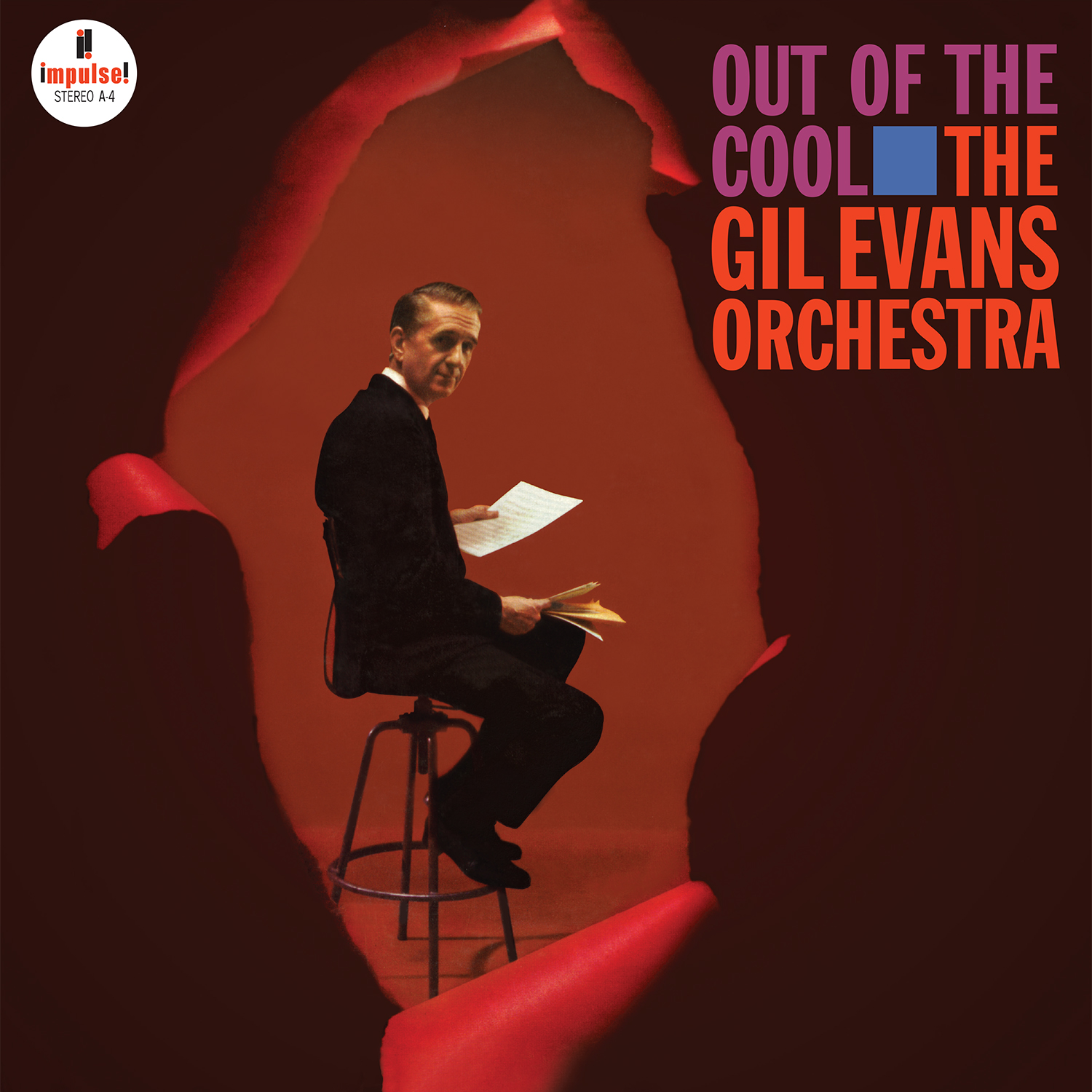
Released in 1961, this Impulse! album is shaped by Gil Evans at the piano and as musical director. Creed Taylor produced it and Rudy Van Gelder handled recording. The five selections combine Evans compositions with music by other writers. That makes a useful starting point for considering his work as an arranger: an album can possess an unmistakable identity without every theme having been composed by the same person. Selection, distribution of voices and the relationship between ensemble and individual players establish a connection extending beyond the origin of a melody.
Listeners who know Evans mainly through collaborations with other bandleaders can hear him here at the centre of his own orchestral project. There is no need to approach it through a supposed contest with more widely recognised albums. This recording has its own personnel and programme. Attention can remain with the actual musicians: a trumpet line, a guitar contribution, the depth of the tuba or a transition between woodwind colours. Such details do not sit outside the larger form. They are the means by which an arranger brings an ensemble together while allowing its different personalities to remain distinguishable.

From La Nevada to Sunken Treasure: five contrasting forms
La Nevada opens the album on a substantial scale. Written by Gil Evans, it occupies more than fifteen minutes and a considerable portion of side one. That allows time to notice changes within a shared development. A useful approach is to consider how attention is distributed: when does the ensemble function as a setting, and when does its sound become an event in itself? How does the arrival of another instrument change the balance without requiring everything to begin again? The duration can become an opportunity to hear relationships grow rather than simply a stretch to pass before the next selection.
Where Flamingos Fly, by John Benson Brooks, Harold Courlander and Elthea Peale, follows as the second piece on the first side. Their juxtaposition already demonstrates how the album draws coherence from the treatment of different musical starting points. The shorter form presents a task unlike the extended La Nevada: an idea has to take shape within a more concentrated frame. The sequence offers a reason to return to the transition after an initial hearing. The orchestra remains the overarching connection, but the material and dimensions make different demands on the distribution of its roles. Continuity need not mean repeating the same solution.
Side two continues with the Bilbao Song by Kurt Weill and Bertolt Brecht. George Russell’s Stratusphunk follows before Evans’ own Sunken Treasure closes the album. Russell’s composition should not accidentally be credited to Evans simply because the orchestra bears his name. The different writers are part of what makes the selection interesting. Five pieces on contrasting scales form an album whose coherence does not depend on a uniform template. Follow the whole sequence first, then return to individual selections. That allows the overall shape and the decisions within a shorter form to become equally rewarding objects of attention.

Fifteen musicians and colours between instrumental sections
The full edition credits name fifteen musicians. Johnny Coles and Phil Sunkel play trumpet, with Jimmy Knepper and Keg Johnson on trombone. Tony Studd is credited with bass trombone and Bill Barber with tuba. Those lower brass instruments are as important to understanding the ensemble as the more immediately recognisable solo voices. They open possibilities between foundation, answering line and shared colour. Listeners who initially follow the upper voices of a large group can deliberately change direction here, attending to the lower register as an active part of the musical design. Instrumentation becomes an invitation to redistribute attention.
Budd Johnson contributes tenor and soprano saxophones, while Bob Tricarico is listed on bassoon, flute and piccolo. The remaining woodwind assignments are explicitly documented by selection: Ray Beckenstein appears on La Nevada and Bilbao Song; Eddie Caine on Where Flamingos Fly, Stratusphunk and Sunken Treasure. Both are credited with alto saxophone, flute and piccolo. Those entries identify their instrumental palettes without claiming that every instrument is played continuously on every assigned piece. The alternation between these musicians remains visible in the personnel tab instead of disappearing inside a general orchestra credit. It provides a practical reference for following the programme.
The group also includes Ray Crawford on guitar, Ron Carter on bass, Charlie Persip and Elvin Jones on percussion, and Evans on piano. The publisher additionally describes Jones as a drummer, while this edition’s credits use the broader term percussion for both rhythm players. That distinction is retained explicitly. A general list of featured soloists would represent only part of the ensemble, so all fifteen names and their roles appear below. Rudy Van Gelder belongs among the engineering credits, not as a sixteenth instrumentalist. Keeping the categories separate makes it easier to connect contributions with musicians without turning a technical credit into a performer.
Out of the Cool on vinyl: the Acoustic Sounds Series edition
This release carries catalogue number AIMP 21101 and belongs to the Acoustic Sounds Series. The Impulse! album is presented as a stereo LP playing at 33⅓ RPM on 180-gram vinyl. The publisher names Ryan K. Smith at Sterling Sound for mastering from the original analogue tapes. Pressing is by Quality Record Pressings, and the packaging is a Stoughton tip-on gatefold jacket. These details describe the specific reissue. For collectors, they connect a frequently shared album title with a clearly identified production route, making comparisons between listings more useful than a title alone would allow.
The five pieces occupy two sides, with La Nevada and Where Flamingos Fly on the first and the remaining three compositions on the second. The single LP therefore preserves two extended listening stretches. In particular, the opening piece can develop within one side. That is a practical feature of the layout rather than a general verdict on other formats. Historical information is also kept within its evidential limits: the original album dates from 1961, but exact recording days are not added where the sources used do not reliably establish them. A precise description can make fewer claims at that point while still supplying the information that matters musically.
If you want to buy Out of the Cool on vinyl, this edition offers an approach to Evans’ orchestral thinking in a clearly specified form. The record rewards hearing as a whole while providing smaller points of entry for later visits: the role of a low brass voice, a woodwind change, the relationship between guitar and ensemble, or the development of an extended piece through time. Its fascination grows out of those connections. A large orchestra remains a group of people with different responsibilities and a shared musical conception. You order from Michael 45 in Germany. We arrange the US import and dispatch from Hilden.
Series: Impulse! – all 19 records: the house that Trane built
Musicians
Participants and documented credit status. Track references correspond to the tracklist.
- Eddie CaineAlto Saxophone, Flute, piccoloParticipation: A2, B2, B3
- Ray BeckensteinAlto Saxophone, Flute, piccoloParticipation: A1, B1
- Ron CarterExisting portrait; not a session depictionBassParticipation: Album personnel; individual scope unspecified
- Tony StuddBass TromboneParticipation: Album personnel; individual scope unspecified
- Bob TricaricoBassoon, Flute, piccoloParticipation: Album personnel; individual scope unspecified
- Ray CrawfordGuitarParticipation: Album personnel; individual scope unspecified
- Charlie PersipExisting portrait; not a session depictionPercussionParticipation: Album personnel; individual scope unspecified
- Elvin JonesExisting portrait; not a session depictionPercussionParticipation: Album personnel; individual scope unspecified
- Gil EvansExisting portrait; not a session depictionPianoParticipation: Album personnel; individual scope unspecified
- Budd JohnsonTenor Saxophone, Soprano SaxophoneParticipation: Album personnel; individual scope unspecified
- Jimmy KnepperExisting portrait; not a session depictionTromboneParticipation: Album personnel; individual scope unspecified
- Keg JohnsonTromboneParticipation: Album personnel; individual scope unspecified
- Johnny ColesExisting portrait; not a session depictionTrumpetParticipation: Album personnel; individual scope unspecified
- Phil SunkelTrumpetParticipation: Album personnel; individual scope unspecified
- Bill BarberTubaParticipation: Album personnel; individual scope unspecified


15 musicians from edition credits. Gil Evans: piano and orchestral direction/arrangements. Eddie Caine and Ray Beckenstein alternate by track. Charlie Persip and Elvin Jones: percussion per edition; publisher also calls Jones a drummer. Rudy Van Gelder: recording engineer. Exact session dates unconfirmed. Reissue: Ryan K. Smith / Sterling Sound, original analogue tapes; QRP, 180 g; Stoughton gatefold (publisher specifications).

Reviews
There are no reviews yet.