The quartet before a major step
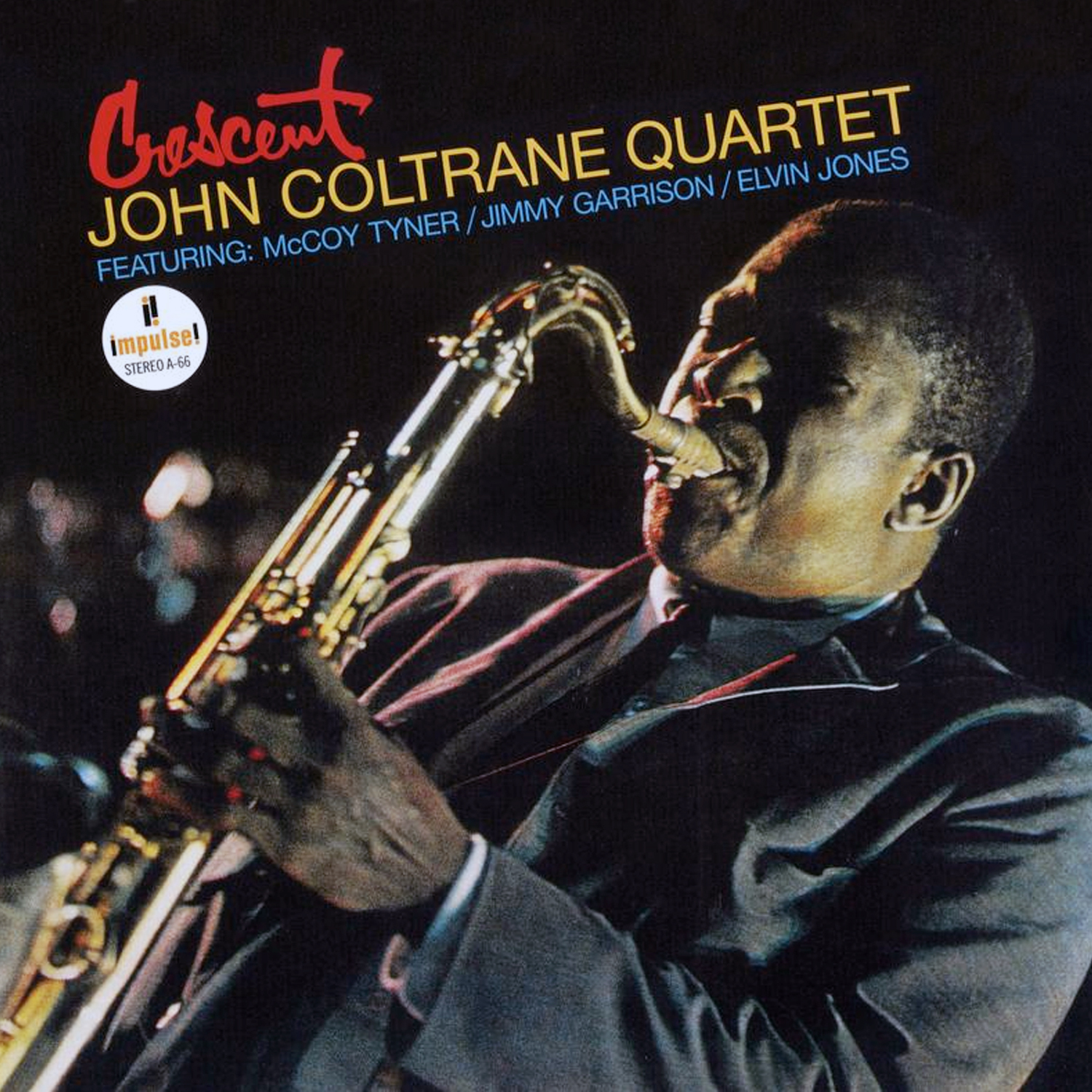
Crescent is one of those albums for which the recording year is especially revealing. In the spring of 1964, John Coltrane, McCoy Tyner, Jimmy Garrison and Elvin Jones worked on these five compositions; in December of the same year they would record A Love Supreme. That proximity matters, but it does not explain the whole record. Crescent deserves to be heard as a work in its own right: a concentrated portrait of the classic quartet, shaped jointly by Coltrane’s compositions and the distinct personalities of his colleagues.
The released performances come from two sessions at Van Gelder Studio in Englewood Cliffs. 27 April 1964 produced “Wise One,” “Lonnie’s Lament” and “The Drum Thing.” The album versions of the title track and “Bessie’s Blues” were recorded on 1 June 1964. The April session had included earlier versions of those two pieces, which should not be confused with the performances subsequently selected for the LP. Bob Thiele produced and Rudy Van Gelder engineered the recording. Impulse! released Crescent in July 1964 as A-66 and AS-66.
All five compositions are Coltrane’s. That creates continuity without restricting the group to a single point of view. The second side, in particular, directs attention decisively towards bass and drums. The leader’s name remains on the cover, but the musical narrative is made by the entire quartet. This offers a useful approach for listeners who principally know Coltrane as an extraordinary saxophone soloist: the album can also be an invitation to understand his music through the people with whom he developed it.

Four personalities and the importance of space
Coltrane plays tenor saxophone on Crescent. That precision is worthwhile because he is also strongly associated with soprano saxophone, and some edition-level credits list both instruments. Tenor is the supported assignment for the album sessions documented here. McCoy Tyner on piano, Jimmy Garrison on double bass and Elvin Jones on drums complete the group. There are no extra horns, strings or visiting players brought in to add another colour. Everything comes from the resources of these four musicians.
The first side moves from the title piece through “Wise One” to the more compact “Bessie’s Blues.” Their differing dimensions already suggest something about the design: two extended performances are followed by a shorter blues composition. That encourages an approach beyond searching for one uniform “Coltrane sound.” Each piece has a different function within the album. How much time is given to developing a theme? When is the movement concentrated? What happens to attention when a shorter performance follows two more expansive arcs?
Side two consists of “Lonnie’s Lament” and “The Drum Thing.” The former gives Jimmy Garrison an extended solo space, while the latter places Elvin Jones at its centre. A drum feature does not mean that Coltrane’s tenor has disappeared completely: tenor and bass frame parts of the performance. What matters is that Coltrane steps back from the usual expectation of continuing saxophone solos across this side. A record issued under his name can reveal a great deal about his musical thinking by listening at length to other voices.

A second side that changes the way we listen
For a first encounter, it is enough to follow Crescent in sequence. On returning, a deliberate change of perspective can be illuminating. Rather than waiting for the saxophone’s next entrance, approach the record through its bass or drums. Garrison is not simply the low line beneath a soloist, and Jones is more than an accompaniment’s engine. Their exposed spaces on the second side demonstrate how much independence is already contained in the quartet’s personnel. Tyner belongs equally to this picture: the relationship between piano, bass and drums is more than a platform for the leader.
Those roles are useful to keep in mind on the first side as well. Once the album has drawn attention to the individuality of the rhythm section, a return to the earlier pieces need not sound like a return to anonymous backing. The same names occupy different places within the whole. It is one reason to let the record establish its own sequence before extracting favourite tracks. The way the pieces are placed teaches the listener something about the band.
The 33⅓ RPM LP makes the original design especially clear. Three pieces on side A introduce the album’s world; after the turn, the two extended second-side performances remain together. Their proximity matters. Bass and drums receive a substantial shared chapter that can be heard without another interruption to change sides. That is a specific musical reason to value this single-LP edition. It does not require a general claim that one playback speed is inherently superior to another.
Placed beside A Love Supreme, Crescent offers a view of the same quartet a few months earlier. It would nevertheless be a loss to treat every moment merely as a sign of the later work. These five compositions have their own order, and the space given to Garrison and Jones is a central feature of this album. For collectors, part of the attraction is following a group’s development through particular recordings—not as an abstract story of progress, but as a succession of decisions about who speaks, when they speak and how an album distributes its time.
Acoustic Sounds Series: AIMP 78301
This stereo edition in the Verve/UMe Acoustic Sounds Series is offered under AIMP 78301; the documented release carries label number B0033783-01. It is one 180-gram LP at 33⅓ RPM, pressed at Quality Record Pressings and presented in a Stoughton tip-on gatefold jacket. Ryan K. Smith at Sterling Sound handled the mastering, from analogue tapes according to the publisher, with Chad Kassem supervising the reissue project. The series should be distinguished from a separate Analogue Productions release, even though people and production facilities connect the two.
Accurate edition identification is particularly helpful with Coltrane. The same album title can appear in different countries, on different formats and with different mastering. The record described here is the Acoustic Sounds Series LP, rather than a Japanese SACD or an unspecified older Impulse! pressing. Its place in a collection can therefore be considered through identifiable features: format, mastering, pressing plant and jacket presentation belong together. They provide a useful basis for choosing an edition without pretending to supply a personal listening comparison or declaring a universal “best” version.
The gatefold presentation also makes this a physical album to spend time with, rather than simply a carrier for five separate performances. That aspect fits a work whose sequencing matters so much. Recording dates, personnel and edition details help establish what is being heard, while the uninterrupted sides allow the music’s proportions to remain evident. Production information supports the encounter; it need not compete with the quartet for attention.
Crescent invites us to hear the quartet as a community. Coltrane’s compositions establish its direction, but the record also takes shape through the room he gives his partners. Returning to side one after the final piece may therefore change the way the tenor is perceived: as one voice within an exceptionally individual group, whose four names are worth remembering separately. This focused single-LP edition preserves the sequence in which that relationship can be discovered.
You order from Michael 45 in Germany. We arrange the US import and dispatch from Hilden.
More by John Coltrane: ‘Live’ At The Village Vanguard · Ballads
Artist page: All titles by John Coltrane
Series: Impulse! – all 19 records: the house that Trane built
Musicians
Participants and documented credit status. Track references correspond to the tracklist.
- John ColtranePortrait: earlier referencetenor saxophoneParticipation: Album personnel; see credits
- McCoy TynerPortrait: 1973pianoParticipation: Album personnel; see credits
- Jimmy GarrisonPortrait: existing portraitdouble bassParticipation: Album personnel; see credits
- Elvin JonesPortrait: 1960sdrumsParticipation: Album personnel; see credits


27 April 1964: Wise One, Lonnie’s Lament, The Drum Thing. 1 June 1964: Crescent, Bessie’s Blues. Van Gelder Studio, Englewood Cliffs; producer Bob Thiele, engineer Rudy Van Gelder. John Coltrane: tenor saxophone only. Quartet credited at album level, not a claim of continuous participation on every track. Side B has no saxophone solo; The Drum Thing features drums with a tenor/bass frame.
How Michael hears this edition
Listening impression · paraphrased from the video
Michael describes his copy as flat and exceptionally quiet, rating its sound a strong nine out of ten. This assessment concerns the Acoustic Sounds edition; a mono comparison is mentioned only as something he would like to hear.
🎧 Review video: John Coltrane Crescent Acoustic Sound Series
This video is hosted by YouTube (Google). It only loads once you switch on “Functional” in the cookie settings.

Reviews
There are no reviews yet.