Eleven points of origin, one narrating voice
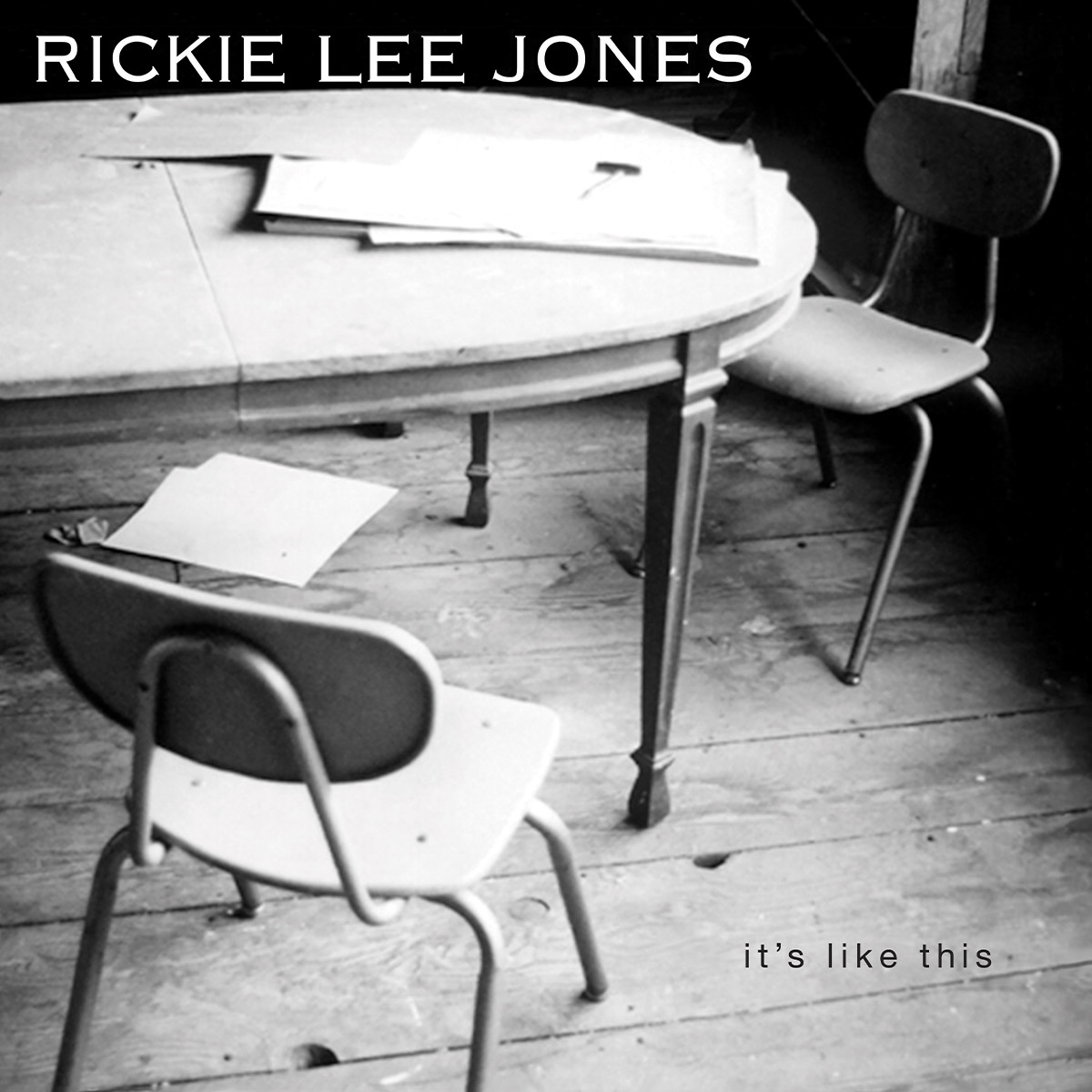
An album bringing together songs by Steely Dan, Marvin Gaye, the Beatles and Traffic could resemble a tour through several record collections. On It’s Like This, Rickie Lee Jones places musical theatre and songbook repertoire beside them. The connection comes neither from a shared period nor from a single genre. It comes from an interpreter deciding to treat these eleven songs as her present programme. Released on September 12, 2000, the album is consequently more than a gathering of familiar originals. It asks what a song retains, and what can change, when another voice takes responsibility for its point of view.
Jones produces with Bruce Brody, who also contributes organ. Ben Sidran is credited as co-producer on five selections. Those shared responsibilities suit a record that admits several musical origins without needing to divide into unrelated projects. Its personnel encompasses guitars, keyboards, double bass, drums, percussion and individual wind instruments. That does not mean every contributor appears on every track. It establishes a circle of players from which different combinations can emerge. The voice supplies the common reference point around which the selection takes shape, allowing the range of material to remain an essential part of the album rather than a problem to conceal.
The title It’s Like This can be understood as an invitation to hear a personal explanation. A familiar melody need not always function as a reminder of its best-known version. Different neighbours, a different duration or a different singer can give a song another role. That openness makes the album appealing in a collection where rock, jazz singing, musical theatre and pop do not need separate compartments. The writers’ names offer orientation. The album’s central idea, however, is that their different histories can meet in a new sequence. Recognition becomes a beginning rather than the complete purpose of listening.

Guests with clearly defined contributions
The well-known guests are more than decorative names. Joe Jackson is documented on piano and backing vocals for Show Biz Kids, For No One and One Hand, One Heart. Ben Folds plays piano on Low Spark Of High Heeled Boys, contributes backing vocals to Up A Lazy River and sings the closing piece as a duet with Jones. Dan Hicks and Taj Mahal also contribute backing vocals to Up A Lazy River. These assignments make particular encounters tangible. They describe individual responsibilities and should not be expanded into an assumption that these guests participate throughout the entire album.
A substantial instrumental cast stands beside them. John Pizzarelli is credited with acoustic guitar, Alex Foster with saxophone, Jeff Dellisanti with bass clarinet and Conrad Herwig with trombone. Richard Davis, Paul Nowinski and Mike Elizondo are the three documented double bassists; Peter Erskine, Carl Allen and Rick Marotta are the drummers. Bashiri Johnson adds percussion. Reliable individual song assignments are not available for all these players. Three bassists in the credits therefore establish neither three simultaneous bass parts nor a track distribution that can be freely deduced from a song’s character. Their participation is clear even where its precise allocation remains undocumented.
Jones herself is credited with vocals, acoustic and electric guitar, and organ. Brody’s instrumental and production work remains the contribution of one person with two responsibilities. That distinction matters in a list of this size: who performs, who produces and who records are different questions. The personnel still provides useful listening orientation. Named guests can be followed on their documented tracks, while elsewhere attention can move between instrumental families. The album gains definition without requiring every audible detail to be assigned prematurely to a familiar name. The variety of the ensemble also connects these different song traditions through the instrumental resources brought to the project.

A songbook without a fixed genre boundary
The opening pair is Show Biz Kids, by Donald Fagen and Walter Becker, followed by Marvin Gaye’s Trouble Man. Lennon and McCartney’s For No One, Smile and Jim Capaldi and Steve Winwood’s Low Spark Of High Heeled Boys follow. Those first five selections already change cultural reference points several times. Steely Dan, the Beatles and Traffic stand beside a song whose melodic origin connects with Charlie Chaplin. The sequence is interesting precisely because it does not attempt a chronological history of music. Jones places the songs on the same plane: material that can be sung in the present and related anew within an album.
On The Street Where You Live leads to Lerner and Loewe, while I Can’t Get Started leads to Ira Gershwin and Vernon Duke. The double LP’s final side contains Up A Lazy River, Someone To Watch Over Me, Cycles and One Hand, One Heart. The programme thus reaches from Hoagy Carmichael and Sidney Arodin through George and Ira Gershwin and Gayle Caldwell to Leonard Bernstein and Stephen Sondheim. Those origins are more than cultural labels. They show how widely the selection reaches, and how little it depends on the idea that a coherent album must draw from only one tradition of songwriting.
The timings give the songs different weights as well. Several remain around two minutes, while Trouble Man and Low Spark Of High Heeled Boys each receive more than five. These are not eleven identically proportioned treatments. Brief encounters stand alongside longer stages before the duet One Hand, One Heart brings the record to its close. A listener entering through one favourite song has good reason to continue through the others. Much of the interest resides in those transitions: the familiar appears beside the unexpected, and an apparently distant musical origin can suddenly seem close to the next. The sequence itself becomes part of the interpretation.
A later vinyl edition with documented makers
The edition described here is the stereo double LP with two 180-gram records playing at 45 RPM identified in the shop as AAPP 51056, with catalogue number APP 51056. It belongs to the later vinyl reissues of the album originally released by Artemis Records. Kevin Gray is credited with mastering and lacquer cutting, and Quality Record Pressings is the pressing plant. Analogue Productions distributes this edition. These details distinguish the particular vinyl version from the original album of 2000. That original release date should therefore not automatically be treated as the manufacturing or release year of this pressing. The history of the work and the history of its edition remain related but separate subjects.
The eleven selections occupy four sides: two songs on side A, three on side B, two on side C and four on side D. The two longer opening performances consequently receive their own section, while the final songbook sequence forms another group. That is a real feature of the side arrangement and a useful guide to handling the double LP. A named mastering and pressing combination also allows the manufacturing history to be identified more precisely. It does not replace the musical selection or an individual listening decision. Its value lies in describing this version, rather than being transferred indiscriminately to any release sharing the same title.
You order from Michael 45 in Germany. We arrange the US import and dispatch from Hilden.
For anyone looking to buy this album on vinyl, these details identify the edition described here. It’s Like This suits listeners who also understand a singer as the curator of a songbook. Jones’ selection does more than present recognisable titles. It places different ways of writing and singing beside one another. The guests extend that idea through specific contributions while the principal voice holds its centre. The result is an album that depends both on recognition and on a willingness to reconsider familiar material. For a collection, that offers a compelling reason to look beyond one genre and discover these eleven songs as a shared programme. Their disparate origins remain part of the pleasure rather than something that must be smoothed away.
Customer question: Buying Analogue Productions records in Europe
Musicians
Participants and documented credit status. Track references correspond to the tracklist.
- Rickie Lee JonesLater portrait: 2022vocals, acoustic guitar, electric guitar, organParticipation: Album credits · track assignment unconfirmed
- Bruce BrodyorganParticipation: Album credits · track assignment unconfirmed
- John Pizzarelliacoustic guitarParticipation: Album credits · track assignment unconfirmed
- Alex FostersaxophoneParticipation: Album credits · track assignment unconfirmed
- Jeff Dellisantibass clarinetParticipation: Album credits · track assignment unconfirmed
- Conrad HerwigtromboneParticipation: Album credits · track assignment unconfirmed
- Richard DavisEarlier portrait: 1964double bassParticipation: Album credits · track assignment unconfirmed
- Paul Nowinskidouble bassParticipation: Album credits · track assignment unconfirmed
- Mike Elizondodouble bassParticipation: Album credits · track assignment unconfirmed
- Peter ErskinePortrait reference: 2001drumsParticipation: Album credits · track assignment unconfirmed
- Carl AllendrumsParticipation: Album credits · track assignment unconfirmed
- Rick MarottadrumsParticipation: Album credits · track assignment unconfirmed
- Bashiri JohnsonpercussionParticipation: Album credits · track assignment unconfirmed
- Joe Jacksonpiano, backing vocalsParticipation: A1, B1, D4
- Ben Foldspiano, backing vocals, duet vocalsParticipation: Piano B3 · backing vocals D1 · duet D4
- Dan Hicksbacking vocalsParticipation: D1
- Taj Mahalbacking vocalsParticipation: D1


Produced by Rickie Lee Jones and Bruce Brody. Co-produced by Ben Sidran on A1, C1, C2, D1 and D3. Recording: Barry Goldberg, James Farber, Larry Alexander and Rob Smith. This edition mastered and cut by Kevin Gray. Design and photography: Lee Cantelon; graphic production: Michael Love.

Rickie Lee –
Rickie Lee Jones’ It’s Like This is one of those rare albums that transcend time and genre. Her voice sounds as fresh and captivating as it did when the album was first released in 2000. The songs, both original and cover, are arranged and performed with honesty, simplicity and elegance. It’s Like This is a beautiful collection of songs that can lift the spirits of anyone who listens to it. A true masterpiece.